Refine
Estimated Years UndatedClear
92,592 results foundRefine Search
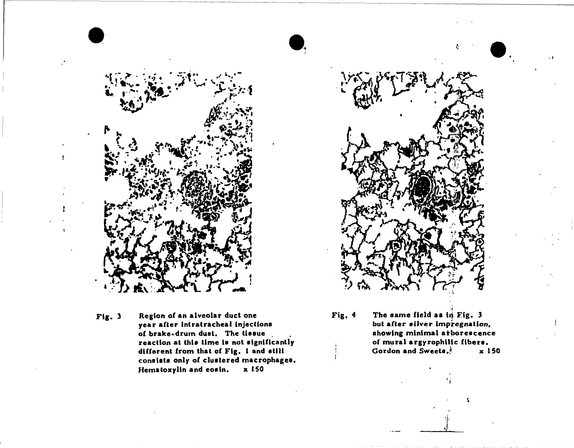
Fig. 3 Region of an alveolar duct one year after intratracheal injections of brake-drutn dual.
refid# wD4Lzb8j6yNXqEzbpzOXRMyQ1 page
MODERATOR'S SUMMARIZATION (Morning Session) W.
refid# gDEB94616y6oKe8Z98JyozrBJ1 page
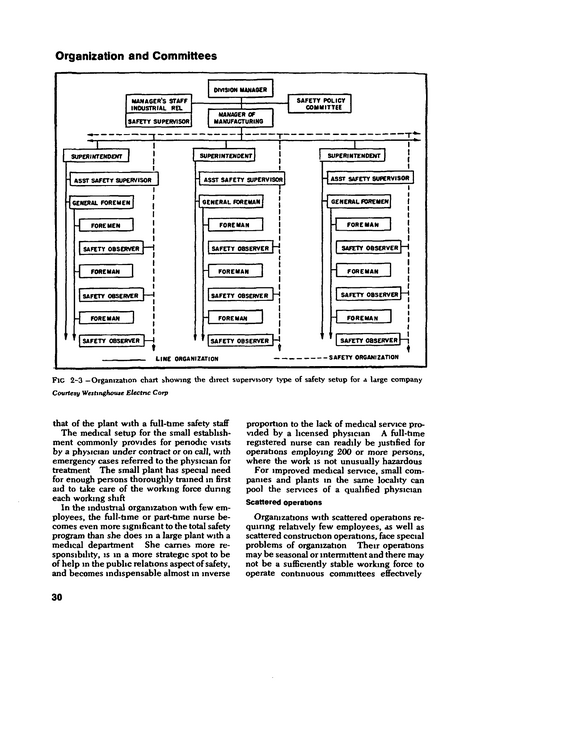
Organization and Committees MANAGERS STAFF INDUSTRIAL REL SAFETY SUPERVISOR DIVISION MANAGER MANAGER OF MANUFACTURING SAFETY POLICY COMMITTEE -I SUPERINTENDENT | ) i ASST SAFETY SUPERVISOR {GENERAL FOREMEN FOREMEN 1 SUPERINTENDENT 1 } 1 - ASST SAFETY SUPERVISOR GENERAL FOREMAN FOREMAN 1 | SUPERINTENDENT - ASST SAFETY SUPERVISOR - GENERAL FOREMEN FOREMAN SAFETY OBSERVER SAFETY OBSERVER SAFETY OBSERVER FOREMAN SAFETY OBSERVER - FOREMAN v,SAFETY OBSERVER FOREMAN SAFETY OBSERVER FOREMAN FOREMAN FOREMAN SAFETY OBSERVER SAFETY OBSERVER SAFETY OBSERVER LINE ORGANIZATION ----------------------------- SAFETY ORGANIZATION FlC 2-3 --Organization chart showing the direct supervisory type of safety setup for a large company Courtesy Westinghouse Electric Corp that of die plant with a full-time safety staff The medical setup for the small establish ment commonly provides for periodic visits by a physician under contract or on call, with emergency cases referred to the physician for treatment The small plant has special need for enough persons thoroughly trained m first aid to take care of the working force during each working shift In the industrial organization with few em ployees, the full-time or part-time nurse be comes even more significant to the total safety program than she does m a large plant with a medical department She carries more re sponsibility, is in a more strategic spot to be of help m die public relations aspect of safety, and becomes indispensable almost in inverse proportion to the lack of medical service pro vided by a licensed physician A full-time registered nurse can readily be justified for operations employing 200 or more persons, where the work is not unusually hazardous For improved medical service, small com panies and plants in the same locality can pool the services of a qualified physician Scattered operations Organizations with scattered operations re quiring relatively few employees, as well as scattered construction operations, face special problems of organization Their operations may be seasonal or intermittent and there may not be a sufficiently stable working force to operate continuous committees effectively 30
refid# NeZ2X1raJZDQgZ5Ry1vp3y8Lp1 page
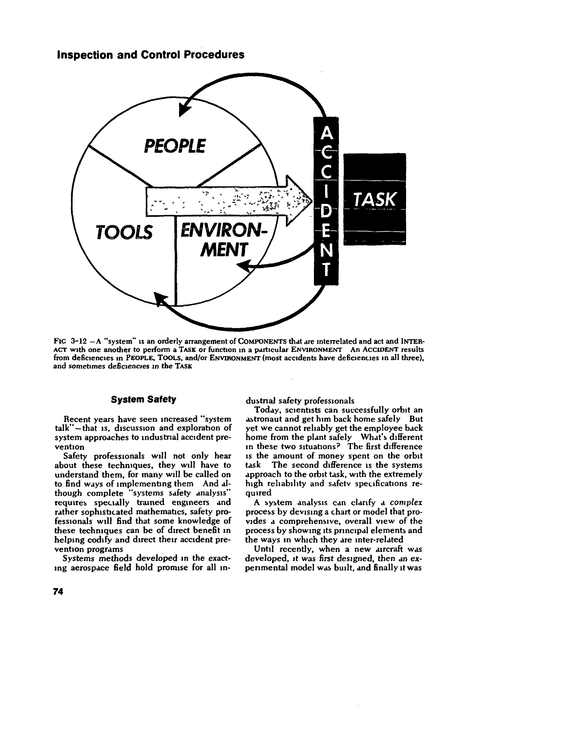
Inspection and Control Procedures FlC 3-12 -- A "system" is an orderly arrangement of COMPONENTS that are interrelated and act and INTER ACT with one another to perform a Task or function in a particular Environment An Accident results from deficiencies in People, Tools, and/or Environment (most accidents have deficiencies in all three), and sometimes deficiencies in the Task System Safety Recent years have seen increased "system talk"--that is, discussion and exploration of system approaches to industrial accident pre vention Safety professionals will not only hear about these techniques, they will have to understand them, for many will be called on to find ways of implementing them And al though complete "systems safety analysis" requires specially trained engineers and rather sophisticated mathematics, safety pro fessionals will find that some knowledge of these techniques can be of direct benefit in helping codify and direct their accident pre vention programs Systems methods developed m the exact ing aerospace field hold promise for all in dustrial safety professionals Today, scientists can successfully orbit an astronaut and get him back home safely But yet we cannot reliably get the employee back home from the plant safely What's different m these two situations?
refid# X7RgXMOVErqeeEReDbnKjqzng1 page
Maintaining Interest in Safety RULES FOR THE XYZ COMPANY' SAFETY CONTEST Rule 1 The contest shall begin January 1, and end December 31, 19 Rule 2.
refid# e76RBypQzb0eKEqkNMrqnD7LE1 page
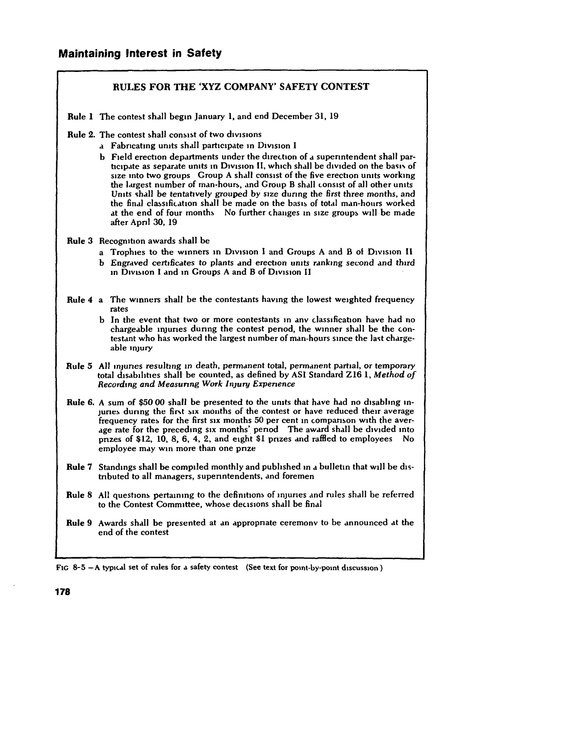
Maintaining Interest in Safety Fig 8-8 --One part of an overall safety program is promotion milestone a happy and important occasion Courtesy Carling Brewing Company This compan> makes each major safety local newspaper or trade journal Recognition of an exceptionally fine "no in jury" record made by a corporation (1,000,000 injury-free manhours would probably be a minimum), or presentation ofa National Safety Council award to a company deserves a dif ferent and more impressive type of publicity As a no-injury record builds up, interest in it may lag unless safety promotions are geared to greater effort See Fig 8-8 Some companies pay for radio or television time to announce the results of a contest Others arrange for photographs and stories to go in their company papers, on their bulletin boards, and perhaps in local or trade associa tion papers One company had large cam paign-type buttons made, and photos of chil dren wearing them appeared m the local press See the next chapter for more details Meaningful awards An award serves several purposes It is an inducement, a builder of good will, a continu ing reminder, and a basis for publicity To serve these purposes, however, an award must be meaningful The winning and display of a multiplicity of awards may detract from the true value of the program, particularly if the awards are given too freelv bv sales-minded donors Employees sense when awards are given onlv for sales or publicity purposes and are based on little or no safety effort The value of awards lies in their appeal to basic interest factors, such as pride, need for recognition, urge to compete, and desire for financial gam Monetary awards, how ever, should not appear to be bribes In gen eral, select awards which are worthy of good publicity, which will photograph well, and 184
refid# aZXyNbpJ3om87QqEZJ1xVog91 page
Accident Investigation, Analysis, and Costs Accident Investigation and Analysis Purpose of investigation Persons making the investigation Cases to be investigated The key facts m accidents Identifying the key facts Examples of identifying key facts Classifying the key facts Making the analysis Using the analysis Estimating Accident Costs Definition of work accidents for cost analysis Method for estimating Example of a cost estimate Items of uninsured cost Making a pilot study Development of final cost estimate References Chapter 12 268 280 288 267
refid# bOxx0JVvXqbVYJ0n4mJeRJZg31 page
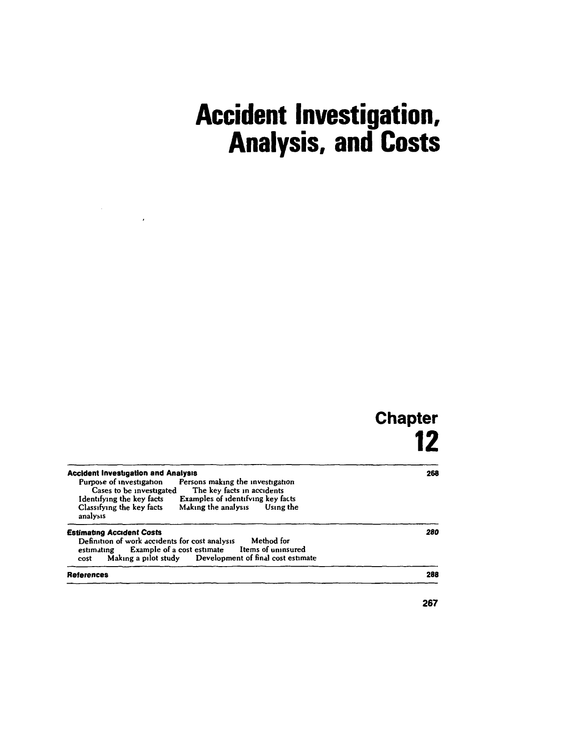
READY MIX TRUCK SIGNALS FlC 17-2 --Suggested signals for mixer drivers and contractor's guides Courtesy Northern California Ready Mixed Concrete 0 Materials Assn .tn area that must be kept in operation, a sheeted bulkhead can be erected to keep out dust and dirt and to isolate the operation as much as possible Studs are put up from floor to ceiling or to the underside of the roof, then sheeted with plain lumber, wallboard panels, plastic or canvas tarpaulins, or other material to make the bulkhead dust-tight Flame-re tardant materials may be required in some cases When construction operations are to be done where flammable vapors and liquids may be present or m other hazardous areas, the con tractor's men should be subjected to the same ngid requirements that apply to the plant employees Before cutting, burning, or welding is done by men employed by the contractor, a clearance should be obtained from the plant engineer or safety department to assure that the necessary fire and safety precautions have been taken The usual requirements for ventilation and health pro tection also should be observed (See NSC Data Sheet 522, Hot Work Permits (Flame or Spark), and Chapters 29, 30, and 31 m this Manual) In an area where no flame is permitted, either the manufacturing process will have to be shut down while welding and cutting are done, or screwed or bolted fittings will have to be used instead of welded connec tions Night lighting should be provided where necessary, especially in areas where open trenches or ditches create hazards in aisles and roadways A minimum of 5 footcandles 427
refid# 6bjYX1yBR9GMg55oM75N1QpMo1 page
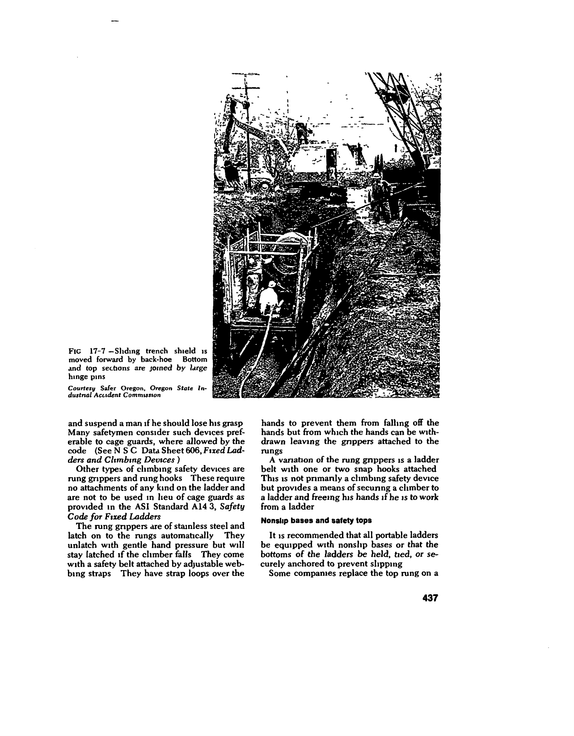
'* j r Fig 17-7 --Sliding trench shield is moved forward by back-hoe Bottom and top sections are joined by large hinge pins Courtesy Safer Oregon, Oregon State In* dustnal Accident Commission and suspend a man if he should lose his grasp Many safetymen consider such devices pref erable to cage guards, where allowed by the code (See N S C Data Sheet 606, Fixed Lad ders and Climbing Devices) Other types of climbing safety devices are rung grippers and rung hooks These require no attachments of any kind on the ladder and are not to be used in lieu of cage guards as provided in the ASI Standard A14 3, Safety Code for Fixed Ladders The rung gnppers are of stainless steel and latch on to the rungs automatically They unlatch with gentle hand pressure but will stay latched if the climber falls They come with a safety belt attached by adjustable web bing straps They have strap loops over the hands to prevent them from falling off the hands but from which the hands can be with drawn leaving the gnppers attached to the rungs A vanation of the rung gnppers is a ladder belt with one or two snap hooks attached This is not pnmanly a climbing safety device but provides a means of secunng a climber to a ladder and freeing his hands if he is to work from a ladder Nonslip bases and safety tops It is recommended that all portable ladders be equipped with nonslip bases or that the bottoms of the ladders be held, tied, or se curely anchored to prevent slipping Some companies replace the top rung on a 437
refid# Ne5gOBr5OM9GxKb9KnYgbjNNV1 page
objects on a earner or car bed, usually con structed of a power or roller conveyor, and elevates or lowers them to other locations Suspended tray conveyor a vertical conveyor having one or more endless chains with pendant trays, cars, or earners that re ceive objects at one or more elevations and deliver them to another or several elevations Vertical chain conveyor (opposed shelf type) two or more vertical elevating conveying units opposed to each other, each unit consisting of one or more endless chains whose adjacent facing runs operate in paral lel paths Thus, each pair ofopposing shelves or brackets receives objects (usually dish trays) and delivers them to any number of ele vations Where vertical conveyors are loaded and unloaded automatically, guards should be pro vided to protect personnel from contact with moving parts Where they are loaded and unloaded manually, guards and safety devices such as lintel and sill switches and deflectors should be installed Carnages of vertical reciprocating convey ors designed to register at a floor, balcony, gallery, or mezzanine level never should have a solid bed This type of conveyor is not in tended to carry passengers or operators, or to have its car or carnage called to a station by a manually-operated pushbutton References U S Army, Corps of Engineers, Washington, D C General Safety Requirements, Manual EM3851-1 (Available from the U S Government Pnnting office, Washington, D C 20402 ) Amencan Standards Institute, 1430 Broadway, New York, N Y 10018 Conveyor Terms and Definitions, MH4 1 (Also available from Convevor Equipment Manu facturers Assn , One Thomas Circle, NW , Washington, D C 20005 ) "Dust Explosions," Z12 Senes National Electrical Code, Cl (NFPA Standard No 70) National Electrical Safety Code, C2 (NBS Handbook H30) Safety Code for Building Construction, A102 Safety Code for Conveyors, Cableways, and Related Equipment B20 1 (Also available from Amencan Society of Mechanical Engineers, 345 East 47th St, New York, NY 10017) "Safety Code for Cranes, Demcks, Hoists, jacks, and Slings," B30 Senes Crawler, Locomotive, and Truck Cranes, B30 5 0 Demcks, B30 6 0 Floating Cranes and Floating Demcks, B30 8 0 Hammerhead, Jib, and Pillar Jib Cranes, B30 3 0 Hoists, B30 7 0 Jacks, B30 1 0 Overhead and Gantry Cranes, B30 2 0 Portal, Tower, and Pillar Cranes, B30 4 0 Slings, B30 9 0 Safety Code for Floor and Wall Openings, Ratltngs, and Toe Boards, A12 1 Safety Code for Mechanical Power-Transmission Apparatus, B15 1 Safety Requirements for Workmen's Hoists, A10 4 Electnc Controller and Manufactunng Co , 2704 East 79th St, Cleveland, Ohio 44104 How To Operate a Crane, Booklet 920 International Union of Operating Engineers, 1125 17th St NW, Washington, DC 20036 (General safety information) National Fire Protection Association, 60 Batterymarch St, Boston, Mass 02110 Life Safety Code, Std No 101 National Electrical Code, Std No 70 National Safety Council, 425 North Michigan Ave , Chicago, 111 60611 Industnal Data Sheets Aenat Baskets, 572 Automotive Hoisting Equipment, 437 577
refid# p2rnDNmmoopnqvEKQ6EJv43DE1 page
rail Railings should be 42 in high and toeboards 6 in high If footwalks are necessary on both sides of the track, crosswalks should connect them Trestles must be designed and built to carry anticipated loads and with stand vibration and shock Openings at ground level for conveyors and similar equipment used to unload cars should be provided with covers that are kept in place when equipment is not in use to prevent per sons from falling into them Hoppers or trackside bins into which ma terial is dumped should also be covered Heavy steel bars 12 in apart will prevent a man from falling or being earned through the openings It may also be necessary to cover walkways that are under trestles in order to protect those using them from falling matenals When tracks are dead end, a standard bump ing post should be installed A switch with a handle swinging parallel to the rails is safest Targets should have rounded comers to lessen the possibility of cuts and scratches and tom clothing Switch lamps are needed if tracks are to be used at night Blocking should be installed in switch points and frogs to prevent employees from getting their feet caught Loading and unloading Tracks at loading and unloading areas war rant special attention because numerous acci dents occur when loads are trucked into and out of cars Excessive clearance requires heavy, large dock plates or gangplanks If the dock level is considerably above or below the level of car door openings, trucking is more hazardous The dock should be wide enough to pro vide temporary storage area without interfer ence with truck movements A narrow dock may force trucks to turn onto dock plates at a dangerous angle The hazard may be reduced somewhat by making dock plates wider at the dock side, with flanges on the plates to turn wheels away from the edge Portable dock plates must be securely anchored Cars spotted for loading or unloading should be protected against being moved by switch ing crews Standard railroad blue flags for daytime and blue lights for night use furnish warnings to train crews Signals should be placed between the rails at each end of a car accessible from either direction Train crews should be stnckly prohibited from coupling engines or cars to any cars so protected The blue signals should be removed only by the employees engaged m loading or unloading operations, when they are ready to release the cars Bells and oscillating warning lights can be installed along the tracks in working areas to warn personnel that switching operations are going on The warning lights and bells should be turned on by plant supervision be fore switching operations are begun It is the responsibility of the local plant management to clear employees from cars before releasing the track to railroad employ ees for switching Therefore, before derails and blue flags are removed, plant supervision must make sure that Building railroad doors are opened and other obstructions cleared six feet from the track area, All plant personnel are cleared from rail road cars and track area, All overhead building cranes in the area being switched have stopped operations and are clear of track vicinity, All bridge plates are removed from cars, All counterweighted retractable service platforms are retracted and secured, All car moving equipment (cables, hooks, etc) is removed from cars Tracks for loading or unloading flammable liquids or other dangerous materials prefer ably are used only for those purposes For additional protection, switches are provided with locks Specific recommendations m re gard to tank cars, grounding, rail bonding, etc , are given in Chapter 34, "Flammable and Combustible Liquids " The consignee of a carload shipment of matenal or merchandise, after unloading the car, should clean it before releasing it to the rail road that serves the establishment Pieces of crating and dunnage, nails, and strapping left loose in the car are serious hazards to rail road employees and others who may have to enter it later 605
refid# K61kOBMrM6OxRQbdmoMd0ao3w1 page
newal, after each accident, injury, or extended illness, or at other appropriate intervals A fair amount of intelligence is required, together with respect for the safety of person nel and property It should be made clear to operators that they carry considerable re sponsibility and that reckless or careless oper ation will not be tolerated They should be checked on the job from time to time for ob servance of this rule Each plant should adopt a set of rules governing the operation of powered industrial trucks Because plant conditions and equip ment vary widely, rules which cover specific conditions should be set up For ready identification, many companies issue badges to authorized truck operators Badges also tend to remind operators of their responsibilities and give them pnde in their job Training A truck incompetently operated may cause severe injury or substantial property damage, no company can afford even one improperly trained truck operator Many companies have set up operator training programs Truck manufacturers can often supply course out lines, instructors' manuals, study text, films, and booklets for training in correct operation and safety Five-day training program A brief discussion of a five-day training course for lift truck operators follows A de tailed description and discussion of this course is available from the manufacturer who supplied the information Courses for train ing operators of other types of powered indus trial trucks are also available A classroom and a paved practice area, at least 50 ft square, should be provided Each class should have no more than five trainees The course is based on four principles tell, show, practice, correct As indicated in the sample outline of curriculum (Fig 22-18), each day's session should be divided between classroom work and practical instruction m the practice area with the trucks On the second and each following day, the session should open with a quiz covering the previous day's work Each trainee should have a record card showing the day's progress and his own weak points He and his in structor should try to eliminate these weak points before the next step is undertaken The final examination should take the form of qualification tests, which require the trainee to demonstrate his skill in handling the truck, his judgment, and his knowledge of safety, basic matenals-handhng, and preventive maintenance A certificate of graduation, which may be an official operator's permit, should be issued upon successful completion of the course Practical training and testing are conducted on obstacle courses consisting of pallets set on end in patterns designed to simulate box cars, aisles, material piles, and other ob structions (Fig 22-19) These obstacle courses and the maneuvers required to nego tiate them have been largely standardized m operator training programs all over the country In many training courses, the final qualifying examination consists of one or more test problems presented on the obstacle course The instructor may be provided with a checklist and test sheet (Fig 22-20) upon which he grades the prospective op erator as he observes the performance Many other points may be included in the checklist, such as failure to look behind when backing, failure to inspect the load before starting, failure to center the forks properly under the load, and traveling with forks raised too high Although other training programs may vary in details from the example given, it demon strates the essentials of good training pro cedures, which include 1 Physical qualification 2 Aptitude selection 3 Classroom instruction and testing 4 Field instruction and testing 5 Authorization only upon satisfactory com pletion of training In some training courses, the candidate is issued a student badge upon successful com pletion of the training course, and can qualify (Text continues on page 630 ) Donald R Holm, "Selecting and Training Fork Truck Operators " Reprinted from Space Magazine liv the Hyster Company, Portland, Ore 627
refid# QMJbZM0O5exVKoVMVx15vRr1E1 page
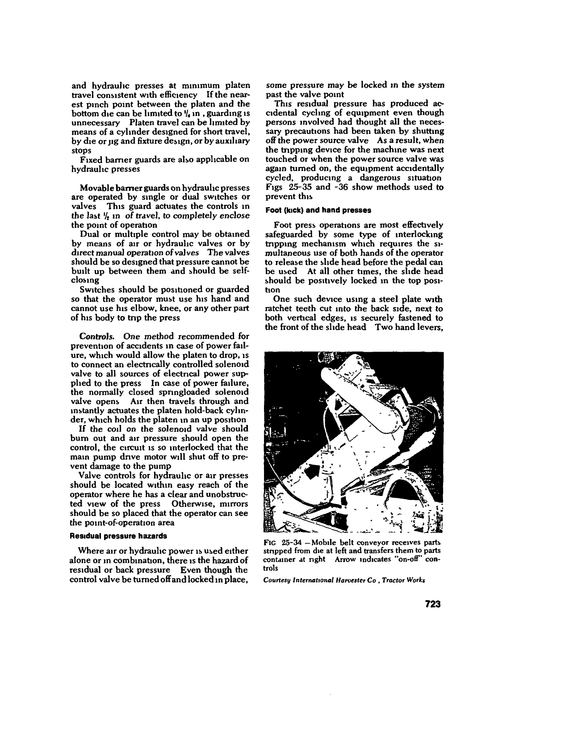
and hydraulic presses at minimum platen travel consistent with efficiency If the near est pinch point between the platen and the bottom die can be limited to V# in , guarding is unnecessary Platen travel can be limited by means of a cylinder designed for short travel, by die or jig and fixture design, or by auxiliary stops Fixed barrier guards are also applicable on hydraulic presses Movable barrier guards on hydraulic presses are operated by single or dual switches or valves This guard actuates the controls in the last '/2 m of travel, to completely enclose the point of operation Dual or multiple control may be obtained by means of air or hydraulic valves or by direct manual operation ofvalves The valves should be so designed that pressure cannot be built up between them and should be self closing Switches should be positioned or guarded so that the operator must use his hand and cannot use his elbow, knee, or any other part of his body to tnp the press Controls.
refid# RJNobJmEomvbLR529j29MyMEX1 page
3 The blade should be in perfect round and balance 4 The blade must be kept sharp at all times A dull blade will not cut Rather, it will pound itself through the wood, so that vibration and heating, then cracking, re sult Repairs should always be made by a spe cially trained employee, using instructions available from saw manufacturers Terms used for ordinary care and repair of saws are Jointinc Restoring a saw to round Straightening Restoring the blade to a straight plane surface Tensioning Giving every part of the saw the proper tension for the type of work it has to do Filing and grinding Sharpening the edges of the teeth and restoring them to the correct pitch (angle with relation to the center of the saw) and shape Gumming Deepening and rounding the gullets between the teeth As the teeth wear shorter, the gullets need to be deepened Swaging and setting Thickening or bending the teeth so that the saw kerf will be thicker than the blade Proper operation.
refid# RJX1qDvBb0XK960EpqNo382Xn1 page
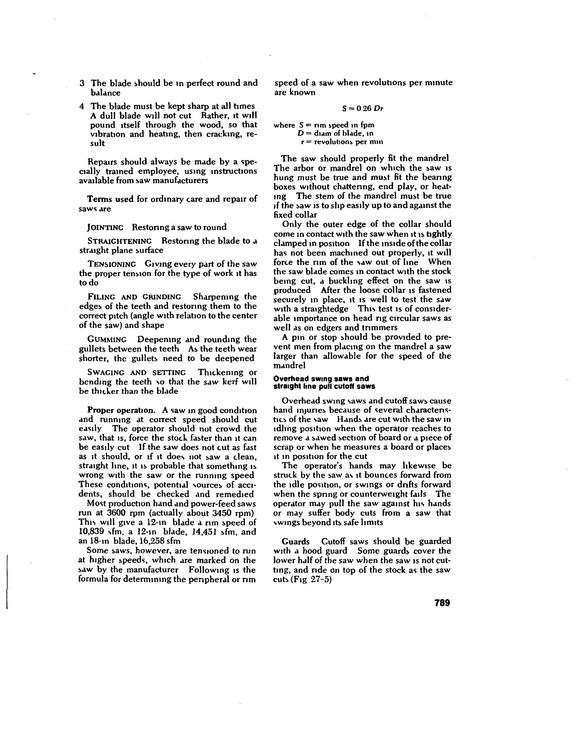
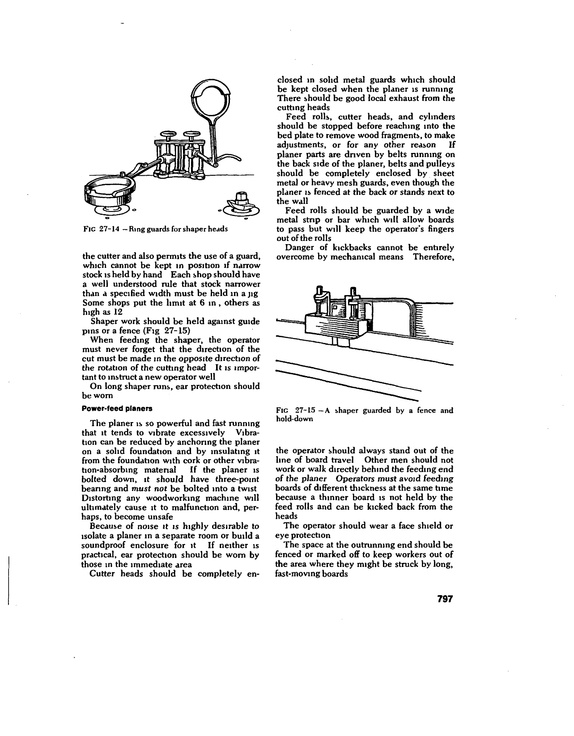
FlC 27-14 --Ring guards for shaper heads the cutter and also permits the use of a guard, which cannot be kept in position if narrow stock is held by hand Each shop should have a well understood rule that stock narrower than a specified width must be held in a jig Some shops put the limit at 6 in, others as high as 12 Shaper work should be held against guide pins or a fence (Fig 27-15) When feeding the shaper, the operator must never forget that the direction of the cut must be made m the opposite direction of the rotation of the cutting head It is impor tant to instruct a new operator well On long shaper runs, ear protection should be worn Power-feed planers The planer is so powerful and fast running that it tends to vibrate excessively Vibra tion can be reduced by anchoring the planer on a solid foundation and by insulating it from the foundation with cork or other vibra tion-absorbing matenal If the planer is bolted down, it should have three-point beanng and must not be bolted into a twist Distorting any woodworking machine will ultimately cause it to malfunction and, per haps, to become unsafe Because of noise it is highly desirable to isolate a planer in a separate room or build a soundproof enclosure for it If neither is practical, ear protection should be worn by those in the immediate area Cutter heads should be completely en closed in solid metal guards which should be kept closed when the planer is running There should be good local exhaust from the cutting heads Feed rolls, cutter heads, and cylinders should be stopped before reaching into the bed plate to remove wood fragments, to make adjustments, or for any other reason If planer parts are driven by belts running on the back side of the planer, belts and pulleys should be completely enclosed by sheet metal or heavy mesh guards, even though the planer is fenced at the back or stands next to the wall Feed rolls should be guarded by a wide metal strip or bar which will allow boards to pass but will keep the operator's fingers out of the rolls Danger of kickbacks cannot be entirely overcome by mechanical means Therefore, Fig 27-15 -- A shaper guarded by a fence and hold-down the operator should always stand out of the line of board travel Other men should not work or walk directly behind the feeding end of the planer Operators must avoid feeding boards of different thickness at the same time because a thinner board is not held by the feed rolls and can be kicked back from the heads The operator should wear a face shield or eye protection The space at the outrunning end should be fenced or marked off to keep workers out of the area where they might be struck by long, fast-moving boards 797
refid# 2VVxkpGNNB4nxZjJrkZqOQjR1 page