Refine
Estimated Years UndatedClear
92,592 results foundRefine Search
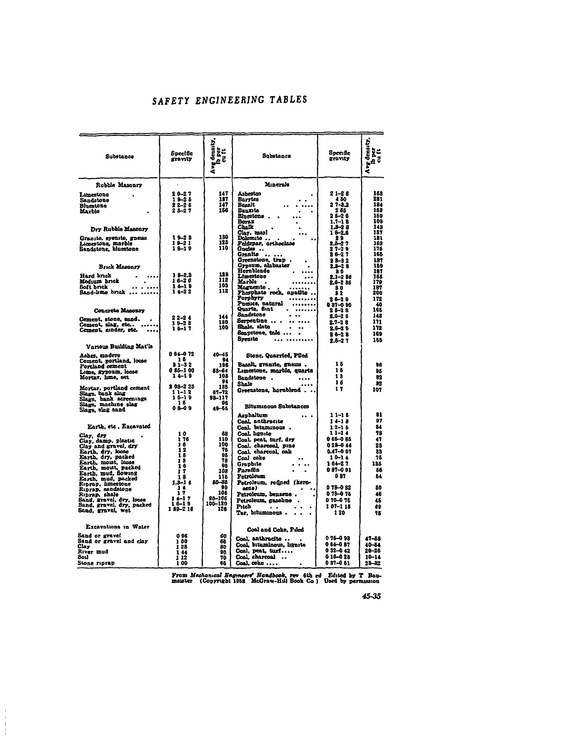
SAFETY ENGINEERING TABLES Substance Bobble Masonry Limestone Sandstone Bluestone Marble Dry Robbie Masonry Granite* syenite* gneiss Limestone, marble Sandstone, Milestone Brick Masonry Bard bnek Medium bnck Soft bnck Sand-lime bnck ...
refid# 9918RDbD8GxKmV5q0zKg1Dy061 page
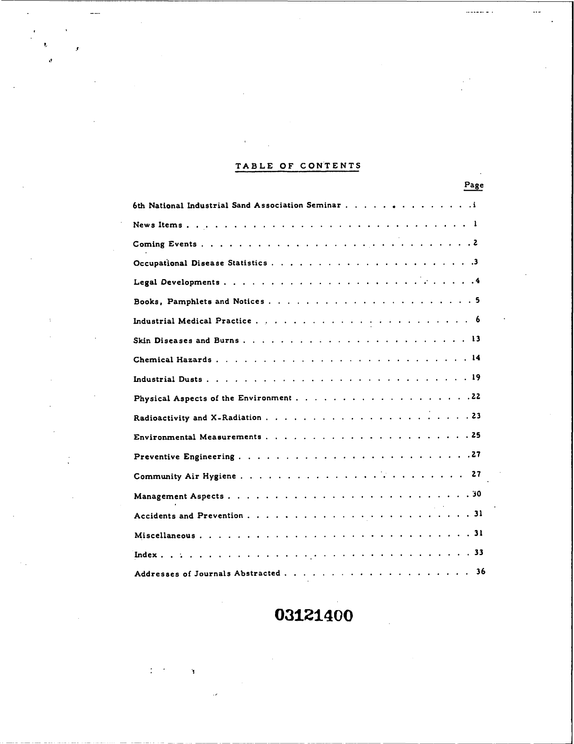
s TABLE OF CONTENTS Page 6th National Industrial Sand Association Seminar............................................................. i News Items...................................................................................................................................... 1 Coming Events................................................................................................................................. 2 Occupational Disease Statistics................................................................................................ 3 Legal Developments................................................................................................. '................... 4 Books, Pamphlets and Notices....................................................................................................5 Industrial Medical Practice .......................................................................................................... 6 Skin Diseases and Burns.............................................................................................................. 13 Chemical Hazards............................................................................................................................14 Industrial Dusts................................................................................................................................ 19 Physical Aspects of the Environment.................................................................................... 22 Radioactivity and X-Radiation................................................................................................. 23 Environmental Measurements................................................................................................... 25 Preventive Engineering................................................................................................................ 27 Community Air Hygiene..................................................................... .................................... 27 Management Aspects......................................................................................................................30 Accidents and Prevention............................................................................................................. 31 Miscellaneous.................................................................................................................................... 31 Index . . .......................................................................................................
refid# aJJ5Mab72GEG0D2Ne3YaZvXMy1 page
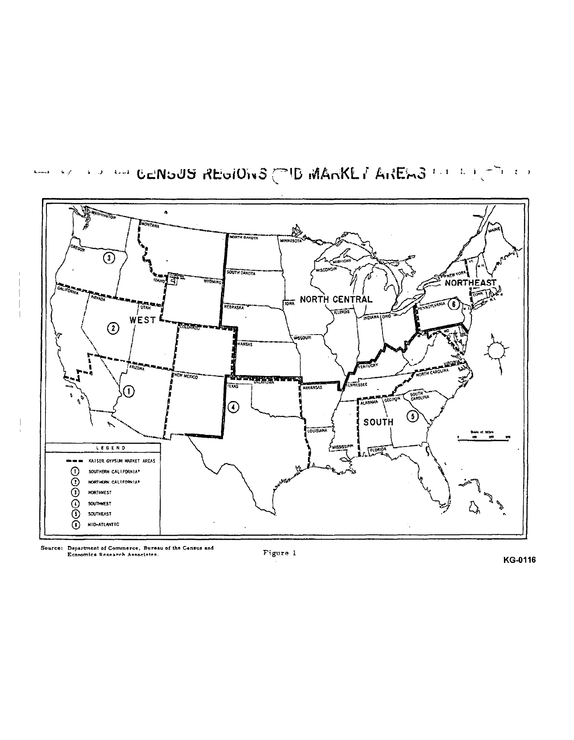
lidNodS rtfctoiOnS r*'D riflAnKL/ A|<EW3 1 . 1 KG-0116
refid# bd7JoykaJbLze0G1qBKNbpM31 page
Volume 3 NATIONAL SAFETY CONGRESS TRANSACTIONS AUTOMOTIVE and MACHINE SHOP; POWER PRESS and FORGING NATIONAL SAFETY COUNCIL 425 North Michigan Avenue Chicago, Illinois 60611 SCF-ALLF-02934 56th NATIONAL SAFETY CONGRESS Papers Delivered in the AUTOMOTIVE & MACHINE SHOP SESSIONS CONTENTS The Most Important Word in Safety...............................
refid# 91r6mJk93kODrzaJn63xVBVyL6 pages
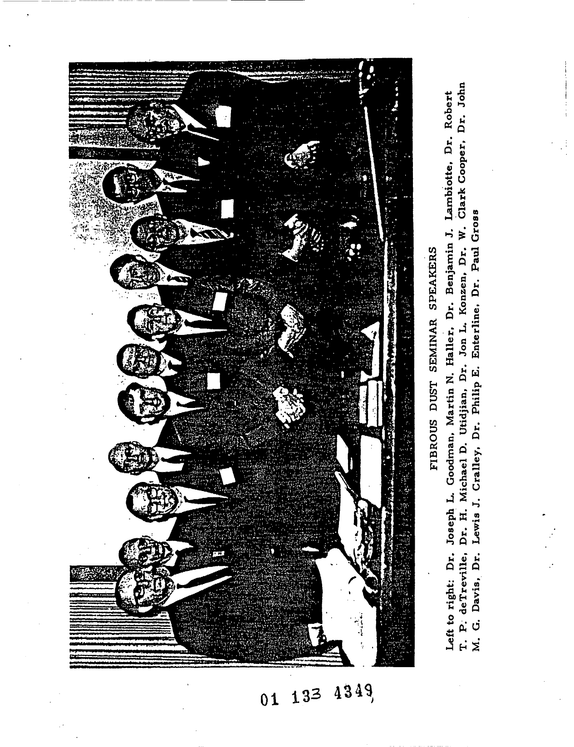
w d 8<u Ph w d < Z 2 w w H S P O oS PQ 01 133 4343 L e ft to rig h t: D r.
refid# p8pp1kjYrOOm7oxLQNVde9Z61 page
Inspection and Control Procedures take 2x2-inch color slides, or even a light weight video tape recorder To add variety to supervisor safety meet ings, arrive a little early for the meeting after making a quick inspection An instant devel oping camera easily records unsafe conditions or practices, and the pictures then become a quiz for the supervisors' meeting The pictures are numbered and passed around the table (or the slides are projected) The supervisors are told to wnte down the unsafe acts or conditions that thev can see m the pictures Occasionallv put one in that doesn't have any noticeable hazard This keeps the audience alert Many details are given m NSC Data Sheet 619, Photography for the Safety Professional Checking plans and specifications An important duty of the safety director should be that of checking plans and speci fications both for new plant buildings and equipment and for products to be made This highly important function presents an oppor tunity to discover and correct conditions that may otherwise be built into the building and its equipment and that would later result m injuries Some companies will not permit a drawing or specification to be used until it has been approved by the safety department Hazards involved in making and using prod ucts should be minimized insofar as possible Instructions and warnings should be re viewed both for safe manufacture and safe use of a product The safety department should also make sure that company policies and applicable standards are followed in purchase specifica tions for new materials and equipment or for modification to existing equipment Some companies have arranged for the purchasing department to notify the safety department when new materials or equipment are to be purchased For instance, when a new chem ical is requested, the safetv department should see that information on flammability, toxicity, and similar properties is obtained from the manufacturer This Manual outlines require ments and performance standards that should be used to evaluate the safety specifications for purchases of industrial equipment and raw materials Making safety an integral part of any modi fication or addition to the industrial plant means that, to list a few examples, each new machine will be received with its moving parts guarded, that all raw materials will be shipped in a manner to minimize preprocess handling hazards, and that selecbon of a flam mable solvent will be based on control by existing local exhaust systems Such plan ning should impress employees with the fact that the company considers safety as a basic part of its operation, and not as an after thought A safety program for the contractor can be tied into the contract documents See Chap ter 17 and the F E McElroy citation in "Ref erences " The rest of this chapter is devoted to discussing some techniques for making safety part of every company operation Total Loss Control and Damage Control An important development m industrial safety in recent years has been that of total loss control and of damage control Progressive companies have investigated and applied a concept of total accident con trol based on studies of "near misses" (noninjury accidents), and on detailed analyses of hidden as well as direct accident costs The emphasis now is on the total safety of the employee, not only on the job but also at home and in public Total loss control Cost-conscious companies find they must control accident costs if they are to do busi ness in a highly competitive market They do not consider safety a nuisance, but a neces sity--not a fringe benefit, but a prerequisite Activities related to safeguarding corporate investment and continuity of operation need coordination with the safety effort Such re lated functions as, for example, personnel safety and fire protection must be closely integrated Those activities which are re lated to loss control must be functionally integrated One large chemical company uses an ap proach consisting of six closely related steps'each following the other in logical order to give a coordinated program 1 Hazard identification-To prevent ac cidents and control losses, it is first neces- 70
refid# jg92gwQONa0OyM8zgYJjmKXLR1 page
Human Behavior and Industrial Safety womed, circular m this thinking, and fearful in such a way as to make his behavior inade quate to reach his goal Even though he him self may realize that his behavior is getting him nowhere, he is unable to find a method that will solve his problem In frustration, some people become angry, some fearful, and some accept frustration as a challenge and attempt to solve the problem Most people who react emotionally to frus tration and threat find it extremely difficult to cope with life situations It is not necessary to discuss the physiological pattern which develops in emotion for evervone is familiar with the feelings experienced during fear, anxiety, anger, shame, and other emotions Rather, one needs to recognize that over the years people have developed accepted social expressions for emotions To some degree, one individual can be aware of how another is feeling This is not to say that one cannot be fooled or that the outward expression al ways truly indicates the feelings of the in dividual Many people learn to mask their real feelings behind the learned emotional expressions However, after day-to-day interaction over a long period of time, one learns to tell the difference between true feelings and those shown This is useful to the foreman and the safety man in his dealings with individ uals in the shop As they go about the plant carrying out their norma) duties, they may discover those individuals having difficulties and take some extra precautions to avoid ac cidents Talking reduces emotions Although no attempt can be made here to train safety directors or supervisors to be come personnel counselors, they can do to help reduce the immediate result of strong emotion The supervisor is in the best posi tion to evaluate the emotional level of an in dividual worker and to do something about it Everyone ,s familiar with the emotional outbursts of people who have had a trying and upsetting experience Such expression of emotion may take many forms from an out burst of invective, a torrent of tears, to phytcal assault on inanimate objects which can not strike back The end result is the same -- relief from the intolerable tension, and emo tional relaxation To reduce the strength of the emotional response, the supervisor can engage in what may be called permissive listening, that is, giving the employee an opportunity to talk about the thing which is bothering him This freedom to say what the individual pleases can reduce tension which might lead to dis traction and accidents It is important that the supervisor not at tempt to evaluate or judge the employee's remarks The employee needs an opportu nity to "blow off steam" without retaliation or evaluation The stresses which cause emotional upset can occur within the work environment or away from it, but each kind has its effect on the other A simple statement, such as "How are you today'1" or "What's bothering you'Y' may well be sufficient to set off the safety valve of verbalization of pent-up emotion After the discussion, the employee can often evaluate more clearly and realistically the things that upset him in the first place This relationship between the supervisor and the worker must be one of the super visor's normal everyday functions Diligent observation and effective and sensitive lis tening should be tools of everv supervisor Attitudes Attitudes and attitudinal responses are closely related to emotions Stnctlv defined, an attitude is a predisposition on the part of a person to respond in a given way In other words, an attitude is manifest when an in dividual will respond to an initiating cause in a predetermined manner each time What the reaction will be depends upon the pre vious experiences of the individual Seeing an individual on the street who resembles a friend, one immediately begins to smile, make friendly gestures, and have a warm quality in his voice When a person is per ceived to be a stranger, there is an immediate change to another facial expression, gesture, voice qualitv, and so on Anticipated reaction can be set off bv a certain look from another person, a manner of speaking, a mustache or the lack of one, the color of hair, or kind of handclasp All individuals have certain feel ings about these things and will react in ac cordance to their attitudes, formed over the years 134
refid# dYw2ZqeG9Yy8rbYzEZ88EeoQ51 page
Publicizing Safety --Is Another Important MORRELL Product!

refid# Z8yX1EqLmrZ44mw7xQrLjJj0J1 page
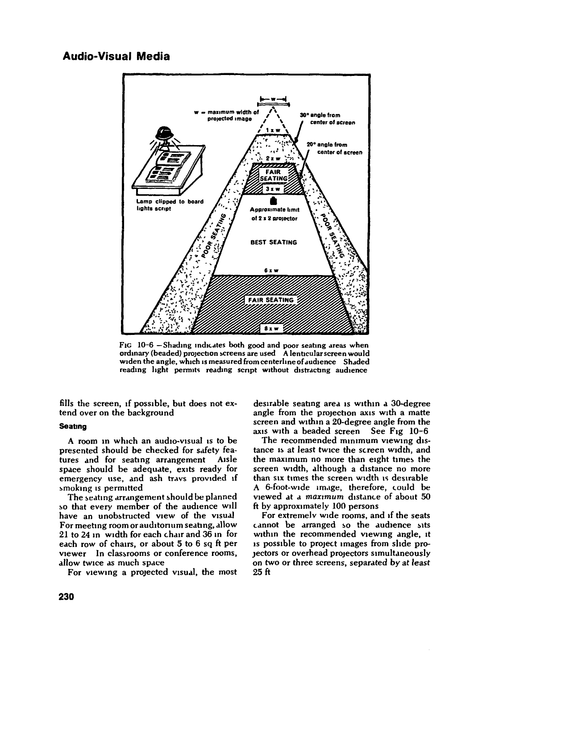
Audio-Visual Media Fig 10-6 --Shading indicates both good and poor seating areas when ordinary (beaded) projection screens are used A lenticular screen would widen the angle, which is measured from centerline ofaudience Shaded reading light permits reading script without distracting audience fills the screen, if possible, but does not ex tend over on the background Seating A room in which an audio-visual is to be presented should be checked for safety fea tures and for seating arrangement Aisle space should be adequate, exits ready for emergency use, and ash trays provided if smoking is permitted The seating arrangement should be planned so that every member of the audience will have an unobstructed view of the visual For meeting room or auditorium seating, allow 21 to 24 in width for each chair and 36 in for each row of chairs, or about 5 to 6 sq ft per viewer In classrooms or conference rooms, allow twice as much space For viewing a projected visual, the most desirable seating area is within a 30-degree angle from the projection axis with a matte screen and within a 20-degree angle from the axis with a beaded screen See Fig 10-6 The recommended minimum viewing dis tance is at least twice the screen width, and the maximum no more than eight times the screen width, although a distance no more than six times the screen width is desirable A 6-foot-wide image, therefore, could be viewed at a maximum distance of about 50 ft by approximately 100 persons For extremely wide rooms, and if the seats cannot be arranged so the audience sits within the recommended viewing angle, it is possible to project images from slide pro jectors or overhead projectors simultaneously on two or three screens, separated by at least 25 ft 230
refid# X8np4MGr9a59o5YrE1jY2BQ5g1 page
Accident Records and Injury Rates Company, a&<?.
refid# jBr08D0qM1Ma8YvjLQL79wmg21 page
The safety engineer A representative of the safety department should verify the find ings of the foreman and make an investiga tion of every important accident for his own information, and in most cases he should make a written report to the proper official or to the general safety committee Nowhere are the safety engineer's value and ability better shown than in the investi gation of an accident His specialized train ing and analytical experience enable him to search for all the facts, apparent and hidden, and to submit a report free from bias or preju dice He has no interest in the investigation other than to get information which can be used to prevent a similar accident The workmen's safety committee In some companies, one function of the work men's safety committee is to investigate and report on all senous accidents This function is particularly important where a contributing factor was an unsafe act on the part of the worker If this committee, composed of the injured employee's fellow workmen, investigates the accident immediately, finds that the injured man did engage in an unsafe act which con tributed to the accident, and so reports to the general safety committee or to other authonty, and if this report is then publicized, it will be more generally accepted among the workers than a similar report made by the supervisor or the safety professional On the other hand, many companies dis agree strongly with this concept of the duties of the workmen's safety committee, believing that the task of assigning responsibility for an accident is sometimes an unpleasant one and should not be foisted upon workers The general safety committee.
refid# mpBvR5XbZ3op67JQZLRZDM9zd1 page
2 Part of body--the part of the injured per son's body directly affected by the injury 3 Source of injury--the object, substance, exposure, or bodily motion which directly produced or inflicted the injury 4 Accident type --the event which directly resulted m the injury 5 Hazardous condition--the physical condi tion or circumstance which permitted or occasioned the occurrence of the accident type 6 Agency of accident--the object, substance, or part of the premises in which the hazardous condition existed 7 Agency of accident part--the specific part of the agency of accident that was hazardous 8 Unsafe act--the violation of a commonly accepted safe procedure which directly permitted or occasioned the occurrence of the accident event Supplementary items of information closely related to the key facts, such as age, sex, oc cupation, and type of work being performed at the time the injury was incurred, are recorded and included m an analysis so that all the facts will be available for taking the proper preventive steps Contributory factors should be indicated The principal source of information for an analysis is the supervisor's accident report (Fig 11-2 in the previous chapter) Complete data regarding all the key facts should be fully and accurately recorded on this form at the time of the accident Injury and accident reports, however, com monly consist of a few specific statements relating to the injury plus a narrative account of how and whv the accident occurred The reports vary widely m the amount of detail given and m the elanty and coherence with which the facts are presented Therefore, the analyst rarely will find the key facts --the items needed for statistical recording--pre cisely stated Usually, he must review all the data given in the report, select pertinent items, and fit them into a predetermined recording pattern Identifying the key facts Since the reliability of an analysis depends greatly on selection of the correct key facts, the analyst must have a clear understanding of the key facts and of the method for identify ing them The bases on which identifications should be made are described and illustrated in the following paragraphs adapted from Standard Z16 2 Nature of injury.
refid# 5kJr0doNpzYL2rJow4vjVK2z81 page
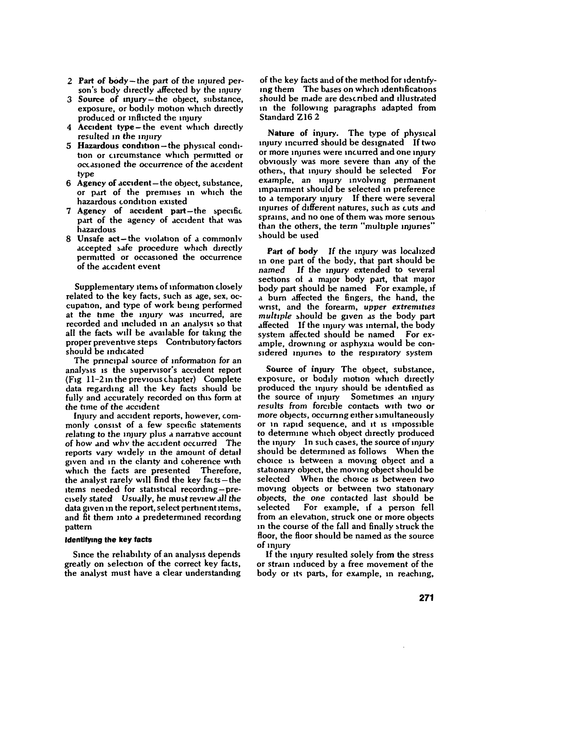
Ropes, Chains, and Slings the core, which may be sisal rope, a metallic strand, or independent wire rope core The size, number, and arrangement of wires, the number of strands, the lay, and the type of core in a rope are determined largely by the service for which the rope is to be used In general, the greater the number of wires in a strand and the greater the number of strands, the more flexible the rope Hoisting ropes require flexibility and are usually made up of six strands of 19 (16 to 26 wires per strand) and six strands of 37 (27 to 49 wires per strand) wire rope classifications Eightstrand ropes are usually 19 wire rope classifi cation, regular lay, fiber core (See Fig 23-2) Depending upon the service conditions, six-strand ropes may have a fiber core (FC), a wire strand core (WSC), or an independent wire rope core (IWRC) and may be either regular lav (wires in the strands are laid in the opposite direction from that of the strands in the rope) or lang lay (wires in the strands are laid m the same direction as that of the strands in the rope) Flexibility is not a requirement for guy wires, highway guards, and similar services Therefore, wire rope of six by seven con struction (six strands with seven or eight wires per strand) is suitable When rope for a particular service is to be selected, it is recommended that engineers of reliable wire rope manufacturers be consulted for the most suitable type Some service conditions require rope with special qualities Fiber cores are affected by temperatures above 212 F, under such conditions, a metallic core provides greater efficiency and safety A zinc-coated or stain less steel wire rope effectively resists some types of corrosion Specific corrosion prob lems should be referred to a wire rope manuacturer Since preformed wire rope does not un ravel, it has advantages for certain services, such as for slings and on construction and similar heavy equipment Preformed rope is less ltkelv to set or kink, and broken wires do not protrude to create a hazard to the hands of workmen However, closer inspection is necessary to detect broken wires It is recommended that hoisting rope have at least the strength of "improved plow steel" grade For many applications "extra im proved plow steel" grade, which is greatest in strength, should be used to provide an adequate factor of xafetv, and better service It resists abrasion, shock, vibration, and fa tigue (Table 23-D) Safety factor for hoisting ropes The safety factor for hoisting ropes is calculated by dividing the breaking strength ot the rope (rated by the manufacturer, or determined by testing) by the sum of the maximum weights to be hoisted (static load) In the case of mine hoisting rope, the max imum weights to be hoisted include the weight of the skip or car and cage, plus the weight of the material, plus the weight of the rope when it is extended to the bottom of the shaft The minimum safety factor for mine hoist ing rope should not be less than that shown in Table 23-E TABLE 23-E SAFETY FACTORS FOR MINE HOISTING ROPES WHEN HANDLING MEN Minimum safety Minimum safety Length of rope factor for factor for (ft) neiu rope used rope 500 or less 500 to 1,000 1,000 to 2,000 2.000 to 3,000 3,000 or more 8 7 6 5 4 64 58 50 43 36 * Hoisting rope must be discarded when these minimum factors of safety are reached Recommended minimum safety factors for other types of services are 6 for haulage ropes and overhead cranes and derricks, 7 for small electric and air hoists, and 8 for hot-ladle cranes The safety' factors for different types of elevators and other rope requirements are specified m ASI Standard A17 1, Safety Code for Elevators, Dumbwatters, and Escalators The factor of safety for wire rope should be determined by consideration of all pertinent data, which include type of load, acceleration, deceleration, rope speed, rope attachments, the number, size, and arrangement of sheaves 642
refid# GzvjyZKEOp4dOdbxKEzQXZX8r1 page
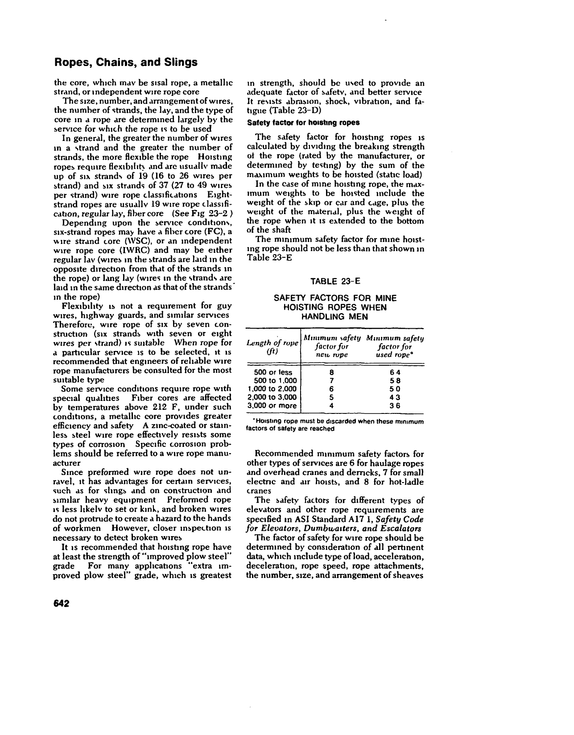
Machine Tools handling of heavy stock or heavy machine parts, such as face plates, chucks, etc, every operator should wear safety shoes Splash guards, shields, and other means may be practical to minimize exposure of workers to cutting oils which may cause skin irritations, especially if contaminated Turning Machines Turning --shaping a rotating piece with a cutting tool, usually to give a circular cross section--is done on machines such as engine lathes, turret lathes, chuckers, semiautomatic lathes, and automatic screw machines Engine lathes An engine lathe must be operated intelli gently, if accidents are to be prevented In juries are likely to result from 1 Contact with projections on work or stock, face plates, chucks, or lathe dogs, especially those with projecting set-screws 2 Flying metal chips 3 Hand braking of the machine 4 Filing nght-handed, using file with un protected tang, or using the hand instead of a stick to hold emery cloth against the work 5 Calipering or gauging the job while the machine is m operation 6 Attempting to remove chips when machine is in operation 7 Contact with rotating stock projecting from turret lathes or screw machines 8 Leaving chuck wrench in chuck Using a spring-loaded wrench can eliminate this hazard 9 Catching loose clothing or wiping rags on revolving parts Injuries may also occur on lathes because operators fail to keep center holes of taper work clean and tme and lathe centers true and sharp Furthermore, it is hazardous for operators to leave the machines running un attended, or to handle chips by hand instead of using a hooked rod Face plates and chucks without projections should be used whenever possible Other wise, a simple shield formed to the contour of the chuck or plate and hinged at the back should be installed to prevent contact with the revolving plate or chuck Safety-type lathe dogs are relatively inex pensive to install and should be substituted for those with projecting setscrews Chip guards, particularly on high-speed operations, will control flying chips Plastic or smallmesh screen chip guards have been success fully used because they allow visibility and confine the flying chips (Fig 26-1) Use of these guards, however, does not eliminate the need for protective eye equipment Mechanical means (Fig 26-2) should be provided to lift heavy face plates, chucks, and stock on both lathes and screw machines and eliminate operator strain Turret lathes and screw machines Injuries from turret lathes and screw ma chines result from the same causes as those listed for other lathes In addition, injuries FiC 26-3 --Chip breakers may be ground into the tip of the tool (A) or a breaker in the form of a piece of metal may be clamped or brazed onto the tool itself (B) frequently occur when the operator fails to move the turret back as far as possible when changing or gauging work or uses the power of the machine to start the face plate or chuck onto the spindle Other injuries result when the operator fails to keep his hand clear of the turret slide or permits his hand, arm, or elbow to strike the cutter while adjusting or setting up Splash guards, especially on automatic machines, should be installed and kept in 752
refid# reMq2Rqe7vgwG5ok6nNwER55E1 page
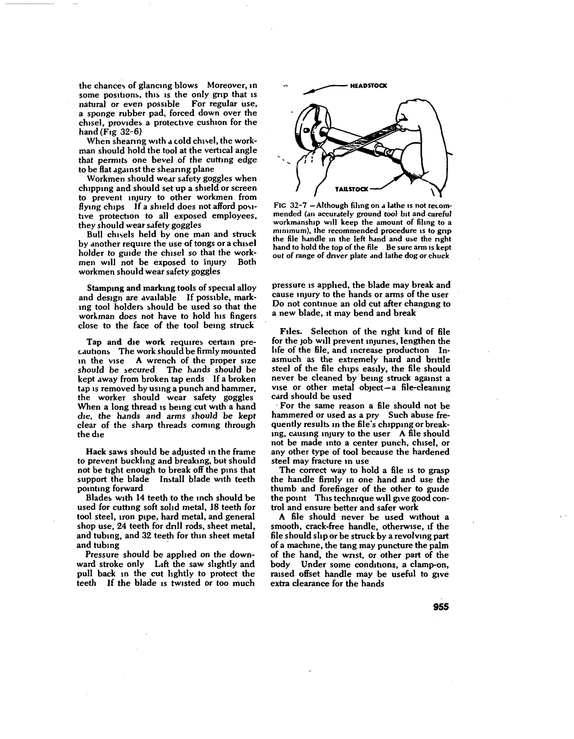
the chances of glancing blows Moreover, in some positions, this is the only grip that is natural or even possible For regular use, a sponge rubber pad, forced down over the chisel, provides a protective cushion for the hand {Fig 32-6) When shearing with a cold chisel, the work man should hold the tool at the vertical angle that permits one bevel of the cutting edge to be flat against the shearing plane Workmen should wear safety goggles when chipping and should set up a shield or screen to prevent injury to other workmen from flying chips If a shield does not afford posi tive protection to all exposed employees, they should wear safety goggles Bull chisels held by one man and struck by another require the use of tongs or a chisel holder to guide the chisel so that the work men will not be exposed to injury Both workmen should wear safety goggles Stamping and marking tools of special alloy and design are available If possible, mark ing tool holders should be used so that the workman does not have to hold his fingers close to the face of the tool being struck Tap and die work requires certain pre cautions The work should be firmly mounted in the vise A wrench of the proper size should be secured The hands should be kept away from broken tap ends If a broken tap is removed by using a punch and hammer, the worker should wear safety goggles When a long thread is being cut with a hand die, the hands and arms should be kept clear of the sharp threads coming through the die Hack saws should be adjusted in the frame to prevent buckling and breaking, but should not be tight enough to break off the pins that support the blade Install blade with teeth pointing forward Blades with 14 teeth to the inch should be used for cutting soft solid metal, 18 teeth for tool steel, iron pipe, hard metal, and general shop use, 24 teeth for drill rods, sheet metal, and tubing, and 32 teeth for thin sheet metal and tubing Pressure should be applied on the down ward stroke only Lift the saw slightly and pull back in the cut lightly to protect the teeth If the blade is twisted or too much HEADSTOCK FIG 32-7 -- Although filing on a lathe is not recom mended (an accurately ground tool bit and careful workmanship will keep the amount of filing to a minimum), the recommended procedure is to gnp the file handle in the left hand and use the right hand to hold the top of the file Be sure arm is kept out of range of dnver plate and lathe dog or chuck pressure is applied, the blade may break and cause injury to the hands or arms of the user Do not continue an old cut after changing to a new blade, it may bend and break Files.
refid# V3VmgEr5BrVn4Y3LDZLg8qLgp1 page