Refine
Estimated Years UndatedClear
92,592 results foundRefine Search
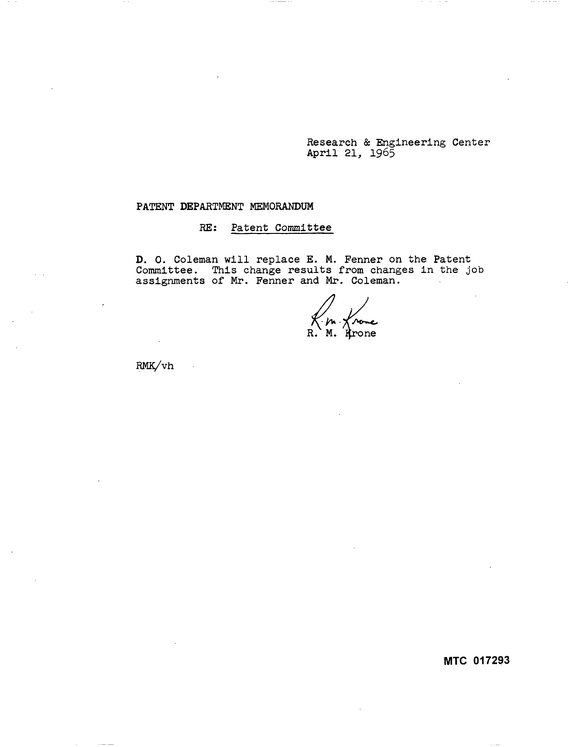
H O O F IN G MTC 017290 efractory fibers I 35 MTC 017291 Research & Engineering Center April 21, 1965 PATENT DEPARTMENT MEMORANDUM RE: Patent Committee D. 0.

refid# zbR2VeOe9dYY3nr2nXjdZ4Vy65 pages
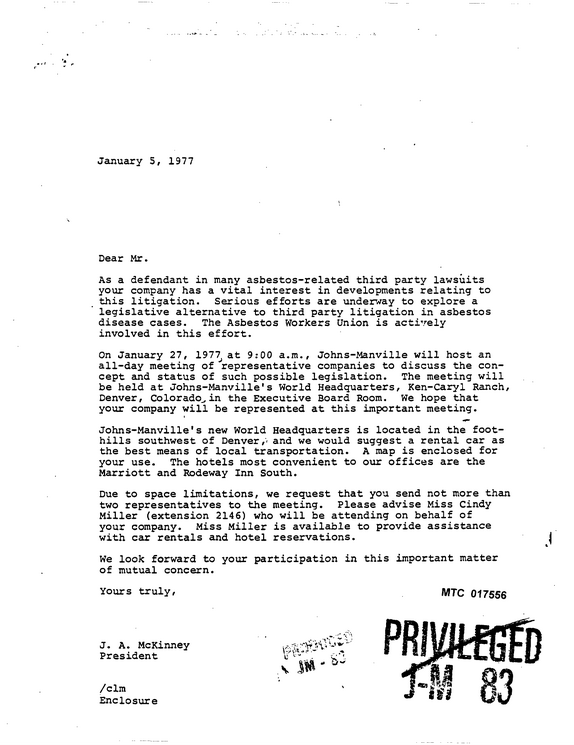
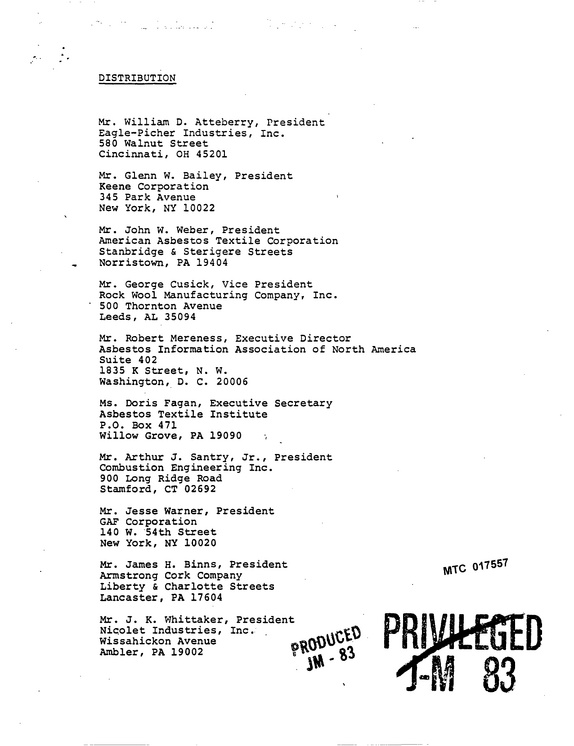
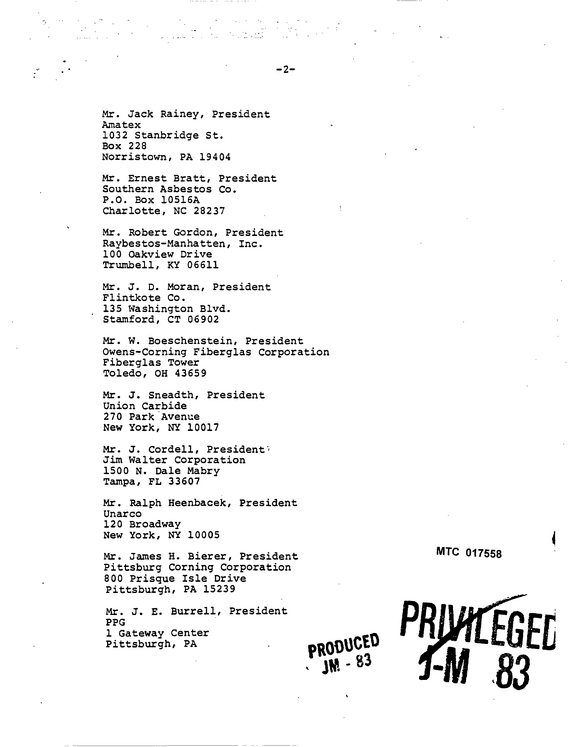
o (A 0\ O 1 MTC 017555 vO \}j January 5, 1977 Dear Mr.

refid# 4JqD9vyDokEQ1DEpX7GX5o3GG7 pages
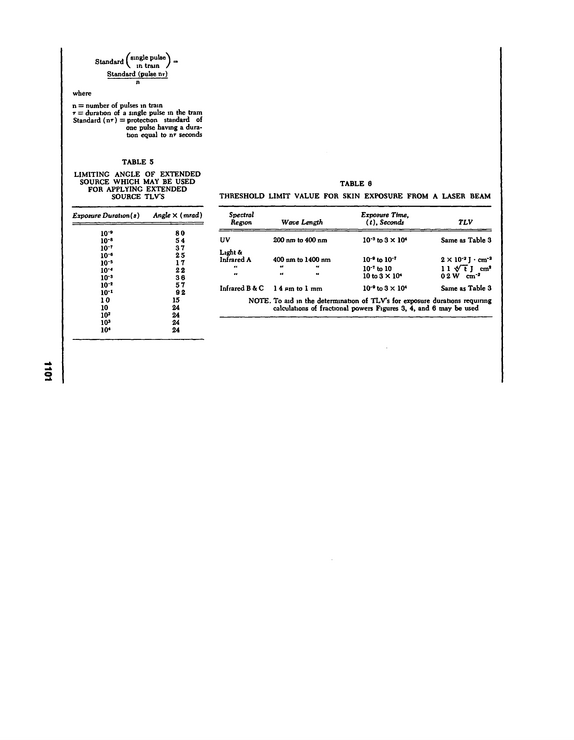
Standard (8,n^epuU,e) = \ in train / Standard (pulae nr) n where n = number of pulses in train t = duration of a single pulse in the tram Standard (nr) = protection standard of one pulse having a dura tion equal to nr seconds TABLE 5 LIMITING ANGLE OF EXTENDED SOURCE WHICH MAY BE USED FOR APPLYING EXTENDED SOURCE TLV'S Exposure Duration(s) Angle X (mrad) 10 80 10-a 54 10T 37 10" 25 10 s 17 10* 22 10'3 36 10* 57 10"1 02 10 15 10 24 103 24 103 24 10* 24 TABLE 8 THRESHOLD LIMIT VALUE FOR SKIN EXPOSURE FROM A LASER BEAM Spectral Region Wave Length Exposure Time, (t).
refid# 36p8QgrvjE7zmqvrVmz7wK8J1 page
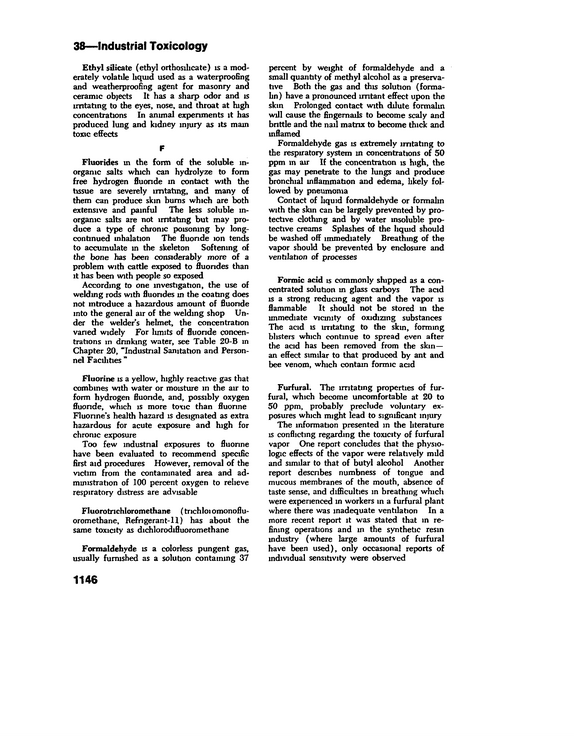
38--Industrial Toxicology Ethyl silicate (ethyl orthosilicate) is a mod erately volatile liquid used as a waterproofing and weatherproofing agent for masonry and ceramic objects It has a sharp odor and is irritating to the eyes, nose, and throat at high concentrations In animal experiments it has produced lung and kidney injury as its mam toxic effects F Fluorides in the form of the soluble in organic salts which can hydrolyze to form free hydrogen fluoride in contact with the tissue are severely irritating, and many of them can produce skin bums which are both extensive and painful The less soluble in organic salts are not irritating but may pro duce a type of chronic poisoning by longcontinued inhalation The fluoride ion tends to accumulate m the skeleton Softening of the bone has been considerably more of a problem with cattle exposed to fluorides than it has been with people so exposed According to one investigation, the use of welding rods with fluondes m the coating does not introduce a hazardous amount of fluonde into the general air of the welding shop Un der the welders helmet, the concentration varied widely For limits of fluonde concen trations m drinking water, see Table 20-B m Chapter 20, 'Industrial Sanitation and Person nel Facilities " Fluorine is a yellow, highly reactive gas that combines with water or moisture m the air to form hydrogen fluonde, and, possibly oxygen fluonde, which is more toxic than fluonne Fluorine's health hazard is designated as extra hazardous for acute exposure and high for chronic exposure Too few industnal exposures to fluonne have been evaluated to recommend specific first aid procedures However, removal of the victim from the contaminated area and ad ministration of 100 percent oxygen to relieve respiratory distress are advisable Fluorotnchloromethane (tnchloi omonofluoromethane, Refngerant-11) has about the same toxicity as dichlorodifluoromethane Formaldehyde is a colorless pungent gas, usually furnished as a solution containing 37 1146 percent by weight of formaldehyde and a small quantity of methyl alcohol as a preserva tive Both the gas and this solution (forma lin) have a pronounced lmtant effect upon the skin Prolonged contact with dilute formalin will cause the fingernails to become scaly and brittle and the nail matrix to become thick and inflamed Formaldehyde gas is extremely irritating to the respiratory system in concentrations of 50 ppm in air If the concentration is high, the gas may penetrate to the lungs and produce bronchial inflammation and edema, likely fol lowed by pneumonia Contact of liquid formaldehyde or formalin with the skin can be largely prevented by pro tective clothing and by water insoluble pro tective creams Splashes of the liquid should be washed off immediately Breathing of the vapor should be prevented by enclosure and ventilation of processes Formic acid is commonly shipped as a con centrated solution in glass carboys The acid is a strong reducing agent and the vapor is flammable It should not be stored m the immediate vicinity of oxidizing substances The acid is irritating to the skin, forming blisters which continue to spread even after the acid has been removed from the skin-- an effect similar to that produced by ant and bee venom, which contain formic acid Furfural.
refid# Q6YON78nNDJnNmNGX7mjzgJ71 page
Fig 42-4 --Because some aboveground flammable liquid storage tanks are not inherently grounded, such tanks should be grounded by either one of these methods or by some other equally effective method have been used interchangeably because of poor understanding of the terms Bonding is done to eliminate a difference in potential between objects The purpose of grounding is to eliminate a difference in potential be tween an object and ground (Fig 42-3) Bonding and grounding are effective only when the bonded objects are conductive Although bonding will eliminate a differ ence m potential between the objects that are bonded, it will not eliminate a difference in potential between these objects and the earth unless one of the objects possesses an adequate conductive path to earth Therefore, bonding will not eliminate the static charge, but will equalize the potential between the objects bonded so that a spark will not occur between them When two objects are bonded, the charges flow freely between the bodies and there is no difference in charge An adequate ground will always discharge a charged conductive body and is recom mended as a safety measure whenever any doubt exists concerning a situation or a governing authority requires it To avoid a spark from discharge of static electricity during filling operations, a wire bond should be provided between the storage container and the container being filled, un less a metallic path between the container is otherwise present For additional safety, it is advisable to have the bonding wire or one of the containers grounded When loading or unloading tank cars through open domes, it is best to use a down spout long enough to reach the tank bottom Generally, tank cars need not be separately grounded because the resistance of the natuial ground through the tank car wheels and rails, and the resistance of piping, flexible metallic joints, or metallic swivel joints, are considered sufficiently low to protect against static electricity For detailed information 1293
refid# R21yRZ6ObxjXxYreRXbpB0Zzn1 page
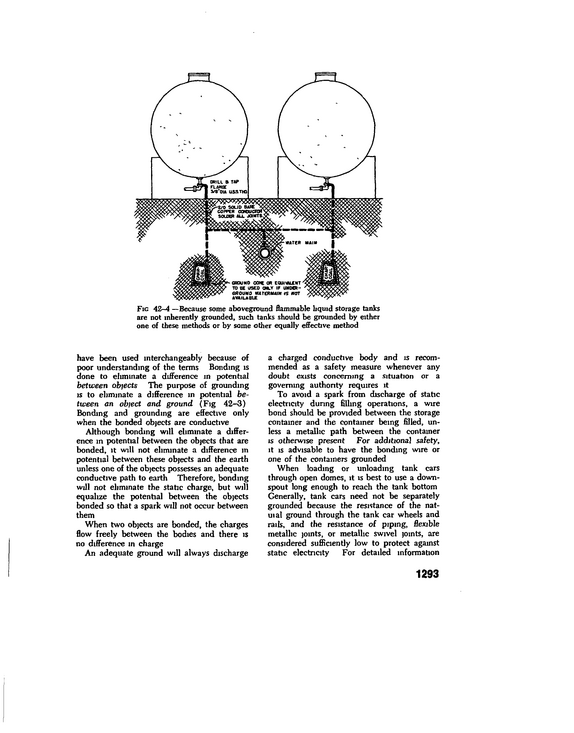
VELOCITY EQUIVALENTS 1 meter per second (m/sec, mps) = 36 km/hr = 2 23694 im/hr = 3 28084 ft/sec -- 196 850 ft/mm 1 kilometer per hour (km hr'1, kph) = 0 277778 m/sec = 0 621371 mi/hr = 0 911344 ft/sec 1 mile per hour (mi hr'1, mph) = 1 46667 ft/sec = 0 44704 m/sec = 1 609344 km/hr = 88 ft/mm 1 foot per second (ft/sec, fps) = 0 681818 mi/hr = 60 ft/mm = 0 3048 m/sec = 1 09728 km/hr 1 foot per minute (ft/mm, fpm) = 0 0113636 mi/hr = 0 00508 m/sec = 0 018288 km/hr PRESSURE EQUIVALENTS 1 pound per square inch (lb/sq in , psi) = 144 lb/sq ft (psf) = 70 3 gr/cnrr = 2 04 in (Hg)* 1 kilogram per square centimeter (kg/cm2) = 14 22 lb/sq m = 0 97 atm = 32 81 ft (H.O) 1 pound per square foot (lb/sq ft, psf) = 478 8 dynes/cm- = 47 88 pascals (Pa)' 1 atmosphere (atm) = 14 696 lb/sq m = 2992 m (Hg)* = 0 016 ft (HsO)8 1 gram per square centimeter (gm/cm2) = 10 kg/cm2 = 2 048 lb/sq ft = 760 cm (Hg) * = 33 93 ft (H,0)" = 101 32 kPa 0 (Hg) stands for mercury at 0 C, (H-0) stands for water at 15 C f At standard gravity of 980 665 cm/sec- or 32 174 ft/sec2 FORCE EQUIVALENTS 1 gram weight* = 980 665 dynes 1 kilogram weight = 9 80665 X 105 dynes 1 newton = 10s dynes 1 pound weight* = 32 174 poundals = 444822 dynes 1 poundal = 13825 5 dynes ' At standard gravity of 980 665 cm/sec2 or 32 174 ft/sec2 1477
refid# 4bR30MQQ4aYppXMMgZz5km5R1 page
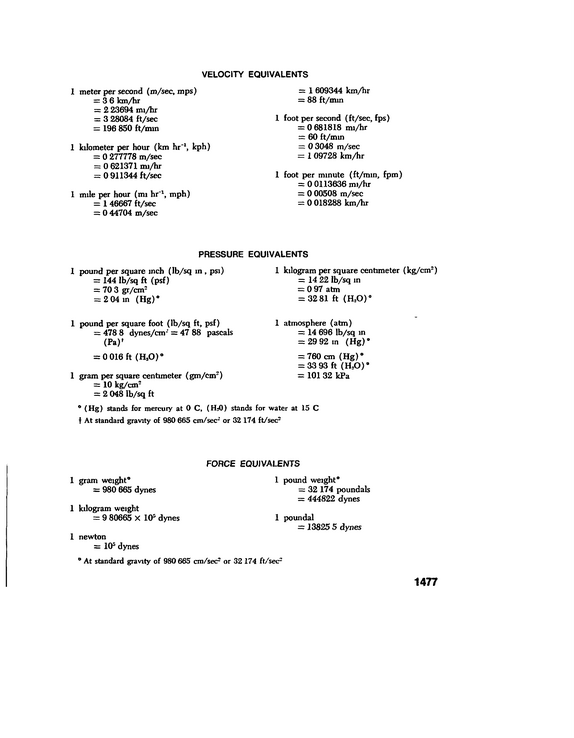
Index Overhead--Continued projectors, 340-341 swing saws, 817-818 Over-the-shoulder coaching, 205 Oxalic acid, 1160 Oxidation, 1237 Oxygen cutting, 948-957 deficiency, 1054, 1289 fire chemistry, 491 purity, 491 toxicity, 1160-1161 welding applications, 948, 949 Oxygen-breathing apparatus, 503-505 Ozone, 970, 1161 P Packaging materials, storing, 647-648 Pads, paper (for talks), 334-335 Pallets, 752 lift trade handling, 643-644, 746-747, 750-751 Pan American Health Organization, 828 Panic in buildings, 584 Paraffins, 1237 Paraldehyde, 1123 Parapet repairs, 429 Parathion, 1161-1162 Parking lots, 370-371, 573 Parsimony, principle of, 225-226, 230 Particles, airborne concentrations, 1183, 1468 Particulate filter respirators, 495, 505-506 Parts per million, 1041 Passageways aisles inspection, 430 office, 353-354 shipping and receiving, 655 storage, 644 doors, see Exits foundry, 904 runways, 387-389 walkways, 370 maintenance, 433 Patron injuries, 148-149 Pendant switches, 1261 Penetrant inspection, 925-926 Pentachlorophenol, 1162 Pentane, 1162 2-Pentanone, 1162 Perchloric acid, 1162 Periodicals, listing, 629-630 Periodic table, 1237 Personal injuries, see Injuries Personal protective equipment--applications cleaning storage tanks, 1315 contaminant control, 1087-1089 forging hammers, 935 lasers, 487 maintenance, 437 1514 Personal protective equipment--Continued materials handling, 660-661 tools hand and power, 1004-1005 machine, 813, 830 welding, 969-974 Personal protective equipment--type ear protection, 476-479 face and eye protection, 479-489 fire proximity suits, 518-519 footwear, 514-517 head protection, 469-476 historical, 7 paying for, 468 respiratory equipment, 489-514 safety belts, 509-514 selection and use, 466--469 Personality factors, 241, 243 Personnel facilities, 536-542 in foundries, 902 Pesticides, 1237 pH, definition, 1237 Pharmaceuticals, 1237 Phenol, 1237 toxicology, 1162-1163 Phosgene, 1163 Phosphine, 1163-1164 Phosphonc acid, 1164 Phosphoric anhydride, 1164 Phosphorus, 901, 1164-1165 Phosphorus oxychloride, 1165 Phosphorus pentasulfide, 1165 Phosphorus trichloride, 1165 Protoelectnc cell, 800 Photographic illustrations, 288, 312-313, 327- 328, 338, 339-340 Photosynthesis, 1237 Phthahc anhydride, 1165 Physical capacities of individuals, 243, 567-568 forms, 565,566 limitations, 110 measuring, 243-244 Physicians, industrial, 551-553 duties, 551-552 relation to safety, 550 Picnc acid, 1165-1166 Piers, marine, 373 Pipes (tubes) blowdown, 1393 boiler, 1394 compressed gas, 952 electrical grounding, 1265 handling, 437, 438, 990-992 high pressure, 1410-1412 identification, 437, 650 isolation, 437-438 storage, 647 storage tanks, 1291-1296 Pipelines gas, 438
refid# 6rMpJm2qqNYNnnn6KYx32wm11 page
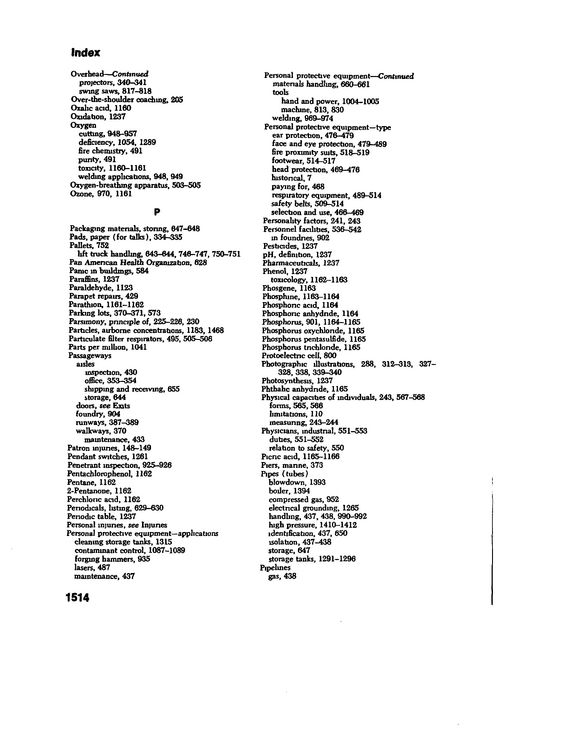
irl*l*Pttiraoa MrV.C.B*ck, Jr, fmi*
refid# KG3ooxm5nrNDyVM8RjQZd0Bn61 page
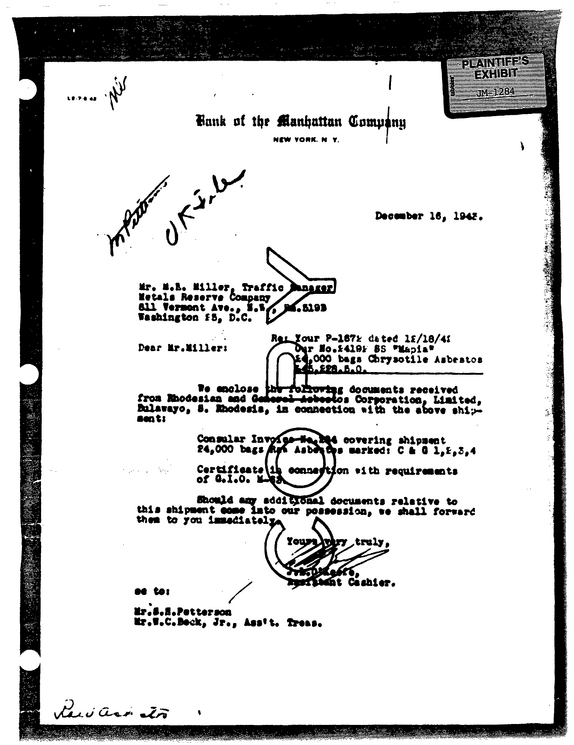
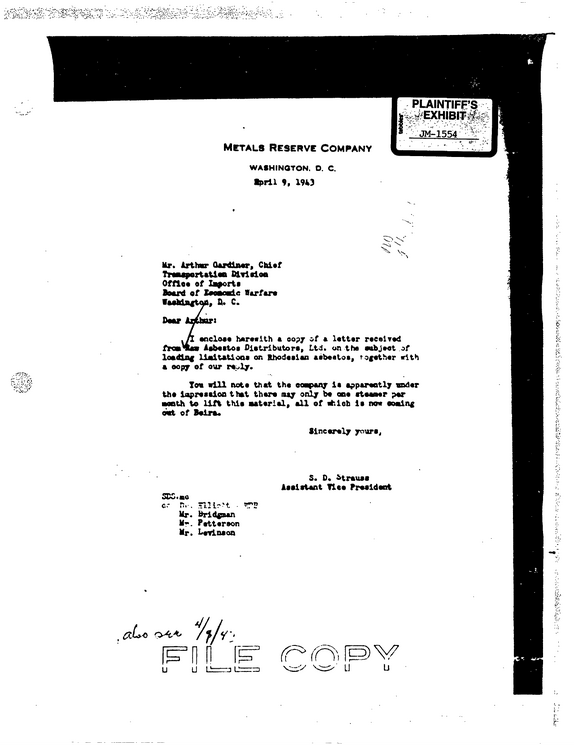
Mr. irthar Qardlaer, Chief Tr--portatlao DiTiwioe Office of Xaporta Board of Boaenelc Varfare aehlngton, Q .fl encloee herewith * oopy of e letter reeelred froaMtaa Aabestoa Cistrlbutora, Ltd. on the sobjeet of loading limitationa or.
refid# 0NrXenBx4wg3vJnDVZXjbaMO1 page
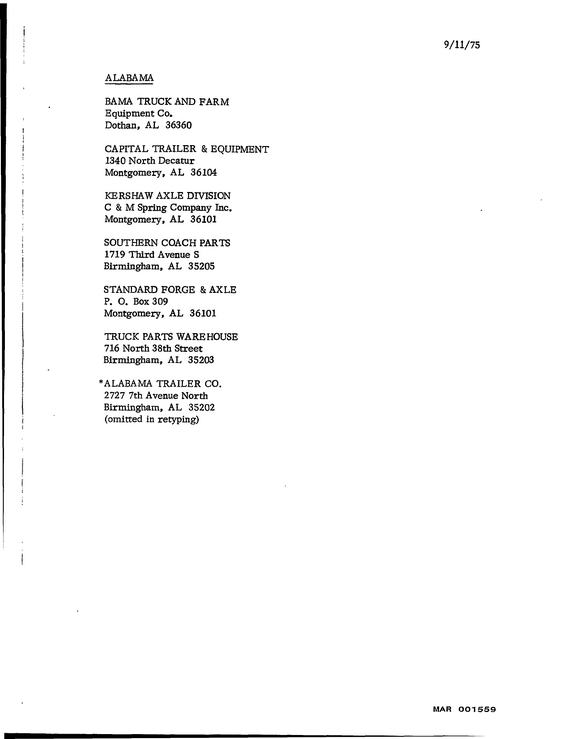
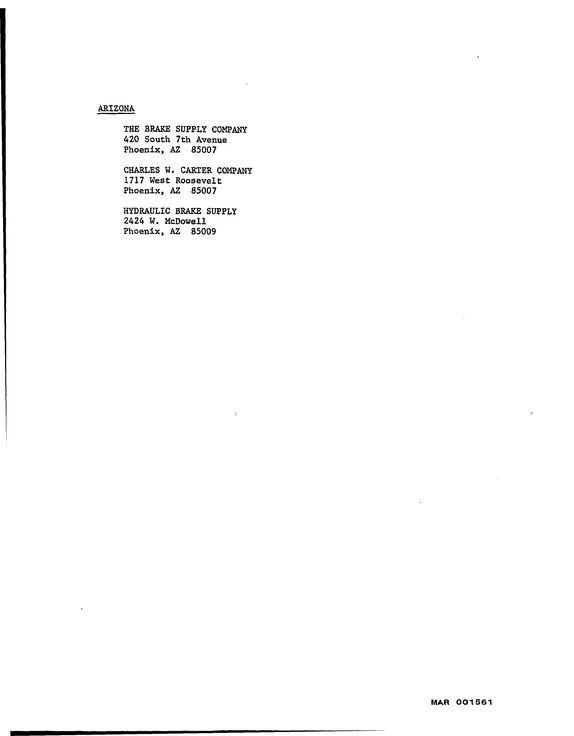
PLAINTIFF'S EXHIBIT DISTRIBUTORS BY STATE MAR 001558 ALABAMA BAMA TRUCK AND FARM Equipment Co.
refid# MGx47LOaZLgnq82Q2ZQ7gkKoL50 pages
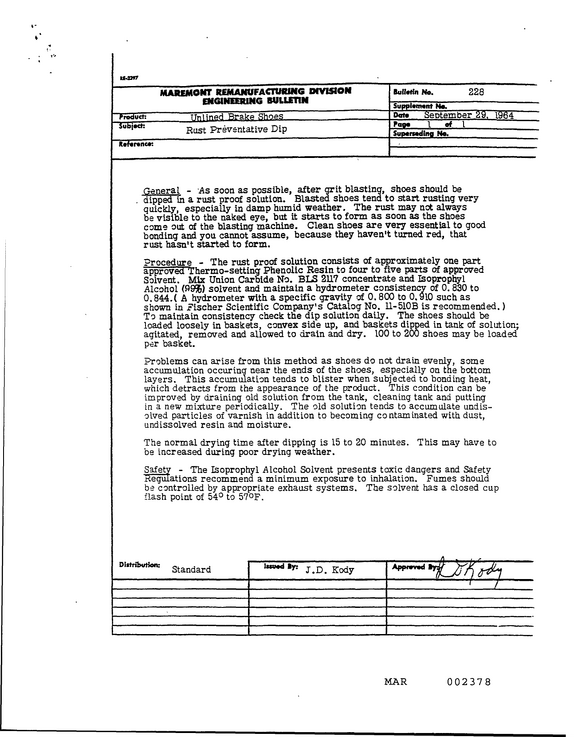
y ( do of Of i 1 Da / V f i PLAINTIFF'S EXHIBIT MAR-382 MAR 002377 U-23V7 MAREMONT REMANUFACTURING MVIStON ENGINEERING BULLETIN Product: Subject: TJnlined Brake Shoes Rust Preventative Dip Rafaranca: Bullarin No. 228 Supplamant Na.
refid# zQD8vkkaBvZVanowwQ1jgyg6n2 pages
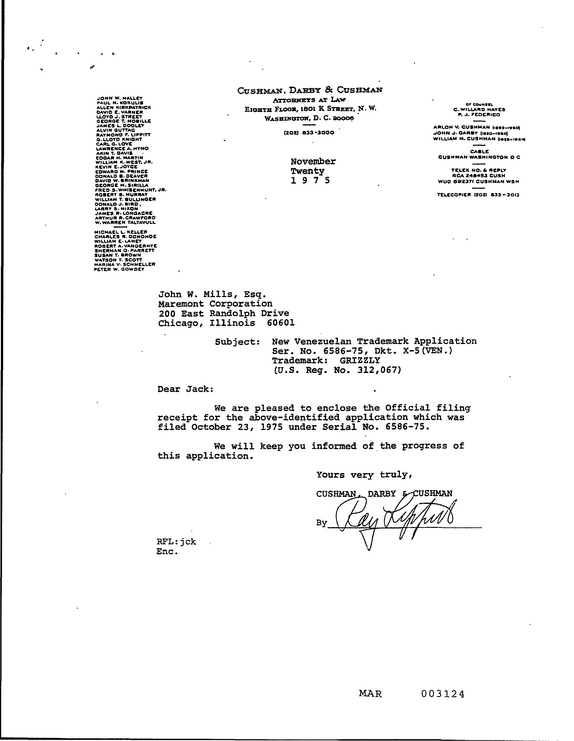
PLAINTIFF'S EXHIBIT y S' MAR 003123 JOHN W.
refid# RJ8V60bL7g5joDRNn54XnvoZa7 pages
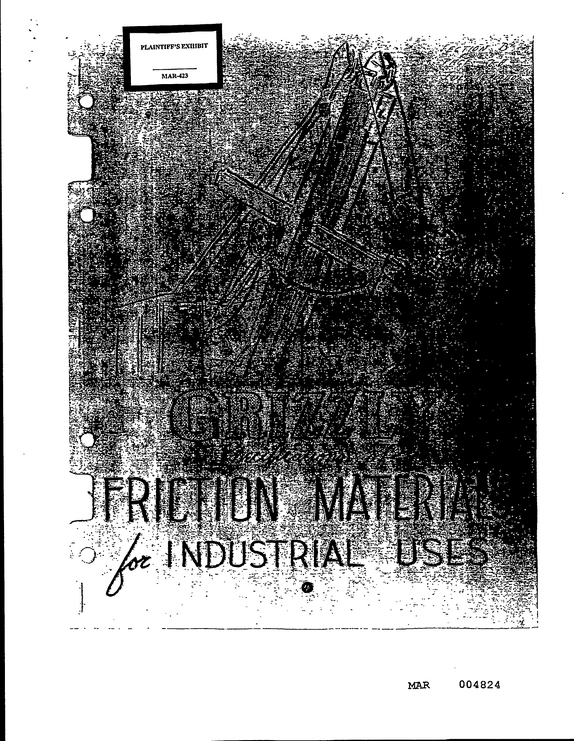
MAR 004824 Vl rH s0 p 03 0P ?
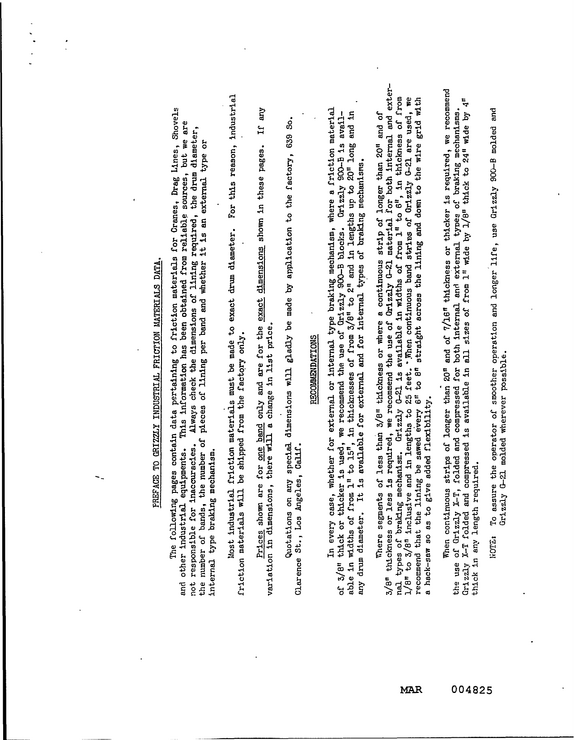
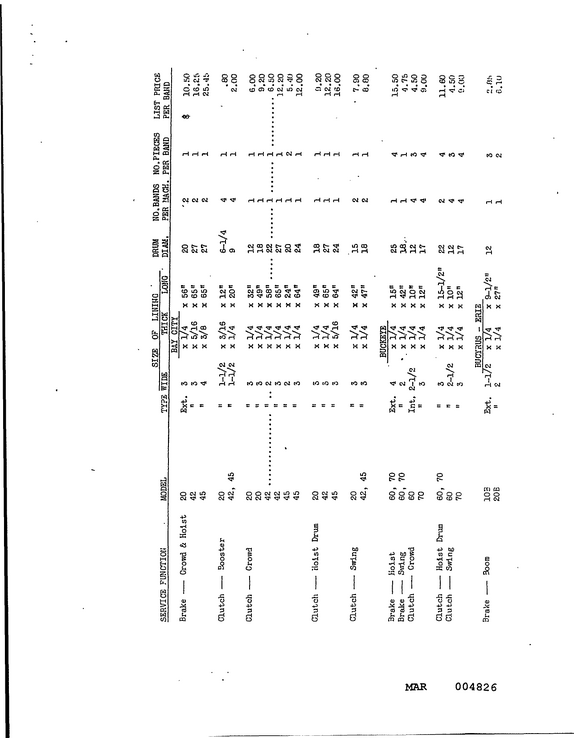
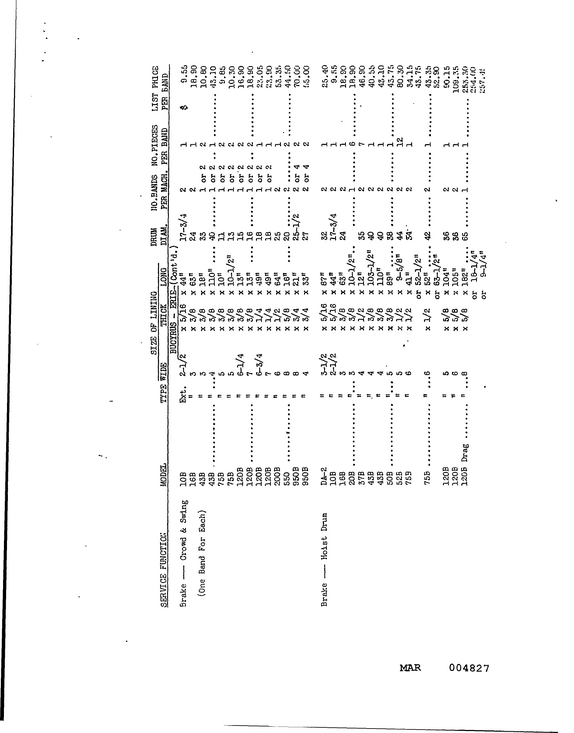
refid# rBmb495wJzBpLk5ZEq7DreyzJ35 pages
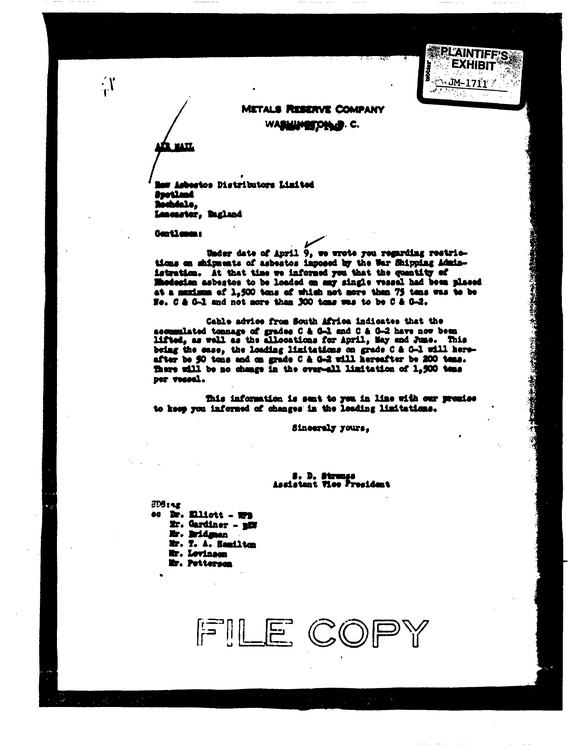
METALS Rnmvt COMPANY wANMWPtfcr c.
refid# 6BEQXn7Y6roj8XNemxnxYYn1g1 page
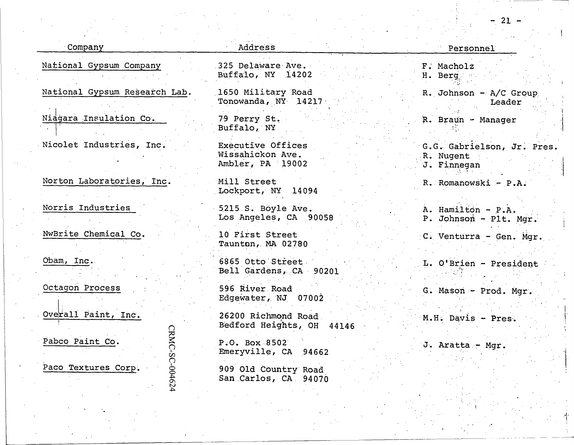
Company National Gypsum Company National Gypsum Research Lab.
refid# 8kwLDoX92QJKjdEXedZd272K1 page