Refine
Estimated Years UndatedClear
92,592 results foundRefine Search
particularly important if there are a number of speakers and some may not be heard in far comers of the room If the speaker must move around, a lavaliere (chest-type), wireless, or lapel micro phone is necessary (Be sure the lavaliere microphone does not rub against a be clip as this makes a lot of noise ) If the speaker can remain m one place, a pedestal or lectern microphone is satisfactory If audience participation is desired from a large group, floor microphones placed in the aisles or roving microphones earned by assistants will enable members of the audi ence to be heard throughout the room.
refid# 5wkkVvqgJKwQmxmvwDdB5M7D1 page
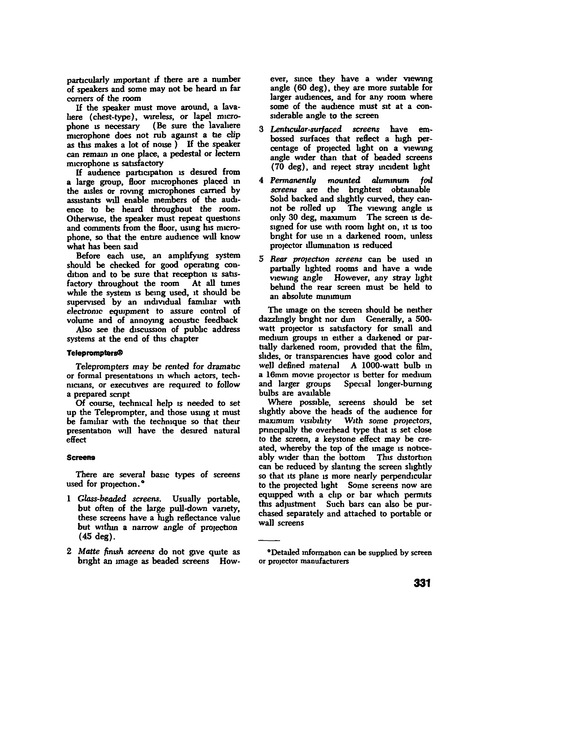
18--Planning for Emergencies Fic 18-9 --Fire brigade hose drill provides familiarity with equipment--makes the group more effective under actual emergency conditions Courtesy Firestone Tire O Rubber Company least two competent men for pump duty in the main pump room, and a man for each pump located elsewhere Training of fire fighters.
refid# jyw4Bv6XM70eEarV6eV9BYX1Z1 page
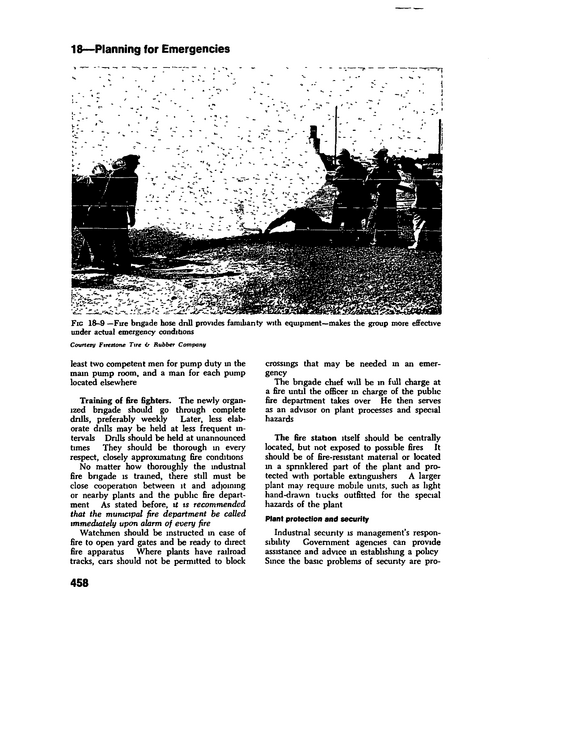
Fic 19-33 --Solder grinders wear hoods to prevent foreign matter from entering their eyes, ears, noses, or mouths Filtered air is supplied to the hoods at 12 to 15 psig and is exhausted around the bottoms bons of rapidly moving abrasive pai tides The requirements for abrasive blashng respirators are the same as those for an air line respirator of the continuous flow type, with the addition that mechanical protection from the abrasive particles is needed for the head and neck (Fig 19-32) NIOSH-MESA tests and ceitifies such equipment There are two foims of abiasive blasting respirators that cover the head and neck, and even the shoulder and chest One form has a full facepiece (made of rubber), and an eyepiece made of impactresistant safety glass (or plastic covered by a metal screen) This unit is attached securely to a hood and cape made of tough, flexible rubber or rubber-covered fabnc Air is supplied to the full facepiece and is exhausted through an exhalation valve located under the hood in order to expel the air at the edges of the hood The other form uses a rigid helmet (gen erally made of metal) to encase the user's head The eyepiece is of impact-resistant safety glass or of plastic covered by a metal screen An adjustable knitted fabric collar, covered with rubber- or plastic-coated fabnc, fits over the metal helmet and down over the user's neck, shoulders, and chest in order to give addibonal protecbon A flexible tube brings air to the helmet Air, exhausted from the helmet, flows between the collar and the user's neck In both units, the eyepiece (window) and the protechve screen should be easily re placeable, preferably without the use of tools Air supplied hoods For some long-term operabons where a completely enclosed suit is not necessary, an air supplied hood may be used These are particularly useful in hot, dusty situabons.
refid# mLGxR83oeX2zzYMQe5yjXY7O1 page
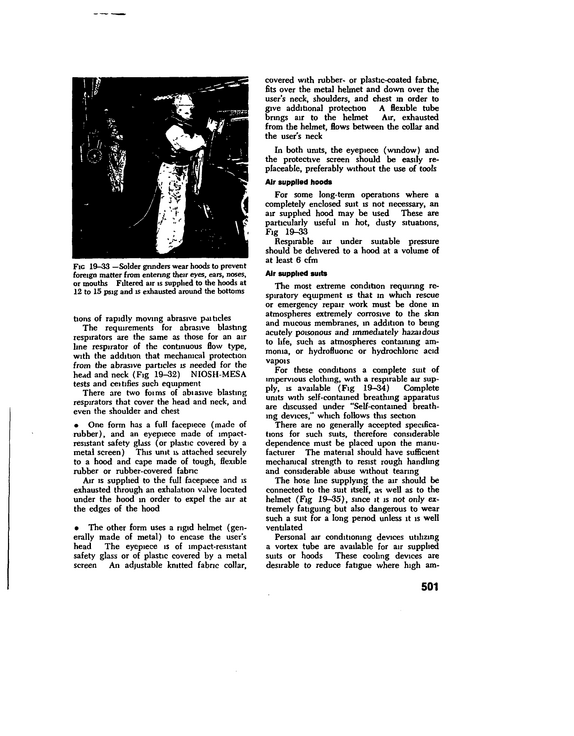
19--Personal Protective Equipment with energized electric equipment is remote, shoes or boots are equipped with reinforced soles or inner soles of flexible metal (Fig 19-45) Special shoes made with a sbtched and cemented construcbon are available for elec tricians These shoes serve as good insula tors, so when they are repaired, avoid the use of nails which will destroy their msulabng value For wet condibons such as are found m dames and breweries, leather shoes with wood soles, or wood-soled sandals worn over shoes, are effective Wood soles provide good foot protection on jobs which require walking upon hot surfaces which are not hot enough to char the wood Wood soles have been so generally used by men handling hot asphalt that they are some- gasoline or other volatile hydrocarbons These shoes do not have conductive soles They have nonferrous eyelets and nails, and metal box toes are coated with a nonferrous metal Electrical hazard shoes Electrical hazard shoes are intended to min imize hazards resulbng from contacts with electric current where the path of the current would be from the point of contact to the ground No metal is used in construction, ex cept for the box toe which is insulated from the rest of the shoe If damp or badlv worn, they cannot be depended on for protection Special shoes In some industries, such as construction, where there may exist an increased hazard from protruding nails, and where contact 516 Fic 19-45 --This type of foot protection is worn extensively m the construcbon industry A flex ible steel insole prevents the nail from punctunng the foot
refid# oKOOdZK9BYpkOM1J94zVKR781 page
r.
refid# wrYRnaMBJ35zN1R3on57Oz4g61 page
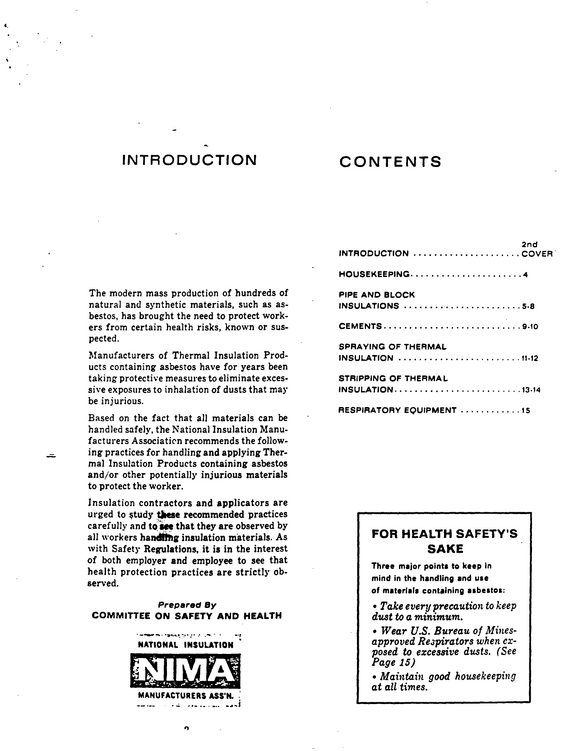
f I PLAINTIFF'S i EXHIBIT f TT/K)393 ia RECOMMENDED HEALTH SAFETY PRACTICES For Handling And Applying Thermal Insulation Products Containing Asbestos for additional copies, write: Executive Secretary National Insulation Manufacturers Association, Inc. 441 Lexington Avenue, New York, N.Y. 10017 NATIONAL tzf> MANUFACTURERS ASSOCIATION INTRODUCTION CONTENTS The modern mass production of hundreds of natural and synthetic materials, such as as bestos, has brought the need to protect work ers from certain health risks, known or sus pected.
refid# 4J95NwZo64kkoje3o89xp0V9G8 pages
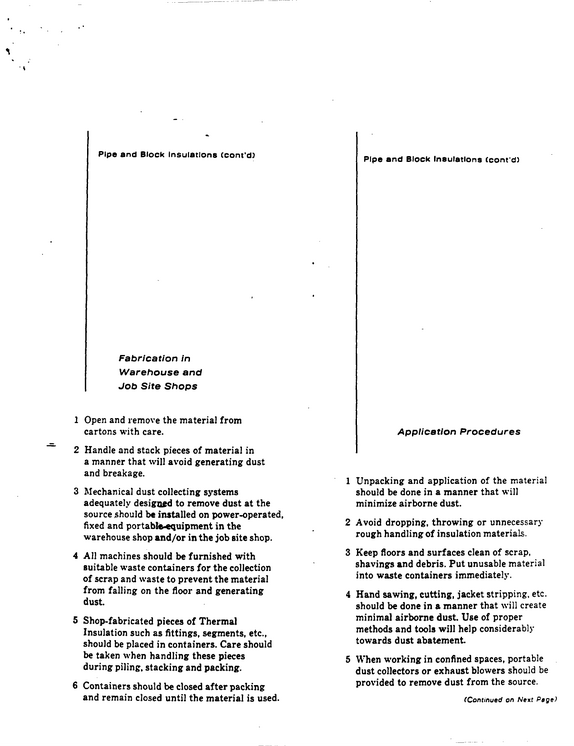
Modem occupational health programs, re gardless of size, ideally are composed of elements and services designed to maintain the health of the work force, to prevent or control occupational and non-occupational dis eases and accidents, and to prevent and lower disability and the resulting lost time They should provide for 1 Maintenance of healthful environment 2 Health examinations 3 Diagnosis and treatment 4 Immunization programs 5 Medical records 6 Health education and counseling 7 Open communication between plant phy sician and personal physician Any treatment of ill or injured persons has some bearing on the practice of medicine All states, therefore, regulate medical and nursing practice to curb the activities of persons who are not properly trained and licensed Ideally, all the services related to health, injuries, first aid, and medication of any kind should be under the supervision of a licensed physician The industrial physician Physicians in industry may be employed on a number of different bases, dependent upon such considerations as the number of em ployees, the hazards in the operations, and the type and extent of the occupational health program Arrangements may be made for full-time, part-time, on-call, or consulting service Where the medical service program re quires a full-time physician, one should be employed by the company Some large or ganizations employ a full-time medical di rector on their headquarters staff, with parttime physicians serving their decentralized operations Some part-time physicians devote a sched uled number of hours, either daily or weekly, to the medical service needs of a company, yet they are available at other times for emergencies Others arrange their service by telephone on the basis of current needs of the company--when applicants require examina tion, injured employees need medical care, or other medical problems anse The on-call physician arrangement is most often used by companies (or establishments) having fewer than 500 employees, a low fre quency of accidental injuries, or a minimum program of health services for employees The on-call physician is usually located nearby and is available m emergencies He cares for most injuries not requiring hospitalization and for those cases requiring hospitalization that fall within his competence He often uses specialists as consultants Frequently, the on-call physician has similar arrangements to serve a number of companies in the vicinity--a particularly convenient sys tem with the small-plant or small-company clusters, such as in industrial parks It is not unusual to find physicians special izing in the caie of industrial injuries and diseases, and the provision of occupational medical services in some manufacturing centers Consulting service is usually reserved for diagnosis and treatment of senous injuries, illnesses, toxicological problems, and special kinds of injuries or disorders (such as eye injuries) that require the services of a spe cialist State and local health departments often supply, without charge, medical, nursing, and engineering consultation, as well as make industrial hygiene and radiological surveys to industries within then areas Many insurance companies also provide this type of service to their clients Duties ot the industrial physician An effective medical service program should be planned by the medical director, with the approval of management Full support of management can only be obtained when management is sympathetic to a cause that reflects management's policies Only then is it possible to establish and maintain an ade quate professional staff and facilities for ex aminations, emergency cases, and storage of records Also, the medical director must be given enough authority so that workers will respect his judgment and follow his instruc tions on personal health and safety The industrial physician should be familiar 551
refid# mm7boaGwpo7gNy19GX8N7Rvq41 page
Johnt4tanvM S/Si Memr To: V /^'/V-'v t Subject: From: Location: /V y '. / '^J:JL*s\ 4/U,n T-t ^ -* '/*-*'* ''J c /o Z''. 7T 3*20 MTC 010677
refid# Jv3r4zzXJ09y4q1QeZ6Z6bz8v1 page
*1 MaH Gn m 5 3 cn 4 M CM O 55'. 01 I 1 1 `.a -H I in3 m 0 CO +J a kM <u JJ J CO fix 9 I s r* .

refid# bBMyzQ3ba8n4mQ3mxxaO8ZpmD2 pages
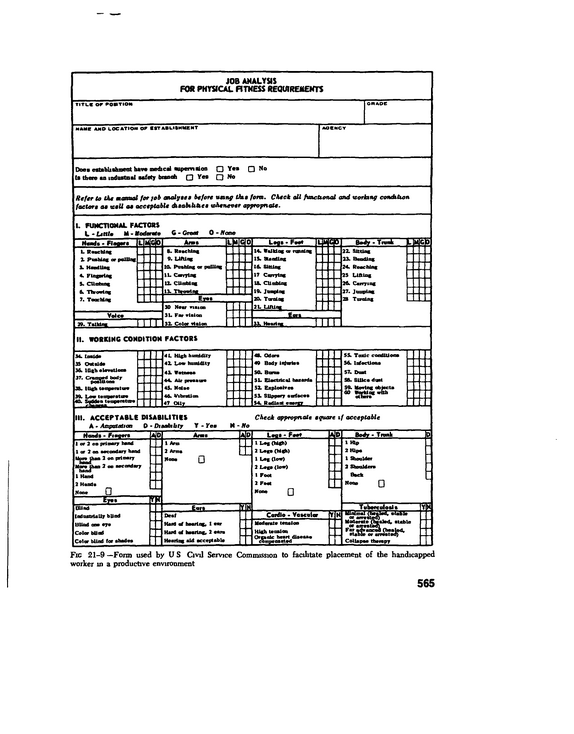
1 JOB ANALYSIS FOR PHYSICAL FITNESS REQUIREMENTS r --" NAME AMO LOCATION OF ESTABLISHMENT AOCNCY GRADE Does establishment have medical uipemiica to thefe aa indostnil safety bnad) Q Yes Yes Q No Q No gefer to the manual for /eb analytet before uung tbit fora.
refid# zbLJVjOD7y30b4dpGn3ZR3ga31 page
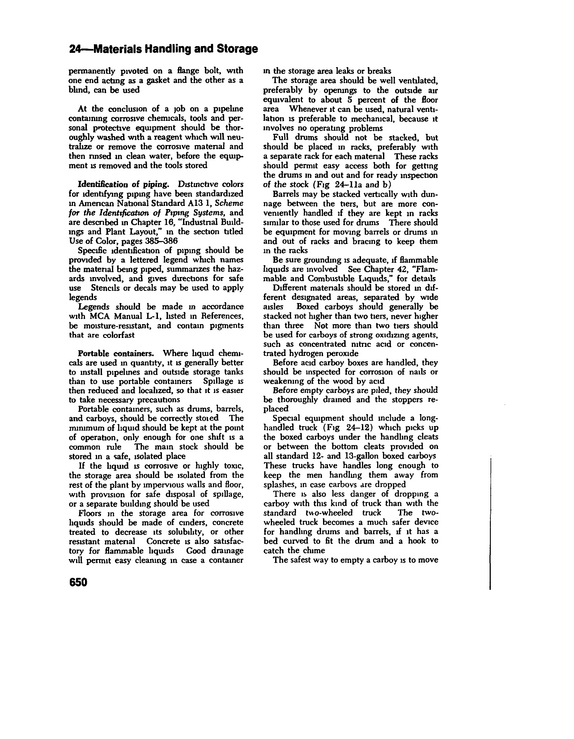
24--Materials Handling and Storage permanently pivoted on a flange bolt, with one end acting as a gasket and the other as a blind, can be used At the conclusion of a job on a pipeline containing corrosive chemicals, tools and per sonal protective equipment should be thor oughly washed with a reagent which will neu tralize or remove the corrosive material and then nnsed in clean water, before the equip ment is removed and the tools stored Identification of piping.
refid# B563J0JwaQn5K0akb8jG86joJ1 page
operating conditions Since fencing and loca tion methods can be used only when a ma chine can be isolated, these methods will have limited use on most production setups Most production machines will require some kind of enclosure of the hazard points to comply with the OSHA regulations Types of guards There are several types of enclosures that are suitable for guarding hazard points de pending on how and where they are used The fixed guard is considered preferable to all other types and should be used m every case unless it has been definitely determined that this type is not at all practicable The fixed guard at all times prevents access to the dangerous parts of the machine Fixed guards may be adjustable to accom modate different sets of tools or various kinds of work Once adjusted, they should remain "fixed," and there should be no movement nor detachment of them Some fixed guards are installed at a distance from the danger point in association with re mote feeding arrangements which make it un necessary for the operator to approach the danger point A table of the safe distance of a guard fiom the danger point and the permissible size of openings in a fixed guard is given m the Pointof-Operation Guards section of this chapter Examples of fixed guards are found on power presses, sheet leveling or flattening machmes, milling machines, gear trains, drill ing machines, and guillotine cutters Interlocking guards.

refid# v13nMG7nxJa2r3qM1d5Xzom5Y1 page
~?
refid# ymKeNY51gmjerL83MqGpJmvOr6 pages
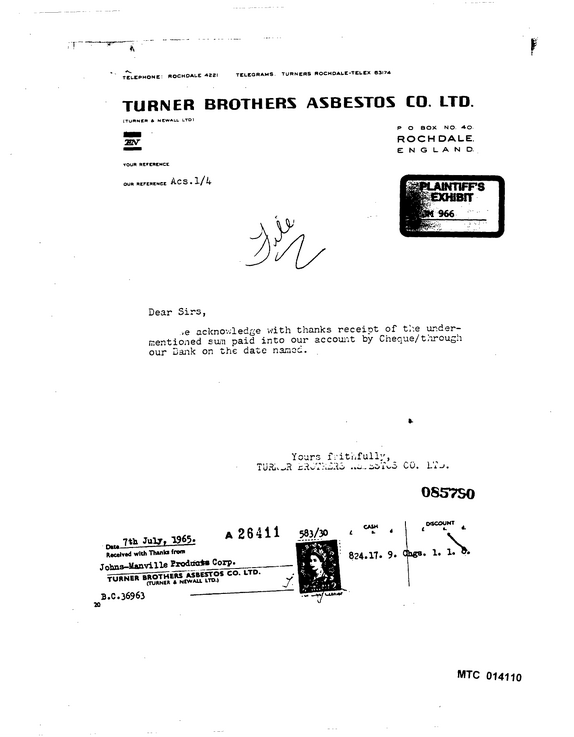
TELEPHONE: ROCHOALE A22I TELEGRAMS.
refid# NNZRj8EZV8bDmk1Xwxrx2YZw3 pages
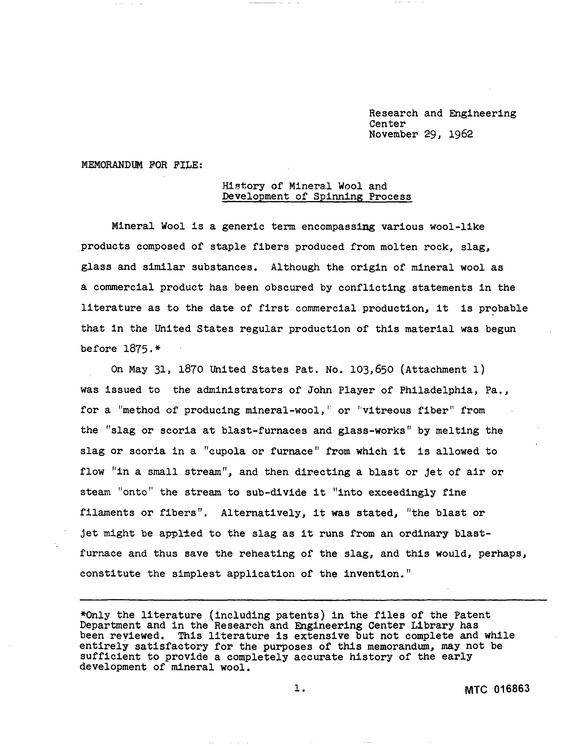
M IN ER AL WOOL - HISTORY OF ___ ___ ___ IN S U LA TIO N S - M INERAL WOO] MTC 016862 Research and Engineering Center November 29, 1962 MEMORANDUM FOR FILE: History of Mineral Wool and Development of Spinning Process Mineral Wool is a generic term encompassing various wool-like products composed of staple fibers produced from molten rock, slag, glass and similar substances.

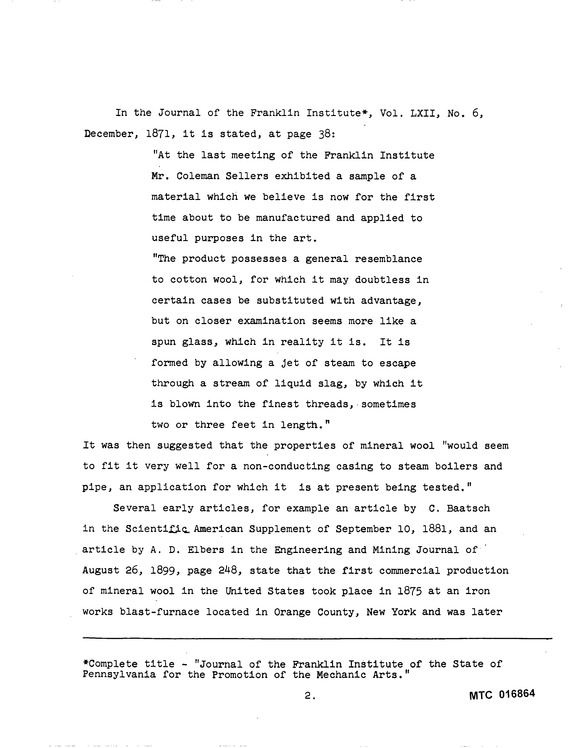
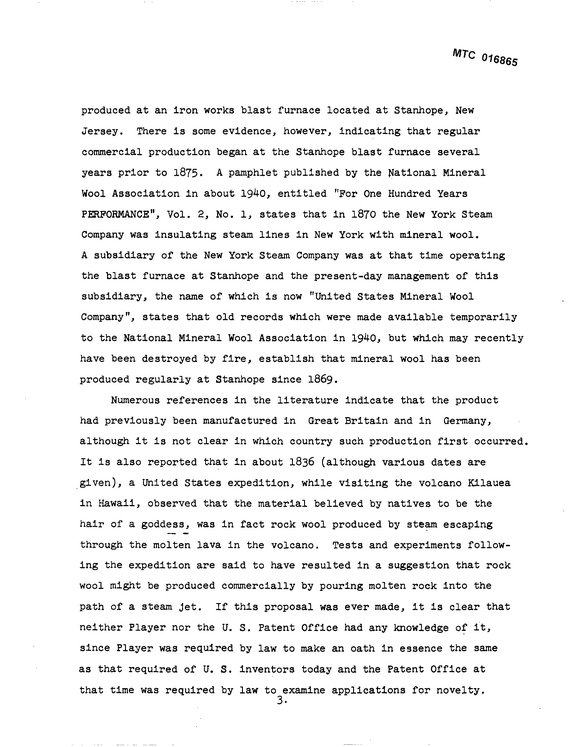
refid# 3Qz7gMzxo0DXnM0pvkBeE0XJn33 pages