Refine
Estimated Years UndatedClear
92,592 results foundRefine Search
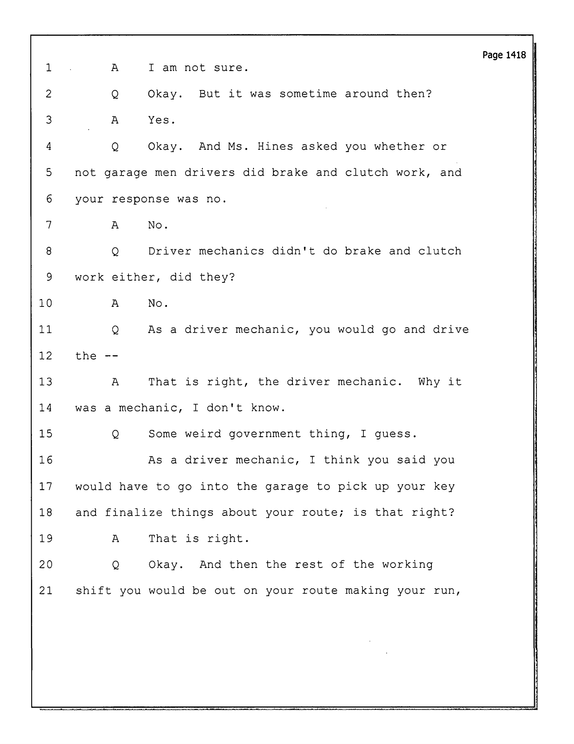
1 A I am not sure.
refid# Y9GZmnYN2ZLGvGg8w0nJgM5081 page
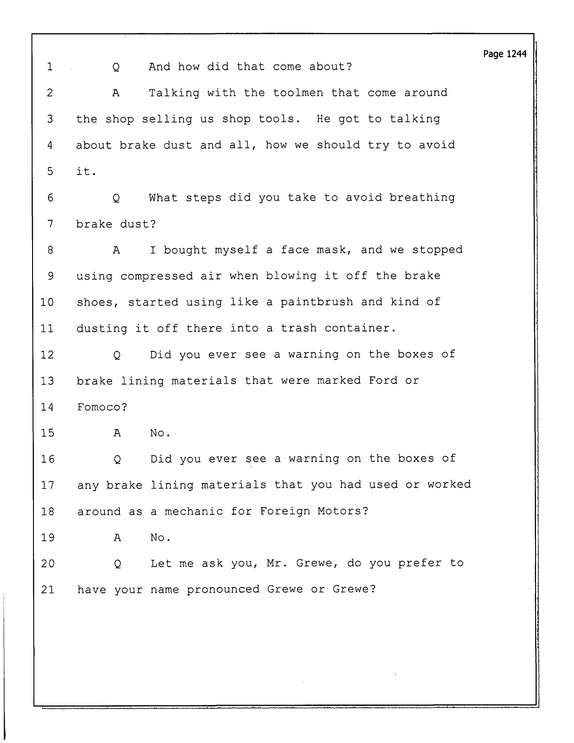
1 And how did that come about?
refid# k6z2jOz8J8M81qkXGV75vMkbD1 page
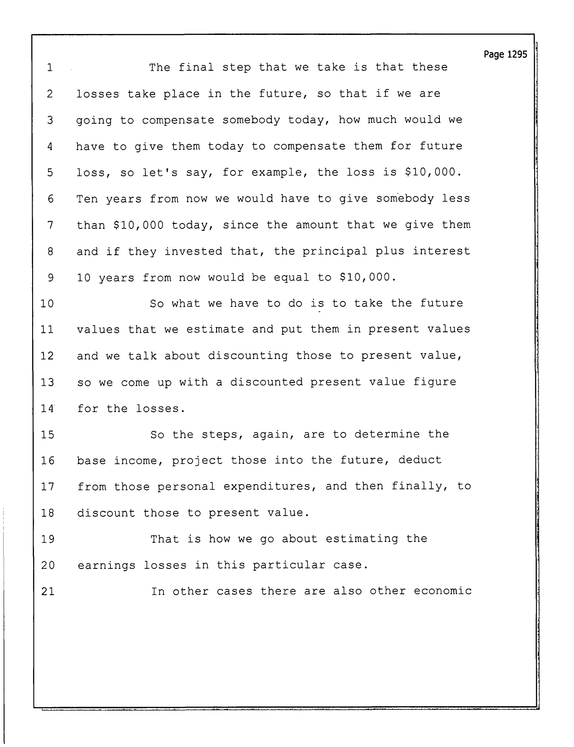
Page 1295 1 The final step that we take is that these 2 losses take place in the future, so that if we are 3 going to compensate somebody today, how much would we 4 have to give them today to compensate them for future 5 loss, so let's say, for example, the loss is $10,000. 6 Ten years from now we would have to give somebody less 7 than $10,000 today, since the amount that we give them 8 and if they invested that, the principal plus interest 9 10 years from now would be equal to $10,000. 10 So what we have to do is to take the future 11 values that we estimate and put them in present values 12 and we talk about discounting those to present value, 13 so we come up with a discounted present value figure 14 for the losses. 15 So the steps, again, are to determine the 16 base income, project those into the future, deduct 17 from those personal expenditures, and then finally, to 18 discount those to present value. 19 That is how we go about estimating the 20 earnings losses in this particular case. 21 In other cases there are also other economic
refid# jBdejNkrnRo5BgB9gr135L7kZ1 page
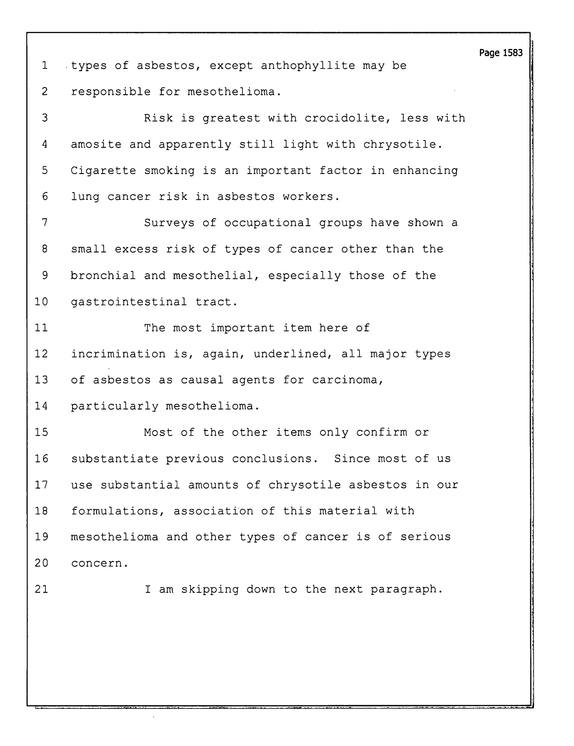
1 types of asbestos, except anthophyllite may be Page 1583 2 responsible for mesothelioma. 3 Risk is greatest with crocidolite, less with 4 amosite and apparently still light with chrysotile. 5 Cigarette smoking is an important factor in enhancing 6 lung cancer risk in asbestos workers. 7 Surveys of occupational groups have shown a 8 small excess risk of types of cancer other than the 9 bronchial and mesothelial, especially those of the 10 gastrointestinal tract. 11 The most important item here of 12 incrimination is, again, underlined, all major types 13 of asbestos as causal agents for carcinoma, 14 particularly mesothelioma. 15 Most of the other items only confirm or 16 substantiate previous conclusions.
refid# BKrxKRMr961rwowzxGBmam1 page
1 electron microscopy, selected area electron Page 1600 2 diffraction. 3 Chrysotile was found in both fiber and 4 fibril form with unaltered structure and chemical 5 composition. 6 MR.
refid# a1bdoMKdpOqjJOzGRovzXYDVy1 page
Page 2884 1 It had a binder system which, at that time, 2 probably was made from the oil of the shell of the 3 cashew nut, but may also have been a phenolic binder 4 or a rubber binder.
refid# mpD1a0BRp0Y3nv2ba7aMbzMbb1 page
1 you analyzed the sample you found .03 percent was Page 2907 2 chrysotile?
refid# 70DRavgLgj75o3EzDOQ286rv81 page
Page 2940 1 Q Okay.
refid# 01j8x6qENy2LMy3zRy8R8JGx1 page
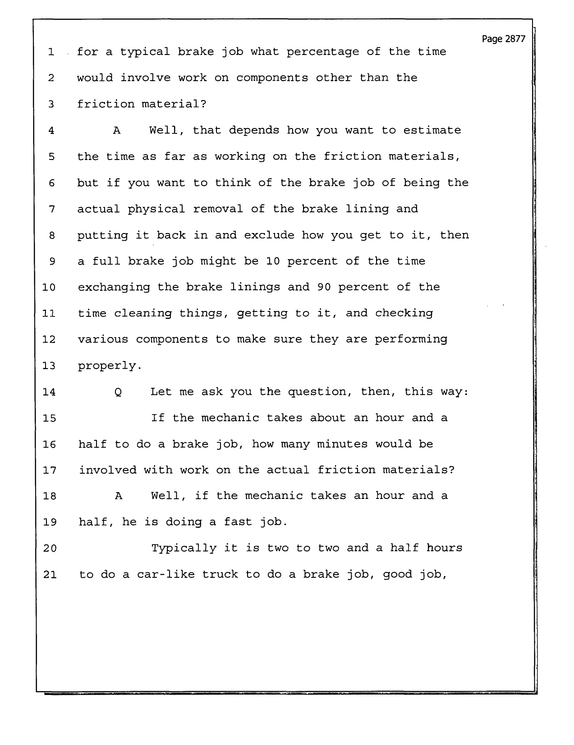
1 for a typical brake job what percentage of the time Page 2877 2 would involve work on components other than the 3 friction material?
refid# gDY64L18bzLON9KKXkdKLaKGL1 page
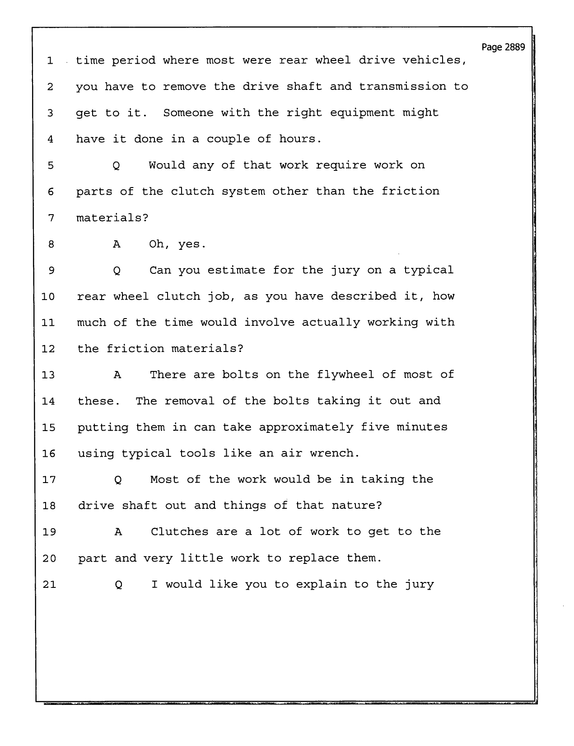
Page 2889 1 time period where most were rear wheel drive vehicles, 2 you have to remove the drive shaft and transmission to 3 get to it.
refid# VGLXZEmaVogGoydLRoZzO4LKo1 page
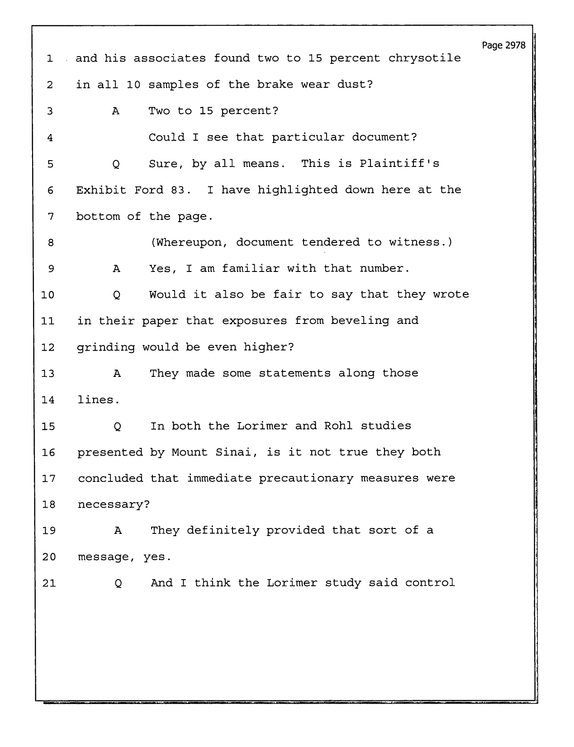
Page 2978 1 and his associates found two to 15 percent chrysotile 2 in all 10 samples of the brake wear dust?
refid# oD860DQ3qQ88E6L7vMzpM61xD1 page
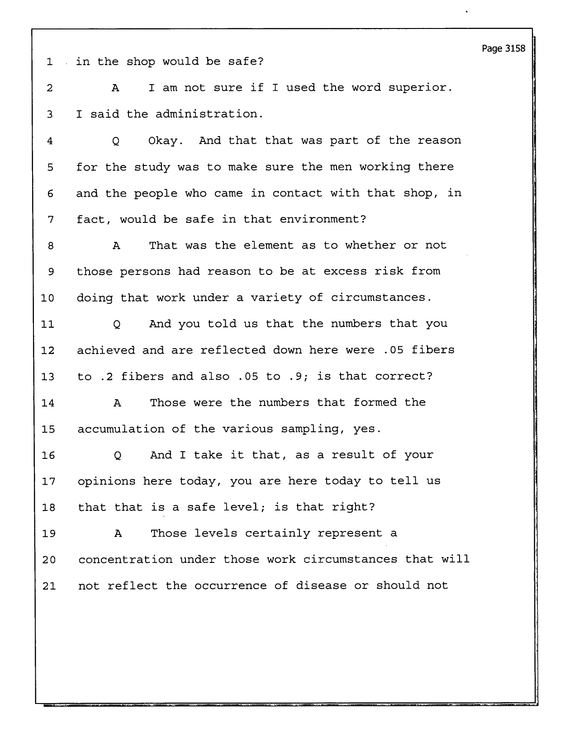
1 in the shop would be safe?
refid# 2R5Z87k3mRmvyNr7nvZQ7ndMN1 page
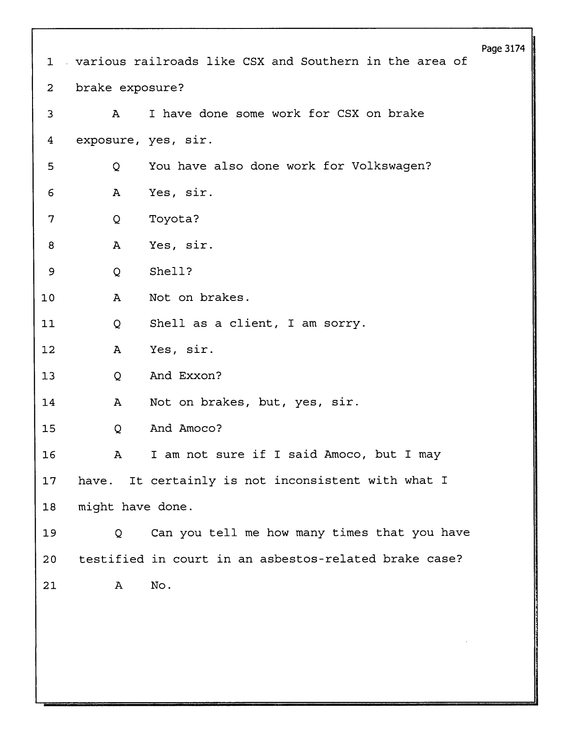
Page 3174 1 various railroads like CSX and Southern in the area of 2 brake exposure?
refid# oKZngrZ0Exkb1aQmk21Og5Zw1 page
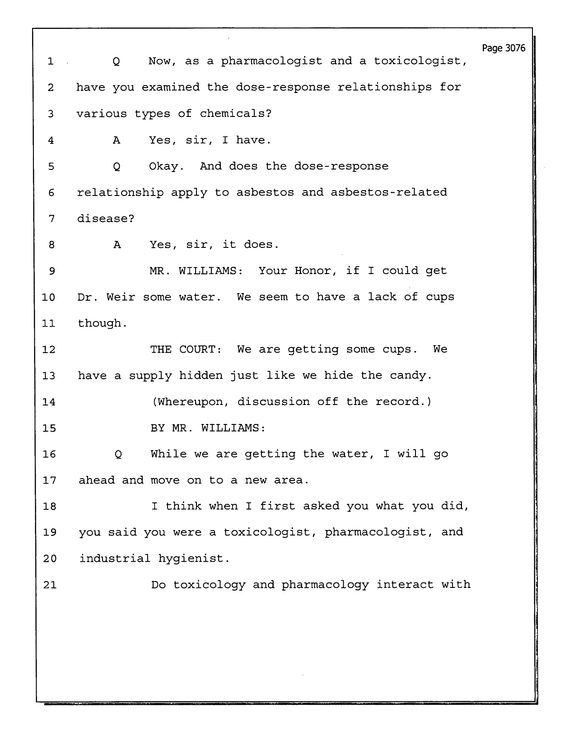
Page 3076 1 Q Now, as a pharmacologist and a toxicologist, 2 have you examined the dose-response relationships for 3 various types of chemicals?
refid# G5oykJ3JKKJx18Dj1nnryxNMv1 page
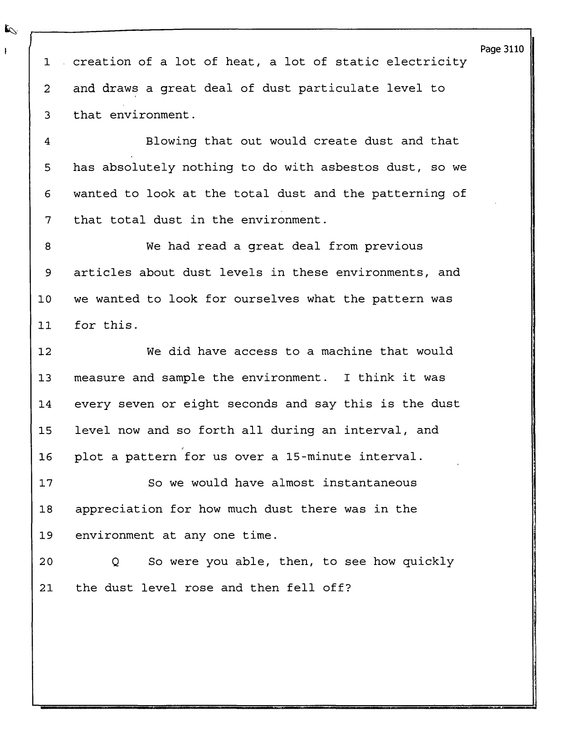
creation of a lot of heat, a lot of static electricity and draws a great deal of dust particulate level to that environment.
refid# O1YQqg2EXj08K1nkKQL4p3nbp1 page