Refine
Estimated Years UndatedClear
92,592 results foundRefine Search
' PRODUCED JM-83 MTC 000592 N1TC 000593 I.

refid# G6GEnLeNNRBv0LD9pyL3RVm2r34 pages
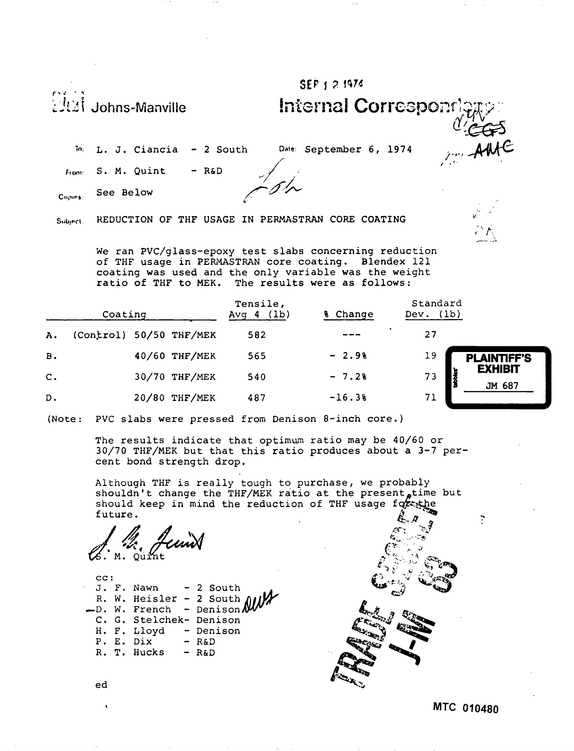
Johns-Manville SEP i ?

refid# 5kjzL2RvBgJZd4yqqLnoDnpNz2 pages
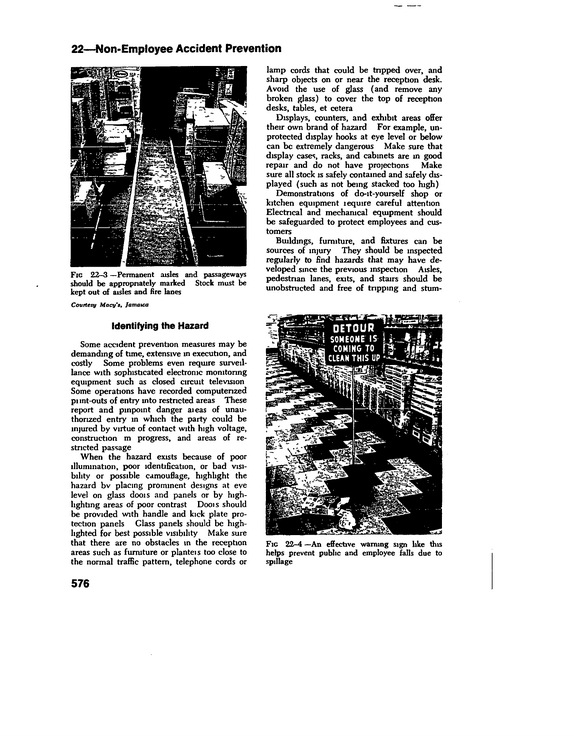
22--Non-Employee Accident Prevention Fic 22--3 --Permanent aisles and passageways should be appropriately marked Stock must be kept out of aisles and fire lanes Courtesy Macy's, Jamaica lamp cords that could be tnpped over, and sharp objects on or near the reception desk.
refid# dYnM43LxJpRaNgn3Nax69dQ651 page
23--Sources of Help Machinery Safety and OSHA Committee Coordinating Committee on Consumer Safety Urethane Safety Group The Safety and Loss Prevention Committee conducts semiannual survey of disabling in jury experiences among plastic processors The recently published Plashes Industry Safety Handbook is designed to assist super visors and other management personnel Safety posters and other visual aids have been developed to supplement total management safety services Machinery Safety and OSHA Committee is made up of representatives from members of the Society's machine builders This com mittee is developing machinery standards for promulgation through the American National Standards Institute These standards will encompass all the machinery that is prom inently used in the plastics-processmg in dustry The Coordinating Committee on Consumer Safety is responsible for the total consumer fire safety program It works closely with re search organizations and other trade associa tions to help the general public to better un derstand how synthetic and natural materials perform in a fire environment This group also coordinates the activities with similar existing federal programs The Urethane Safety Group represents the urethane industry, fosters intelligent regula tions, meaningful standards, and truthful com munications looking toward safety for the consumer It will assure that the urethane in dustry is represented on matters before gov ernmental agencies, industry, and other con cerned groups as regards questions of urethane flammability and the safe use of urethane products It will collect statistics and other data concerning the use of urethane, as may be necessary or appropriate, and will support and conduct research and testing progiams re lated to the safe use of urethane Steel Plate Fabricators Association, Inc. 15 Spinning Wheel Rd , Hinsdale, III 60521 The association has an active safety commit tee which prepares publications on safety for member companies and then: employees Some of these are "Supervisor's Accident Pievention Manual for 618 Field Erection and Construction," "Basic Safety Rules for Fabricating Shops," and "Basic Safety Rules for Field Erection and Construction " The Association sponsors jointly with the National Safety Council the Steel Plate Fab ricators Safety Contest U.
refid# 4QBEpadod09XLw8J01Y2m89p11 page
24--Materials Handling and Storage the normal curvatures are maintained This normally curved spine is termed a "straight back '' With "straight back lifting" the spine is fairly ngid (nonmedically speaking) and the pressure on the lumbar intervertebral disks is evenly distributed When lifting with the back bent, the spine forms an arc with the re sult that the lower back muscles are subject to strain and there is uneven pressure on the disks In addition to the risk of intervertebial disk lesions, lifting an object with the back bent and the legs straight imposes excessive stress on the muscles of the back for two reasons First, the back must be inclined at a greater angle to the vertical for the hands to reach the object Since the "effective weight" (of the object plus the upper part of the worker's body) increases rapidly as this angle is in creased, a much greater effort is required to raise the back to its vertical position Second, muscular effort is required to "straighten" the spine When a weight is being lifted from the ground, making maximum effective use of the legs, the back is straight but inclined for wards As the lift proceeds by the extension of the knees, the back returns to the vertical position The position of the feet and the flexion of the knees are the key factors for maintaining a straight back Arms close to the body When lifting and carrying weights, the arms should be close into the body and remain straight whenever possible This is because flexing the elbows and raising the shoulders imposes unnecessaiy strain on the muscles of the upper arms and chest Carrying involves a static posture of the arms, and particularly m the case of long distances, any assistance given by the body in supporting the weight will lessen the tension m the muscles Carrying with the aims straight enables the weight to rest against the thighs Correct hold.
refid# ZBOGdNxrXOoy4LmY1odE4ZDLZ1 page
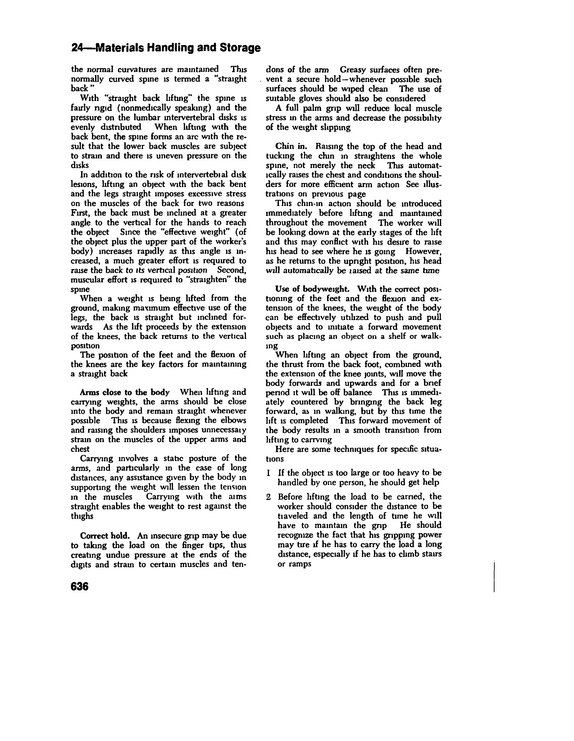
sling out from under a load may cause wear to the spiral, thus reducing the wire diameter and requiring the sling to be taken out of service Nylon has definite advantages for some material handling applications It is light weight and inexpensive However, it also has limits in safe material handling operations Nylon slings are not pretested, but they are rated by the manufacturer as to the slings' lifting capability This capability should al ways be checked before use Many nylon slings have their weight limits printed on their surface, and there is a tendency for the ink to fade with wear A safety professional should make the renewal of this stamping a part of his continuing inspection of materials handling equipment Applications for which nylon mesh is safe will vary from plant to plant Nylon can be dangerous when used near machinery or steel racks and m the lifting of sharp-edged metals Yet for safely transporting polished metal it is widely accepted (Fig 26-12) Wear pads that can be attached to nylon can help alleviate the cutting problem at the lifting edge of the sling but, when taut, nylon can still be sliced easily Nylon should never be used in temperatures above 180 F or m lifting materials that have been heated beyond that point 735
refid# O3gxXeyqE3mb36G13Zjv9rGYv1 page
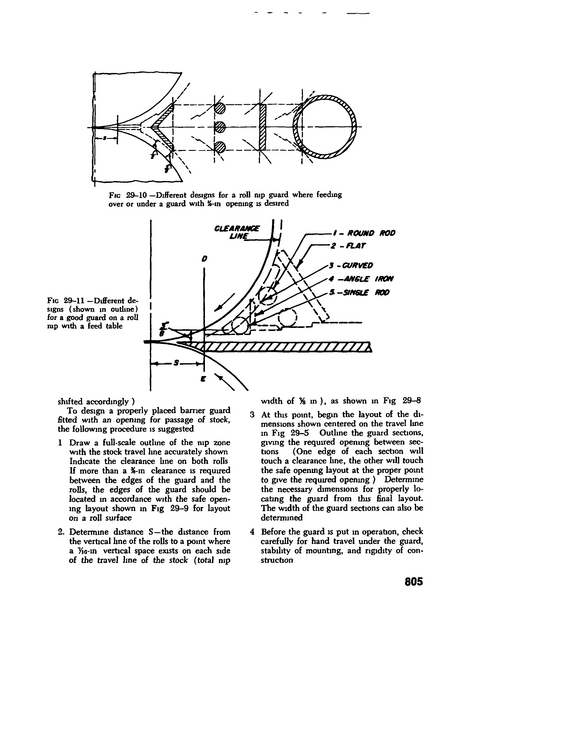
Fic 29-10 --Different designs for a roll nip guard where feeding over or under a guard with 5a-in opening is desired Fic 29-11 --Different de signs (shown in outline) for a good guard on a roll nip with a feed table shifted accordingly ) To design a properly placed barrier guard fitted with an opening for passage of stock, the following procedure is suggested 1 Draw a full-scale outline of the nip zone with the stock travel line accurately shown Indicate the clearance line on both rolls If more than a %-in clearance is required between the edges of the guard and the rolls, the edges of the guard should be located m accordance with the safe open ing layout shown in Fig 29-9 for layout on a roll surface 2.
refid# EqVGLj4L4YN4g51jjjqgEd1501 page
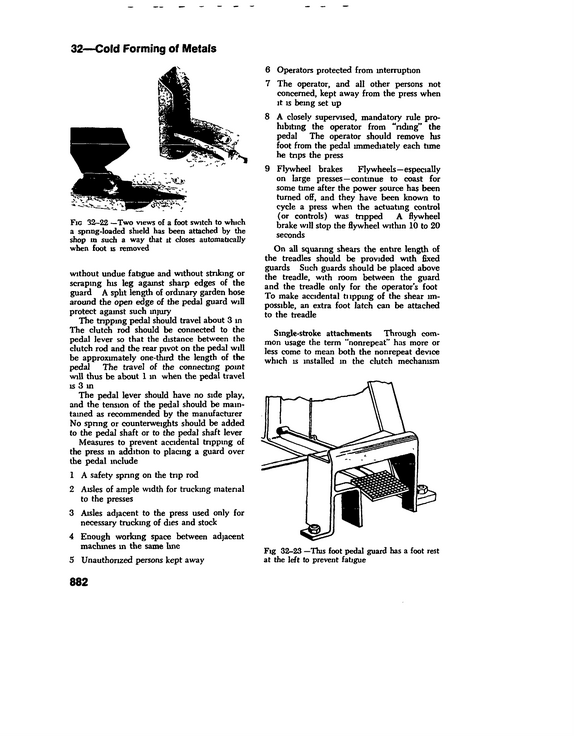
32--Cold Forming of Metals Fig 32-22 --Two views of a foot switch to which a spring-loaded shield has been attached by the shop in such a way that it closes automatically when foot is removed without undue fatigue and without striking or scraping his leg against sharp edges of the guard A split length of ordinary garden hose around the open edge of the pedal guard will protect against such injury The tripping pedal should travel about 3 in The clutch rod should be connected to the pedal lever so that the distance between the clutch rod and the rear pivot on the pedal will be approximately one-third the length of the pedal The travel of the connecting point will thus be about 1 in when the pedal travel is 3 in The pedal lever should have no side play, and the tension of the pedal should be mamtamed as recommended by the manufacturer No spring or counterweights should be added to the pedal shaft or to the pedal shaft lever Measures to prevent accidental tripping of the press in addition to placing a guard over the pedal include 1 A safety spnng on the tnp rod 2 Aisles of ample width for trucking material to the presses 3 Aisles adjacent to the press used only for necessary trucking of dies and stock 4 Enough working space between adjacent machines m the same line 5 Unauthorized persons kept away 882 6 Operators protected from interruption 7 The operator, and all other persons not concerned, kept away from the press when it is being set up 8 A closely supervised, mandatory rule pro hibiting the operator from "riding" the pedal The operator should remove his foot from the pedal immediately each time he trips the press 9 Flywheel brakes Flywheels--especially on large presses--continue to coast for some time after the power source has been turned off, and they have been known to cycle a press when the actuating control (or controls) was tnpped A flywheel brake will stop the flywheel within 10 to 20 seconds On all squaring shears the entire length of the treadles should be provided with fixed guards Such guards should be placed above the treadle, with room between the guard and the treadle only for the operator's foot To make accidental tupping of the shear im possible, an extra foot latch can be attached to the treadle Single-stroke attachments Through com mon usage the term "nonrepeat" has more or less come to mean both the nonrepeat device which is installed in the clutch mechanism Fig 32-23 --This foot pedal guard has a foot rest at the left to prevent fatigue
refid# By686pXmm3E8rYBKerkGwJkJ41 page
Dust is generated in many foundry proc esses and presents a two-fold problem clean ing to .remove deposits and control at the point of origin to prevent further accumulation Some foundries have found water under pressure or mixed with steam to be a good cleaning agent A combination water and compressed air hose with a special nozzle also does a good job With this method, how ever, workers should wear approved respi rators, see Chapter 19, "Personal Protective Equipment " In any case, water cleaning should not be done during or immediately before melting and pounng These opera tions should be started only after all equip ment has been allowed to dry thoroughly Vacuum cleaning is probably the most satis factory method used for dust removal in found ries, and the special equipment needed is well worth the investment Once dust has been removed, further ac cumulation can be prevented by local ex haust systems which remove it at the point of origin See the discussion m Chapter 36, "Ex haust and Ventilation '' Solvents include many different substances, each of which must be evaluated on the basis of its chemical ingredients Proper labeling, limitations on quantities in use, and other methods of control as detailed m Chapter 37, "Industrial Hygiene," can help minimize the toxic and flammable hazards involved m sol vent use Other materials.
refid# ZBdYEqzkNQBOXeR1DN6by4eg71 page
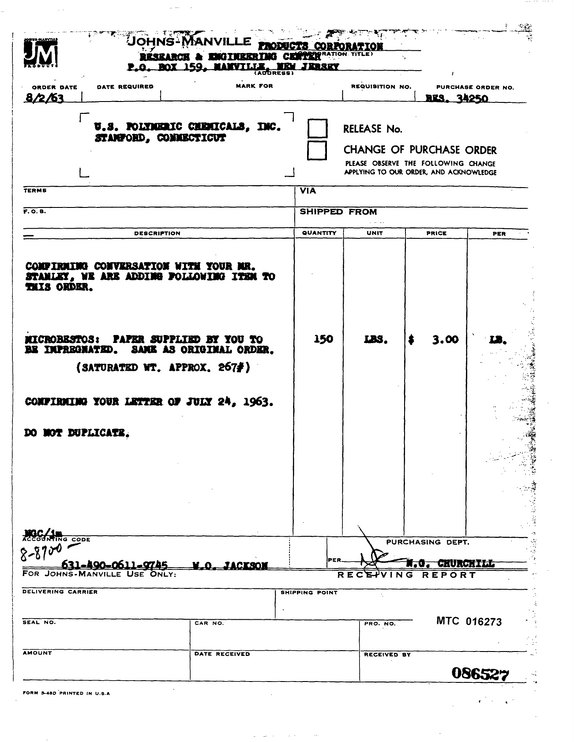
The B/L NO.
refid# Vk3wbe5NZ0o1OzN7R33xK5dN2 pages
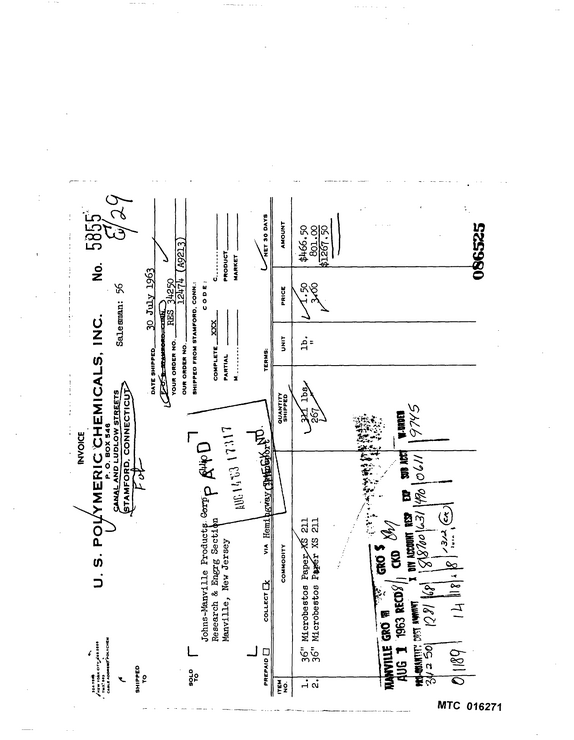
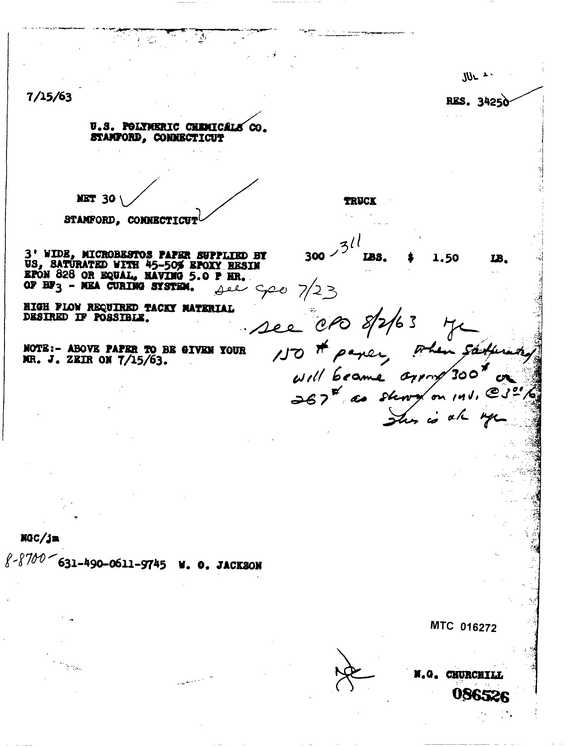
- \F 088524 & MTC 016270 086525 MTC 016271 MTC 016272 M.O.
refid# nmQj7gGGMK2rkzbzRK2Kw3OB210 pages
/ LI PLAINTIFFS (I EXHIBIT I JM 1028 /h C j 0 MTC 016895 i f f - 1nr- ' r- *# ' .-.
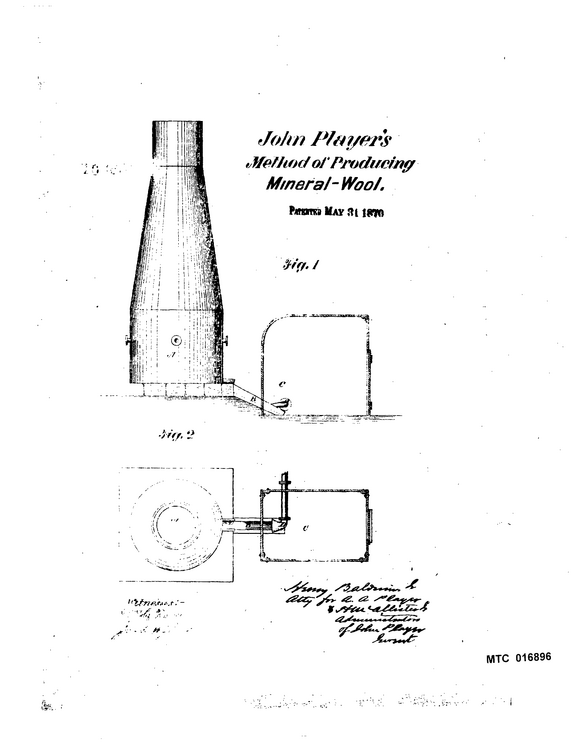
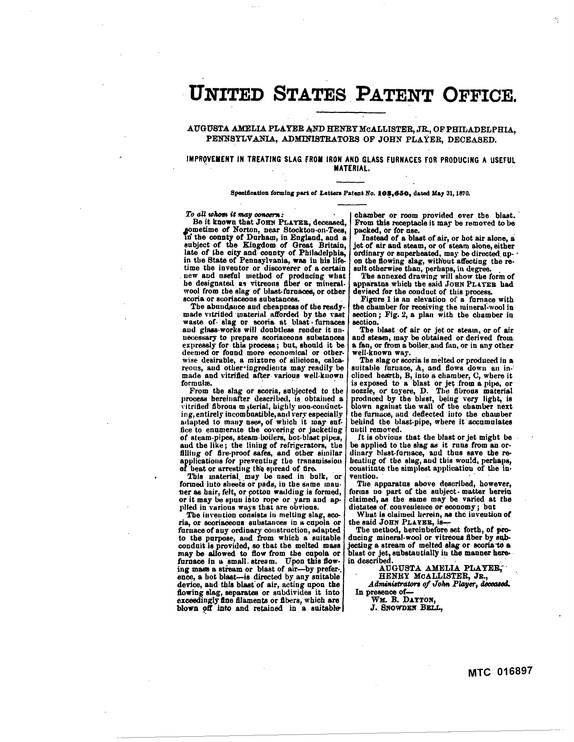
refid# x5OegMKezZ5wan8yLeEvdZD6J3 pages
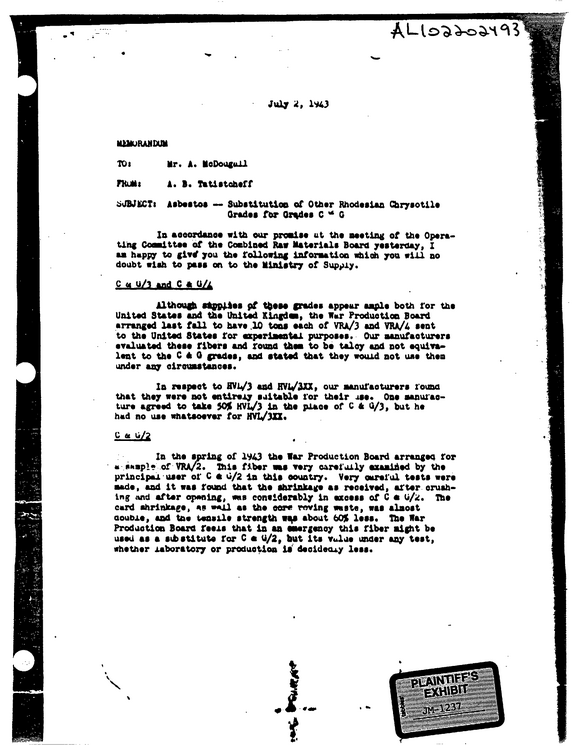
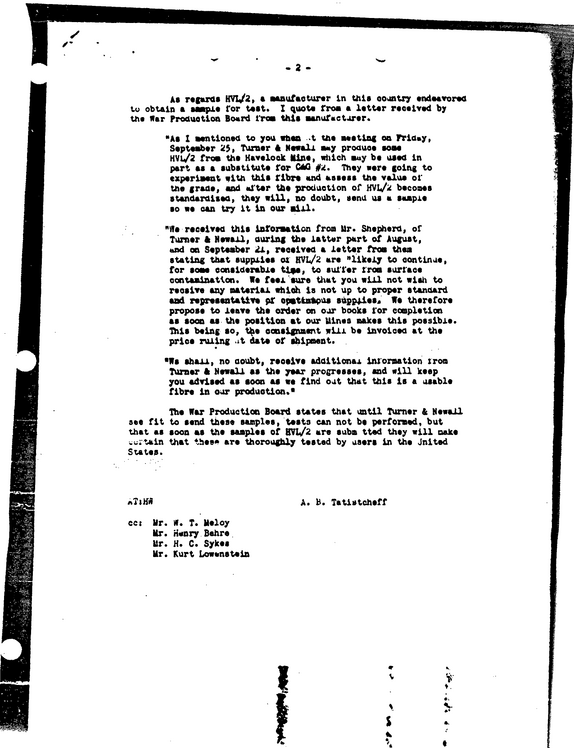
July Z, 1*43 UUtuRAKDUM TOi Mr.
refid# 6axYoadOgragpj9L1Bgkwb732 pages
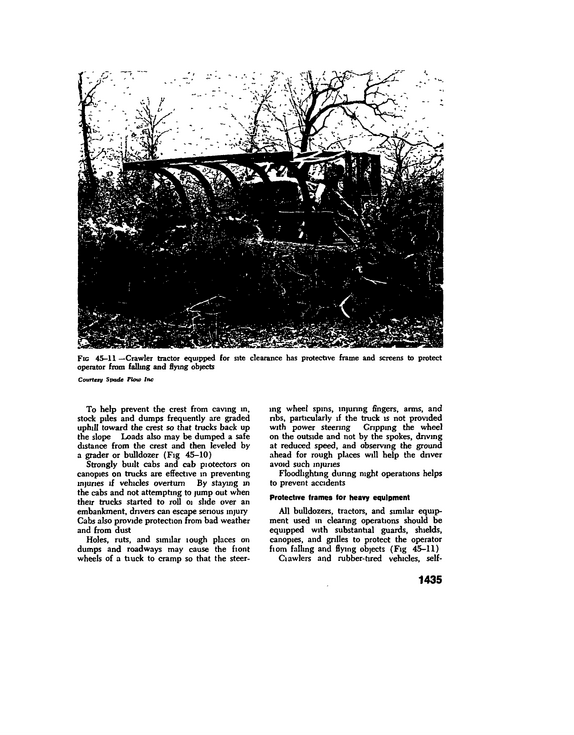
Fic 45-11 --Crawler tractor equipped for site clearance has protective frame and screens to protect operator from falling and flying objects Courtesy Spade Plow Inc To help prevent the crest from caving in, stock piles and dumps frequently are graded uphill toward the crest so that trucks back up the slope Loads also may be dumped a safe distance from the crest and then leveled by a grader or bulldozer (Fig 45-10) Strongly built cabs and cab piotectors on canopies on trucks are effective in preventing injuries if vehicles overturn By staying in the cabs and not attempting to jump out when their trucks started to roll 01 slide over an embankment, drivers can escape serious injury Cabs also provide protection from bad weather and from dust Holes, ruts, and similar lough places on dumps and roadways may cause the fiont wheels of a tiuck to cramp so that the steer ing wheel spins, injuring fingers, arms, and nbs, particularly if the truck is not provided with power steering Gripping the wheel on the outside and not by the spokes, driving at reduced speed, and observing the ground ahead for rough places will help the driver avoid such injuries Floodlighting dunng night operations helps to prevent accidents Protective frames for heavy equipment All bulldozers, tractors, and similar equip ment used in clearing operations should be equipped with substantial guards, shields, canopies, and grilles to protect the operator fiom falling and flying objects (Fig 45-11) Ciawlers and rubber-tired vehicles, self- 1435
refid# gbEOdnJ1xgx1Jp8V5wwnZkM4Q1 page
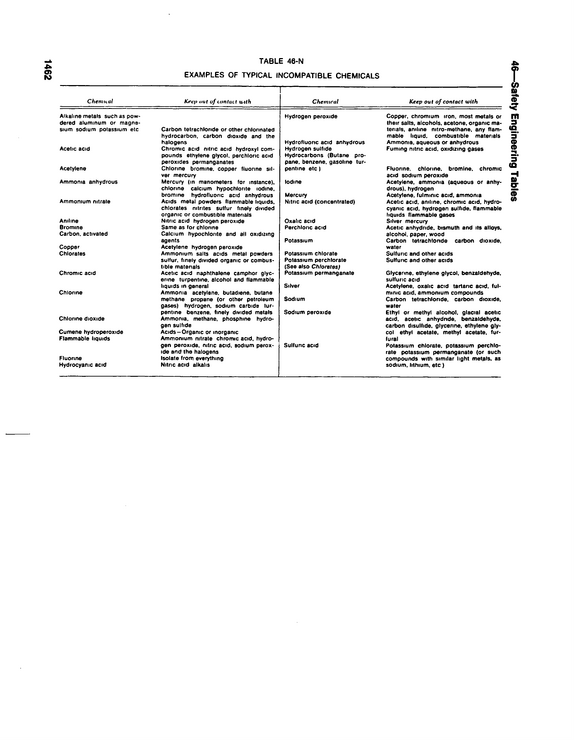
46-- Safety Engineering Tables 1462 TABLE 46-N EXAMPLES OF TYPICAL INCOMPATIBLE CHEMICALS Chemual Alkaline metals such as pow dered aluminum or magnesium sodium potassium etc Acetic acid Acetylene Ammonia anhydrous Ammonium nitrate Aniline Bromine Carbon, activated Copper Chlorates Chromic acid Chlorine Chlorine dioxide Cumene hydroperoxide Flammable liquids Fluorine Hydrocyanic acid Keep out of umtuct u-tth Chemiral Hydrogen peroxide Carbon tetrachloride or other chlorinated hydrocarbon, carbon dioxide and the halogens Chromic acid nitric acid hydroxyl com pounds ethylene gtycot. perchloric acid peroxides permanganates Chlorine bromine, copper fluonne sil ver mercury Mercury (in manometers for instance), chlorine calcium hypochlorite iodine. bromine hydrofluoric acid anhydrous Acids metal powders flammable liquids, chlorates nitrites sulfur finely divided organic or combustible materials Nitric acid hydrogen peroxide Same as for chlonne Calcium hypochlorite and all oxidizing agents Acetylene hydrogen peroxide Ammonium salts acids metal powders sulfur, finely divided organic or combus tible matenals Acetic acid naphthalene camphor glyc erine turpentine, alcohol and flammable liquids in general Ammonia acetylene, butadiene, butane methane propane (or other petroleum gases) hydrogen, sodium carbide turpentine benzene, finely divided metals Ammonia, methane, phosphine hydro gen sulfide Acids-Organic or inorganic Ammonium nitrate chromic acid, hydrogen peroxide, nitric acid, sodium perox ide and the halogens Isolate from everything Nitric acid alkalis Hydrofluonc acid anhydrous Hydrogen sulfide Hydrocarbons (Butane pro pane. benzene, gasoline turpentine etc) Iodine Mercury Nitric acid (concentrated) Oxalic acid Perchloric acid Potassium Potassium chlorate Potassium perchlorate (See also Chlorates) Potassium permanganate Silver Sodium Sodium peroxide Sulfunc acid Keep out of contoct with Copper, chromium iron, most metals or their salts, alcohols, acetone, organic matenals, aniline mtro-methane. any flam mable liquid, combustible materials Ammonia, aqueous or anhydrous Fuming mtnc acid, oxidizing gases Fluorine, chlorine, bromine, chromic acid sodium peroxide Acetylene, ammonia (aqueous or anhy drous). hydrogen Acetylene, fulmtmc acid, ammonia Acetic acid, aniline, chromic acid, hydro cyanic acid, hydrogen sulfide, flammable liquids flammable gases Silver mercury Acetic anhydride, bismuth and its alloys. alcohol, paper, wood Carbon tetrachlonde carbon dioxide, water Sulfunc and other acids Sulfuric and other acids Glycerine, ethylene glycol, benzaldehyde. sulfuric acid Acetylene, oxalic acid tartaric acid, fulmime acid, ammonium compounds Carbon tetrachlonde. carbon dioxide, water Ethyl or methyl alcohol, glacial acetic acid, acetic anhydnde, benzaldehyde. carbon disulfide, glycenne, ethylene glycol ethyl acetate, methyl acetate, furfural Potassium chlorate, potassium perchlo rate potassium permanganate (or such compounds with similar light metals, as sodium, lithium, etc)
refid# kmzZOEgrgywO8m2v9B5mxQVEb1 page