Refine
Estimated Years UndatedClear
92,592 results foundRefine Search
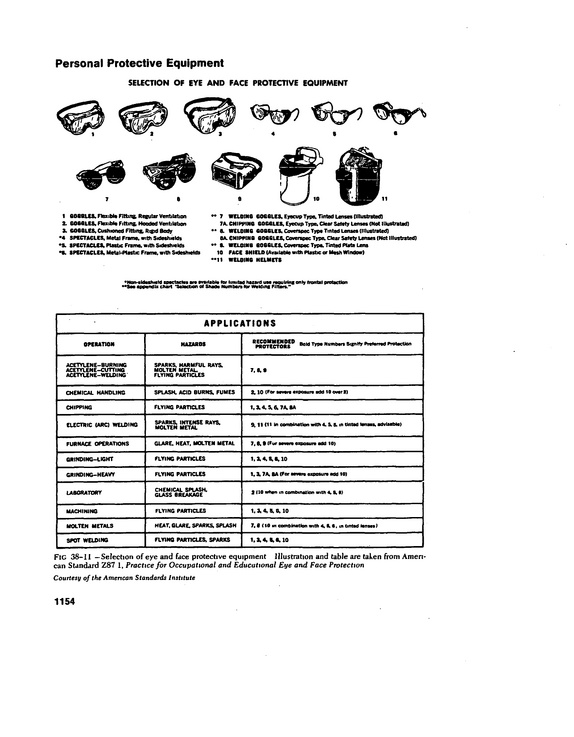
Personal Protective Equipment SELECTION OF EYE AND FACE PROTECTIVE EQUIPMENT m 1 GOGGLES, Flexible Fitting, Regular Ventilation 2.
refid# oeY6nm1YK3wZE5bx8bkBKGnJo1 page
pitalizahon and for those cases requiring hospitalization that fall within his compe tence (He frequently uses specialists as consultants Severe cases are usually sent to them) Frequently, the on-call physician has sim ilar arrangements to serve a number of com panies in the vicinity--a particularly con venient system with the small-plant or small-company clusters, such as m industrial parks It is not unusual to find physicians special izing m the care of industrial injuries and diseases, and the provision of occupational medical services m some manufacturing centers Consulting service is usually reserved for diagnosis and treatment of serious in juries, illnesses, toxicological problems, and special kinds of injuries or disorders (such as eye injuries) that require the services of a specialist State and local health departments often supply, without charge, medical, nursing, and engineering consultation, as well as make industrial hygiene and radiological surveys to industries within their areas Many insurance companies also provide this type of service to their clients Duties of the industnal physician An effective medical service program should be planned by the medical director, with the approval of management Full support of management can only be obtained when management is sympathetic to a cause that reflects management's policies Only then is it possible to establish and maintain an adequate professional staff and facilities for examinations, emergency cases, and stor age of records Also, the medical director must be given enough authority so that work ers will respect his judgment and follow his instructions on personal health and safety The industrial physician, accompanied by the nurse, should inspect the working areas regularly to acquaint himself with all jobs, materials, and processes that are used Known as an industnal hygiene survey, this inventory of plant hazards will help the phy sician suggest to the safety director ways to protect employees from actually or potentially harmful environments This basic knowledge will also aid the in dustnal physician when he recommends placement of employees in jobs that are suited to their mental, emotional, and phy sical fitness This knowledge is especially useful in placing handicapped workers (More details later in this chapter ) The physician should be involved m other company services that relate to health of workers, such as food service, welfare serv ice, safety program, and sanitation He can also initiate and be responsible for sponsor ship of company-wide immunization pro grams (against tetanus, polio, or flu) as well as tor blood donor and chest X-ray programs Maintenance of the true physician-patient relationship with fairness to both employee and employer is essential to the success of any occupational health program workmen should receive the same courtesy and profes sional honesty as do private patients The first meeting of physician and employee usually occurs at the preplacement examina tion and this meeting may be followed up by subsequent examinations The exami ning physician m his professional discretion should acquaint the examinee with the re sults of these examinations and, if necessary, refer him to his own personal physician for correction of defects The industnal physician should provide emergency medical care for all employees who are injured or become ill on the job, and he should arrange for the necessary followup treatment of employees suffenng from oc cupational disease or injuries The treat ment of employee injuries or diseases not industrially induced is the function of pnvate medical practice Therefore, the indus tnal physician should abstain from render ing such services except where independent facilities are not readily available, or where the ailment or discomfort is so minor that the employee would ordinanly not seek medical attention, or where the rendering of such service would enable an employee to com plete a shift The industrial physician should not de vote time or facilities to diagnose or treat dependents of all employees He should, however, promote health education programs for employees and their families so that they will be encouraged to seek proper private consultation 1225
refid# 3eM41kYRaZ1eO9pjxYd1KgbZ31 page
Physical classification.
refid# RaBaBoq7MK9vz3wR3nDokbv2z1 page
!
refid# 85QxJpN3jn0XrjL4zQeVM2xbk1 page
:?.
refid# LgL1GjKmQnBk1eV7jj98ZpQLw1 page
-5 tad filter say be sees in Figure 3.
refid# NGz8NG0EOjL6xMzJ4dp5r1dRg1 page
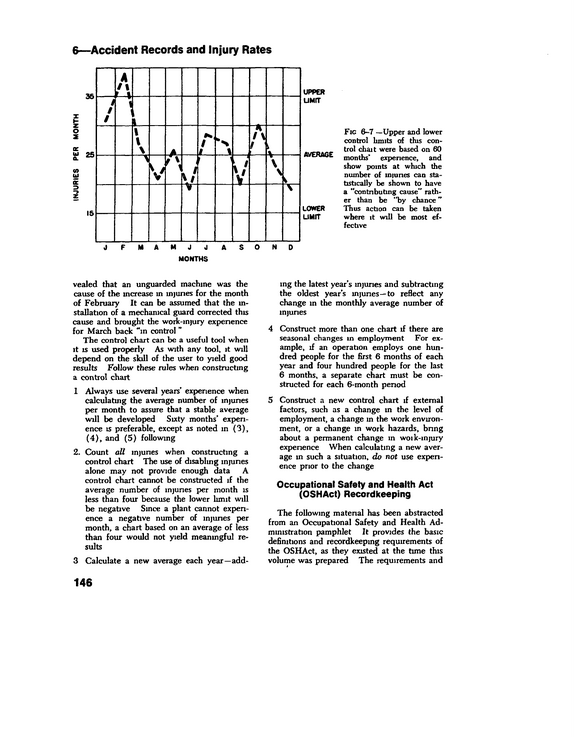
6--Accident Records and Injury Rates /A1 r 1 t* / /1 1 1\\ V A '\ , v' r i< 15 UPPER UMIT /h\ \t '\ 'j \\ \ AVERAGE LOWER UMIT Fic 6-7 --Upper and lower control limits of this con trol chait were based on 60 months* experience, and show points at which the number of iniunes can sta tistically be shown to have a "contributing cause" rath er than be "by chance " Thus action can be taken where it will be most ef fective J F M A M J J ASOND MONTHS vealed that an unguarded machine was the cause of the increase in injuries for the month of February It can be assumed that the in stallation of a mechanical guard corrected this cause and brought the work-injury experience for March back "in control " The control chart can be a useful tool when it is used properly As with any tool, it will depend on the skill of the user to yield good results Follow these rules when constructing a control chart 1 Always use several years' experience when calculating the average number of injuries per month to assure that a stable average will be developed Sixty months' experi ence is preferable, except as noted m (3), (4), and (5) following 2.
refid# YGxKz34ZKBbMZROpV0Q3LbrYD1 page
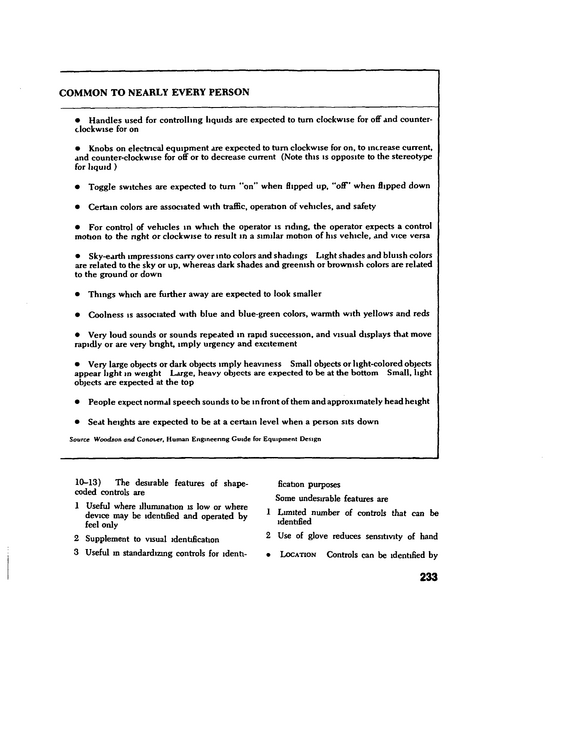
COMMON TO NEARLY EVERY PERSON Handles used for controlling liquids are expected to turn clockwise for off and counter clockwise for on Knobs on electrical equipment are expected to turn clockwise for on, to increase current, and counter-clockwise for off or to decrease current (Note this is opposite to the stereotype for liquid ) Toggle switches are expected to turn "on'' when flipped up, "off' when flipped down Certain colors are associated with traffic, operation of vehicles, and safety For control of vehicles in which the operator is riding, the operator expects a control motion to the right or clockwise to result in a similar motion of his vehicle, and vice versa Sky-earth impressions carry over into colors and shadings Light shades and bluish colors are related to the sky or up, whereas dark shades and greenish or brownish colors are related to the ground or down Things which are further away are expected to look smaller Coolness is associated with blue and blue-green colors, warmth with yellows and reds Very loud sounds or sounds repeated in rapid succession, and visual displays that move rapidly or are very bright, imply urgency and excitement Very large objects or dark objects imply heaviness Small objects or light-colored objects appear light m weight Large, heavy objects are expected to be at the bottom Small, light objects are expected at the top People expect normal speech sounds to be in front of them and approximately head height Seat heights are expected to be at a certain level when a person sits down Source Woodson and Conover, Human Engineering Guide for Equipment Design 10-13) The desirable features of shapecoded controls are 1 Useful where illumination is low or where device may be identified and operated by feel only 2 Supplement to visual identification 3 Useful in standardizing controls for identi fication purposes Some undesirable features are 1 Limited number of controls that can be identified 2 Use of glove reduces sensitivity of hand Location Controls can be identified by 233
refid# 65BQQoywx0YL5eXv1voXG47211 page
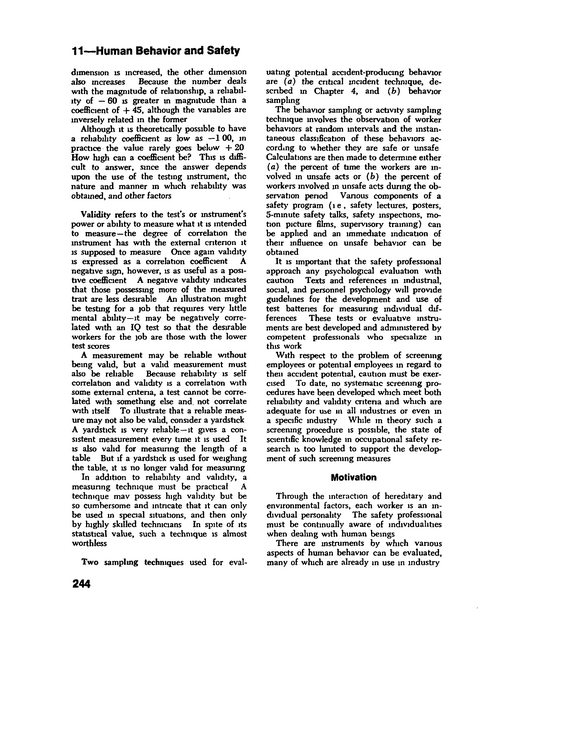
11--Human Behavior and Safety dimension is increased, the other dimension also increases Because the number deals with the magnitude of relationship, a reliabil ity of -- 60 is greater in magnitude than a coefficient of + 45, although the variables are inversely related in the former Although it is theoretically possible to have a reliability coefficient as low as --1 00, m practice the value rarely goes below + 20 How high can a coefficient be?
refid# peeqj6Z33pvvL0LdR0Mebn8X71 page
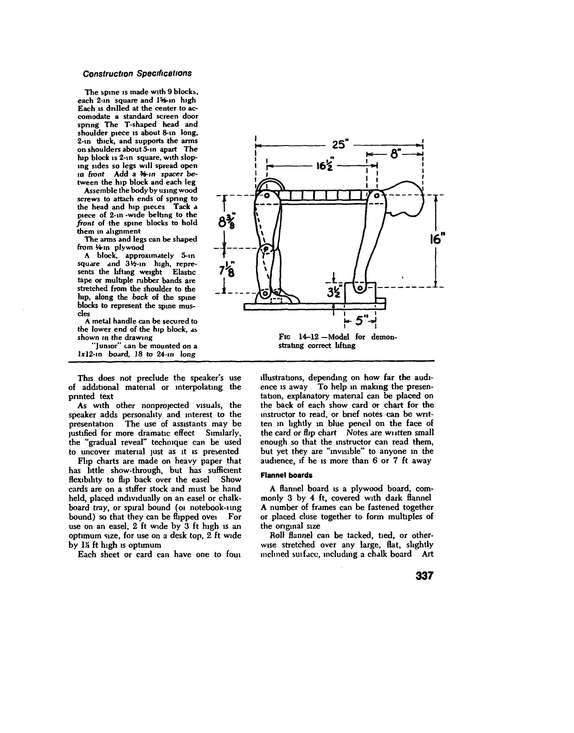
Construction Specifications The spine is made with 9 blocks, each 2-m square and 1%-in high Each is drilled at the center to ac comodate a standard screen door spring The T-shaped head and shoulder piece is about 8-in long, 2-in thick, and supports the arms on shoulders about 5-in apart The hip block is 2-in square, with slop ing sides so legs will spread open id front Add a W-in spacer be tween the hip block and each leg Assemble the body by using wood screws to attach ends of spring to the head and hip pieces Tack a piece of 2-in -wide belting to the front of the spine blocks to hold them in alignment The arms and legs can be shaped from Win plywood A block, approximately 5-in square and 3ki-in high, repre sents the lifting weight Elastic tape or multiple rubber bands are stretched from the shoulder to die hip, along the hack of the spine blocks to represent the spine mus cles A metal handle can be secured to the lower end of the hip block, as shown in the drawing "Junior" can be mounted on a lx!
refid# e7z97wmGDJvQyGQgYpvYda28E1 page
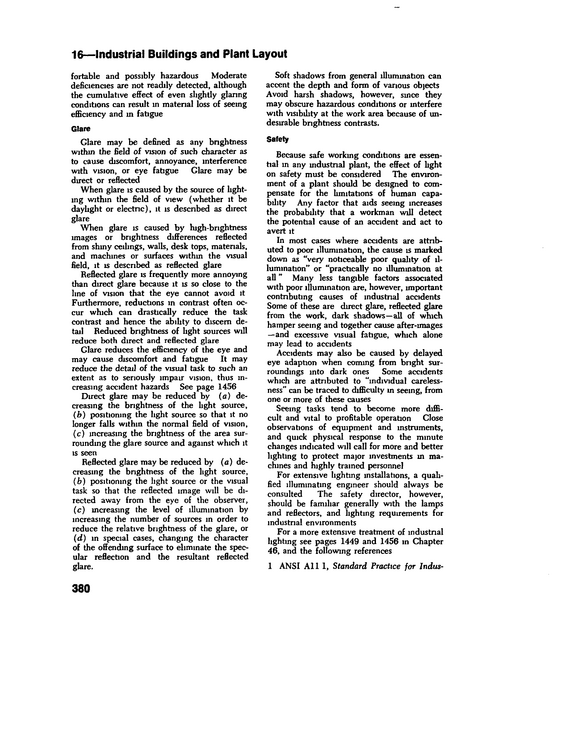
16--Industrial Buildings and Plant Layout fortable and possibly hazardous Moderate deficiencies are not readily detected, although the cumulative effect of even slightly glaring conditions can result in material loss of seeing efficiency and m fatigue Glare Clare may be defined as any brightness within the field of vision of such character as to cause discomfort, annoyance, interference with vision, or eye fatigue Glare may be direct or reflected When glare is caused by the source of light ing within the field of view (whether it be daylight or electnc), it is described as direct glare When glare is caused by high-brightness images or brightness differences reflected from shiny ceilings, walls, desk tops, materials, and machines or surfaces within the visual field, it is described as reflected glare Reflected glare is frequently more annoying than direct glare because it is so close to the line of vision that the eye cannot avoid it Furthermore, reductions in contrast often oc cur which can drastically reduce the task contrast and hence the ability to discern de tail Reduced brightness of light sources will reduce both direct and reflected glare Clare reduces the efficiency of the eye and may cause discomfort and fatigue It may reduce the detail of the visual task to such an extent as to seriously impair vision, thus in creasing accident hazards See page 1456 Direct glare may be reduced by (a) de creasing the brightness of the light source, (b) positioning the light source so that it no longer falls within the normal field of vision, (c) increasing the brightness of the area sur rounding the glare source and against which it is seen Reflected glare may be reduced by (a) de creasing the brightness of the light source, (b) positioning the light source or the visual task so that the reflected image will be di rected away from the eye of the observer, (c) mcreasing the level of illumination by increasing the number of sources in order to reduce the relative brightness of the glare, or (d) in special cases, changing the character of the offending surface to eliminate the spec ular reflection and the resultant reflected glare.
refid# Xz2NYzwqBM5xeOYoEvqg3979R1 page
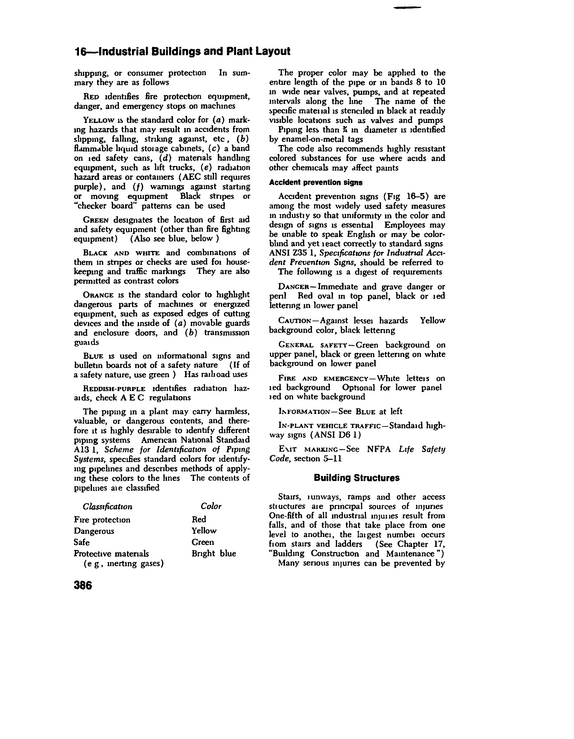
16--Industrial Buildings and Plant Layout shipping, or consumer protection In sum mary they are as follows Red identifies fire protection equipment, danger, and emergency stops on machines Yellow is the standard color for (a) mark ing hazards that may result m accidents from slipping, falling, striking against, etc, (b) flammable liquid stoiage cabinets, (c) a band on led safety cans, (d) materials handling equipment, such as lift trucks, (e) radiation hazard areas or containers (AEC still requires purple), and (/) warnings against starting or moving equipment Blade stnpes or "checker board" patterns can be used Green designates the location of first aid and safety equipment (other than fire fighting equipment) (Also see blue, below ) Black and white and combinations of them in stnpes or checks are used foi house keeping and traffic markings They are also permitted as contrast colors Orance is the standard color to highlight dangerous parts of machines or energized equipment, such as exposed edges of cutting devices and the inside of (a) movable guards and enclosure doors, and (b) transmission guaids Blue is used on informational signs and bulletin boards not of a safety nature (If of a safety nature, use green ) Has raihoad uses Reddish-purple identifies radiation liazaids, check AEC regulations The piping in a plant may carry harmless, valuable, or dangerous contents, and there fore it is highly desirable to identify different piping systems American National Standaid A13 1, Scheme for Identification of Piping Systems, specifies standard colors for identify ing pipelines and describes methods of apply ing these colors to the lines The contents of pipelines aie classified Classification Fire protection Dangerous Safe Protective materials (eg, inerting gases) Color Red Yellow Green Bright blue The proper color may be applied to the entire length of the pipe or in bands 8 to 10 in wide near valves, pumps, and at repeated intervals along the line The name of the specific mateual is stenciled in black at readdy visible locations such as valves and pumps Piping less than in diameter is identified by enamel-on-metal tags The code also recommends highly resistant colored substances for use where acids and other chemicals may affect paints Accident prevention signs Accident prevention signs (Fig 16-5) are among the most widely used safety measures m mdustiy so that uniformity in the color and design of signs is essential Employees may be unable to speak English or may be color blind and yet leact correctly to standard signs ANSI Z35 1, Specifications for Industrial Acci dent Prevention Signs, should be referred to The following is a digest of requirements Dancer--Immediate and grave danger or peril Red oval in top panel, black or led lettering in lower panel Caution--Against lessei hazards Yellow background color, black lettering General safety--Green background on upper panel, black or green lettering on white background on lower panel Fire and emergency--White letteis on led background Optional for lower panel led on white background Information--See Blue at left In-plant vehicle traffic--Standaid high way signs (ANSI D6 1) E\it marking--See NFPA Life Safety Code, section 5-11 Building Structures Stairs, mnways, ramps and other access stiuctures aie principal sources of injuries One-fifth of all industrial injuiies result from falls, and of those that take place from one level to anothei, the hugest numbei occurs from stairs and ladders (See Chapter 17, "Building Construction and Maintenance ") Many serious injuries can be prevented by 386
refid# gb29Roypyyen1dmrzQR7R2emJ1 page
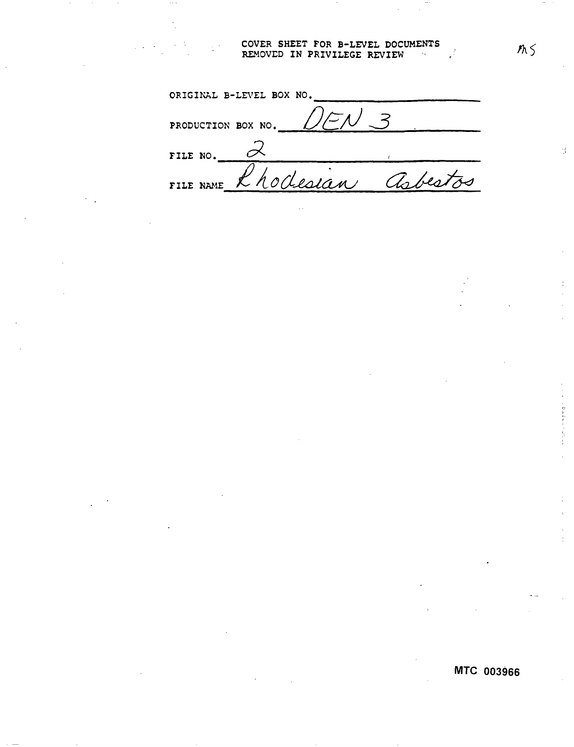
MTC 003965 COVER SHEET FOR B-LEVEL DOCUMENTS REMOVED IN PRIVILEGE REVIEW ' ORIGINAL B-LEVEL BOX NO.
refid# Rj6VKEbqLzjw4OEp8a06yxBQB84 pages
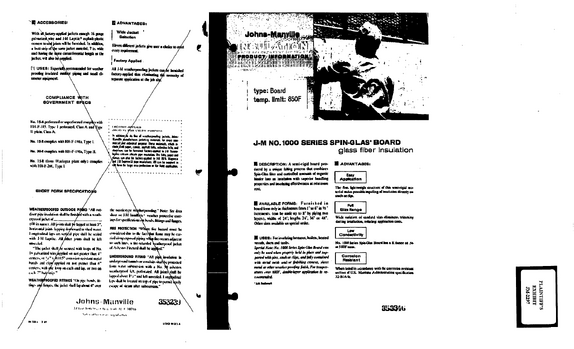
'B ACCESSORIES: With aHfacUry-applied jackets cm|h 16 gonge galvaniiMywire and J-M Laptik* asphak-plaitic cement to teal joints 1 be furnished.
refid# Oz8aJoeEj92LBEGr293OzKrxX2 pages
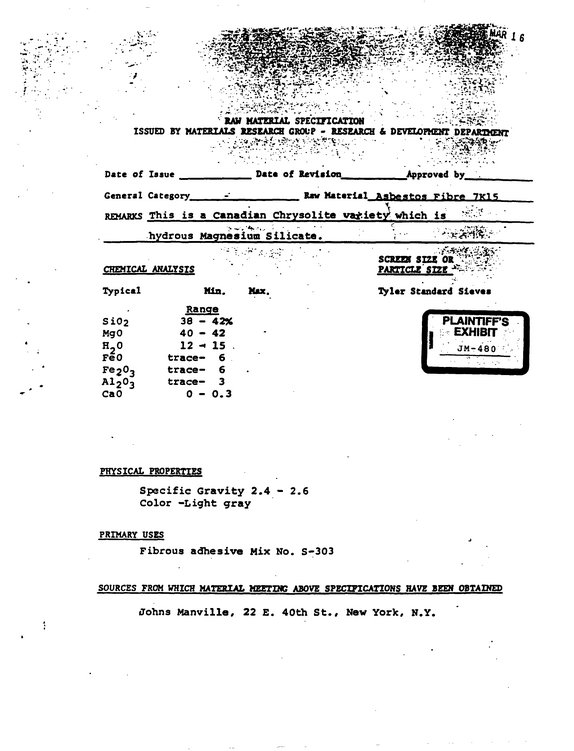
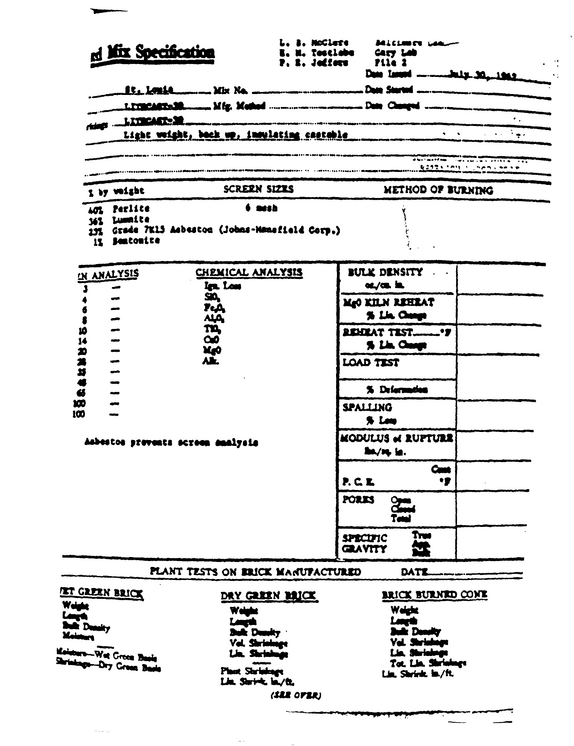
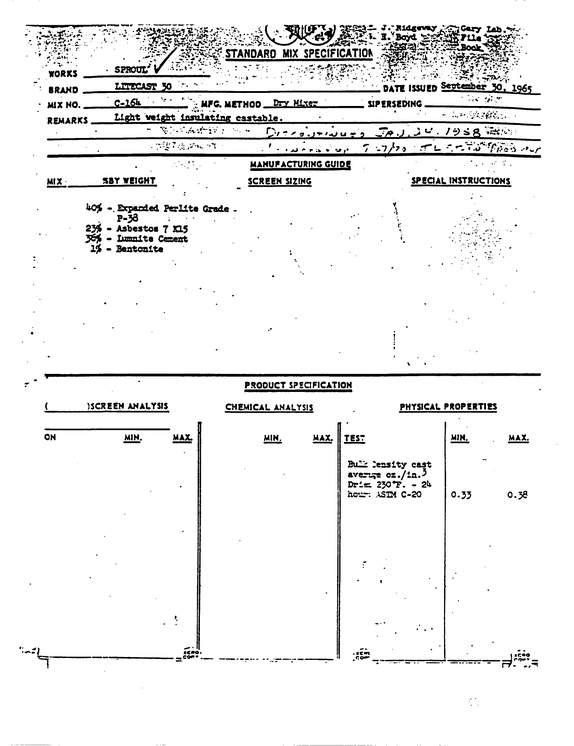
BAH MATERIAL SPECIFICATION ISSUED BY MATERIALS RESEARCH GROUP - RESEARCH & DEVELOPMENT DEPARTMENT * v r'-\*.........
refid# pB6E5djL65w9X6QyxrJoEV9Jk7 pages