Refine
Estimated Years UndatedClear
92,592 results foundRefine Search
BOX NUMBER CODES MTC 010679 V.--" i-j MTC 010681 'i?

refid# MGD8JwGr2aav18LYZM0ZLy4Nj6 pages
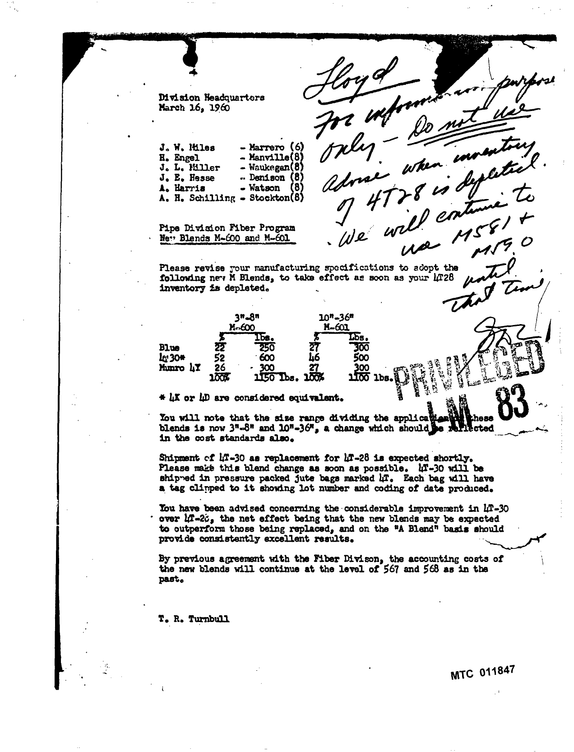
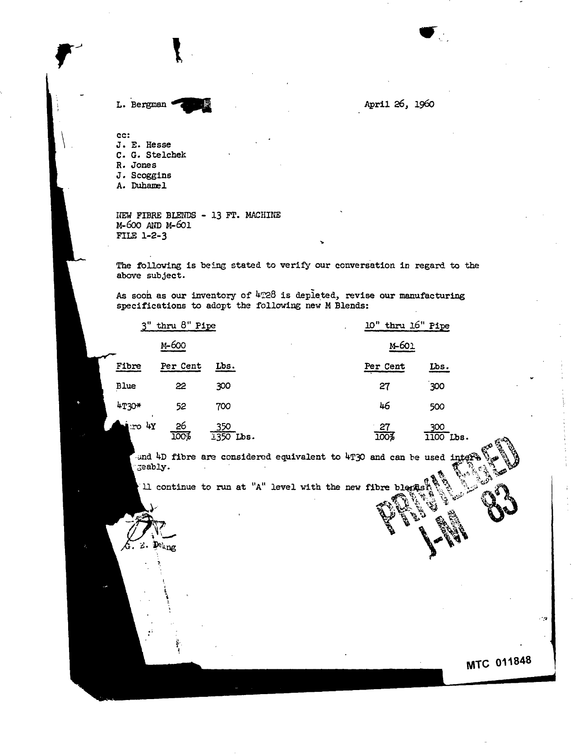
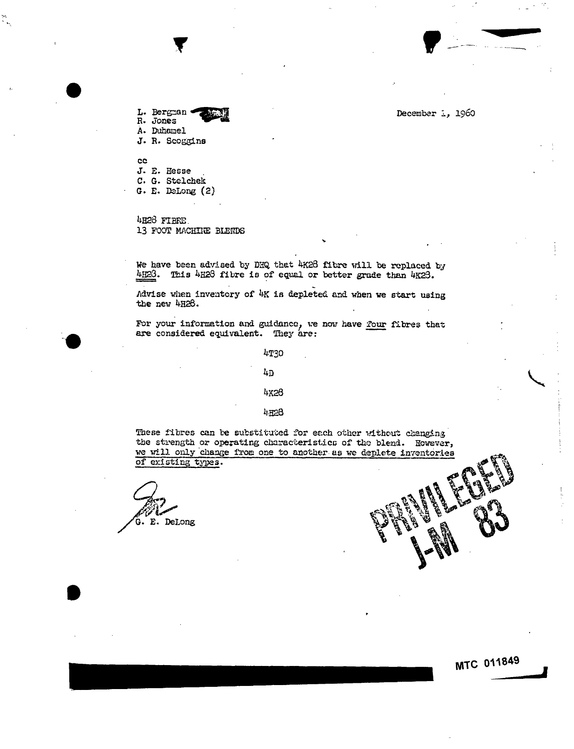
MTC 011846 Division Headquarters March 16, I960 Jo W.
refid# X8R9Ev51NEOyGr2rnJzRq8nJw360 pages
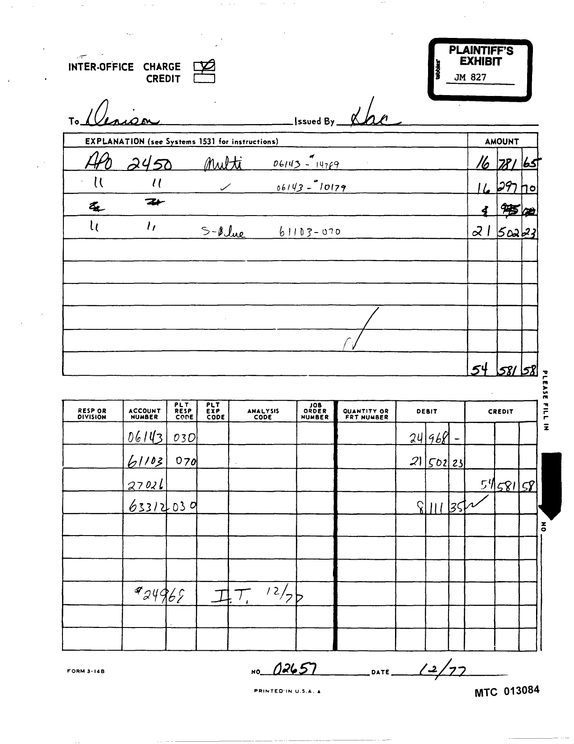
INTER-OFFICE CHARGE CREDIT ATo, jv^ Issued By EXPLANATION (see Systems 1531 for instructions) /-!
refid# aygBrxwBbOw5RN8pwkn59gVX6 pages
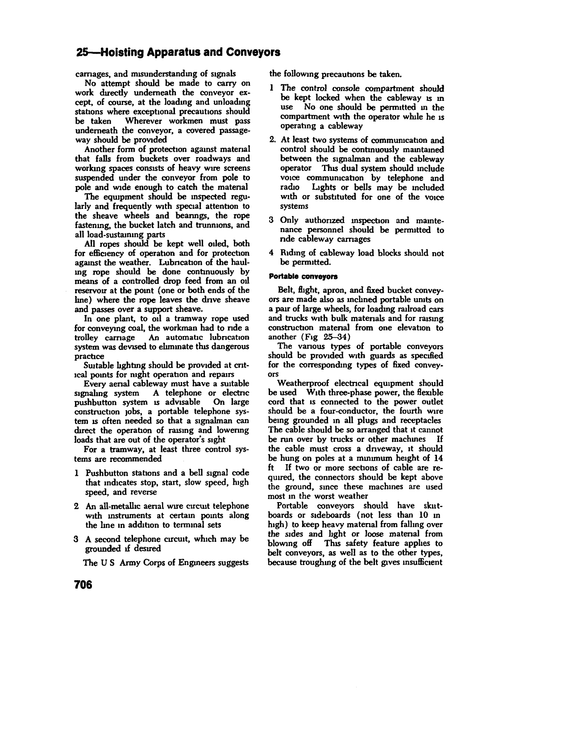
25--Hoisting Apparatus and Conveyors carnages, and misunderstanding of signals No attempt should be made to carry on work directly underneath the conveyor ex cept, of course, at the loading and unloading stations where exceptional precautions should be taken Wherever workmen must pass underneath the conveyor, a covered passage way should be provided Another form of protection against material that falls from buckets over roadways and working spaces consists of heavy wire screens suspended under the conveyor from pole to pole and wide enough to catch the material The equipment should be inspected regu larly and frequently with special attention to the sheave wheels and bearings, the rope fastenmg, the bucket latch and trunnions, and all load-sustaining parts All ropes should be kept well oiled, both for efficiency of operation and for protection against the weather.
refid# npZyGXxJa1xXke32dYzZrV9181 page
'i 1?

refid# RKdjwm61R3bLMRybQeYXJpy713 pages
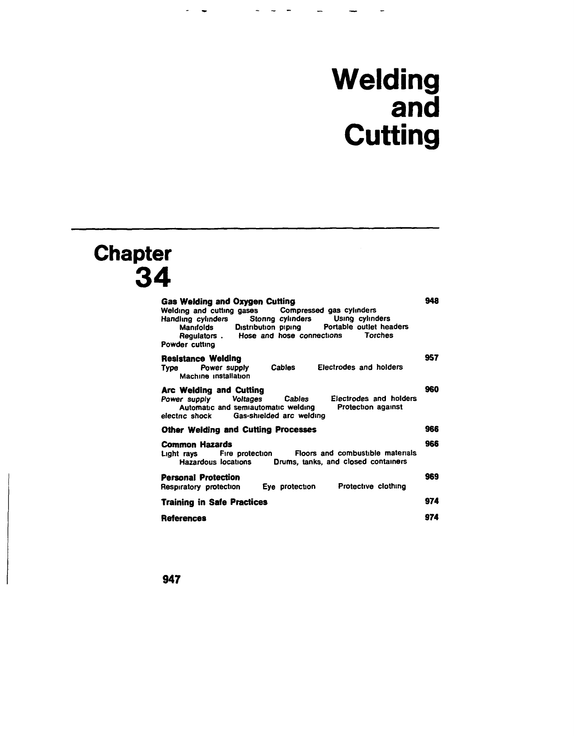
Welding and Cutting Chapter 34 Gas Welding and Oxygen Cutting Welding and cutting gases Compressed gas cylinders Handling cylinders Stonng cylinders Using cylinders Manifolds Distnbution piping Portable outlet headers Regulators .
refid# xz64OXX4aOkdMJoY7VVYGZVx01 page
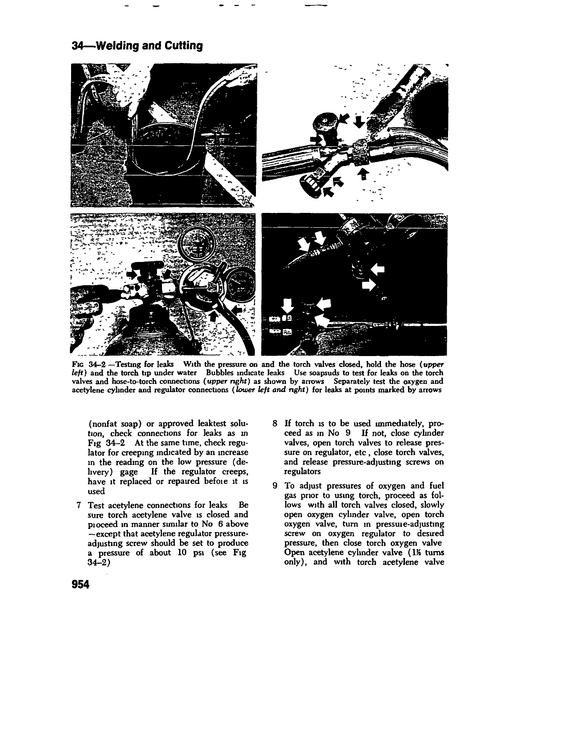
34--Welding and Cutting Fic 34-2 --Testing for leaks With the pressure on and the torch valves closed, hold the hose (upper left) and the torch tip under water Bubbles indicate leaks Use soapsuds to test for leaks on the torch valves and hose-to-torch connections (upper right) as shown by arrows Separately test the oxygen and acetylene cylinder and regulator connections (lower left and right) for leaks at points marked by arrows (nonfat soap) or approved leaktest solu tion, check connections for leaks as in Fig 34-2 At the same time, check regu lator for creeping indicated by an increase in the reading on the low pressure (de livery) gage If the regulator creeps, have it replaced or repaired befoie it is used 7 Test acetylene connections for leaks Be sure torch acetylene valve is closed and pioceed in manner similar to No 6 above --except that acetylene regulator pressure adjusting screw should be set to produce a pressure of about 10 psi (see Fig 34-2) 954 8 If torch is to be used immediately, pro ceed as in No 9 If not, close cylinder valves, open torch valves to release pres sure on regulator, etc, close torch valves, and release pressure-adjusting screws on regulators 9 To adjust pressures of oxygen and fuel gas prior to using torch, proceed as fol lows with all torch valves closed, slowly open oxygen cylinder valve, open torch oxygen valve, turn m pressuie-adjusting screw on oxygen regulator to desired pressure, then close torch oxygen valve Open acetylene cylinder valve (15 turns only), and with torch acetylene valve
refid# mB36EKZza51RezQLvBB7KoV1d1 page
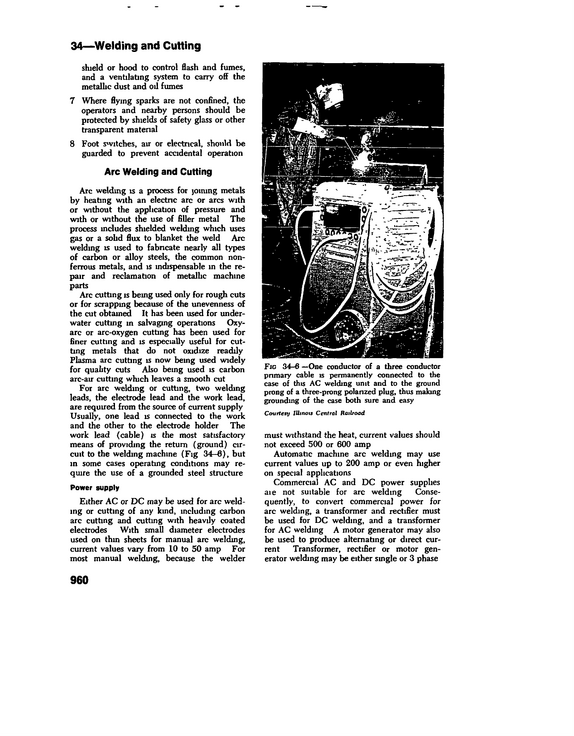
34--Welding and Cutting shield or hood to control flash and fumes, and a ventilating system to carry off the metallic dust and oil fumes 7 Where flying sparks are not confined, the operators and nearby persons should be protected by shields of safety glass or other transparent material 8 Foot switches, air or electrical, should be guarded to prevent accidental operation Arc Welding and Cutting Arc welding is a process for ynning metals by heating with an electric arc or arcs with or without the application of pressure and with or without the use of filler metal The process includes shielded welding which uses gas or a solid flux to blanket the weld Arc welding is used to fabricate nearly all types of carbon or alloy steels, the common nonferrous metals, and is indispensable in the re pair and reclamation of metallic machine parts Arc cutting is being used only for rough cuts or for scrapping because of the unevenness of the cut obtained It has been used for under water cutting m salvaging operations Oxyarc or arc-oxygen cutting has been used for finer cutting and is especially useful for cut ting metals that do not oxidize readily Plasma arc cutting is now being used widely for quality cuts Also being used is carbon arc-air cutting which leaves a smooth cut For arc welding or cutting, two welding leads, the electrode lead and the work lead, are required from the source of current supply Usually, one lead is connected to the work and the other to the electrode holder The work lead (cable) is the most satisfactory means of providing the return (ground) cir cuit to the welding machine (Fig 34--6), but in some cases operating conditions may re quire the use of a grounded steel structure Power supply Either AC or DC may be used for arc weld ing or cutting of any kind, including carbon arc cutting and cutting with heavily coated electrodes With small diameter electrodes used on thin sheets for manual arc welding, current values vary from 10 to 50 amp For most manual welding, because the welder 960 Fic 34-6 --One conductor of a three conductor pnmary cable is permanently connected to the case of this AC welding unit and to the ground prong of a three-prong polanzed plug, thus making grounding of the case both sure and easy Courtesy IUinots Central Railroad must withstand the heat, current values should not exceed 500 or 600 amp Automatic machine arc welding may use current values up to 200 amp or even higher on special applications Commercial AC and DC power supplies aie not suitable for arc welding Conse quently, to convert commercial power for arc welding, a transformer and rectifier must be used for DC welding, and a transformer for AC welding A motor generator may also be used to produce alternating or direct cur rent Transformer, rectifier or motor gen erator welding may be either single or 3 phase
refid# dnYK1JoOOzbj5oN1NQ7dyrJLb1 page
_ - . o' _, te_ - V*..* `I. -....:.te.V-i :=* - ':?
refid# rBBZMQYpMYdEjbMGdpdR0q7yv4 pages
MTC 013686 exe g.
refid# oe7V7GyL8VvRdbnOD7DMoxXrX7 pages
refid# bB7deN7LpMMB2K5GaXKbn7rj61 page
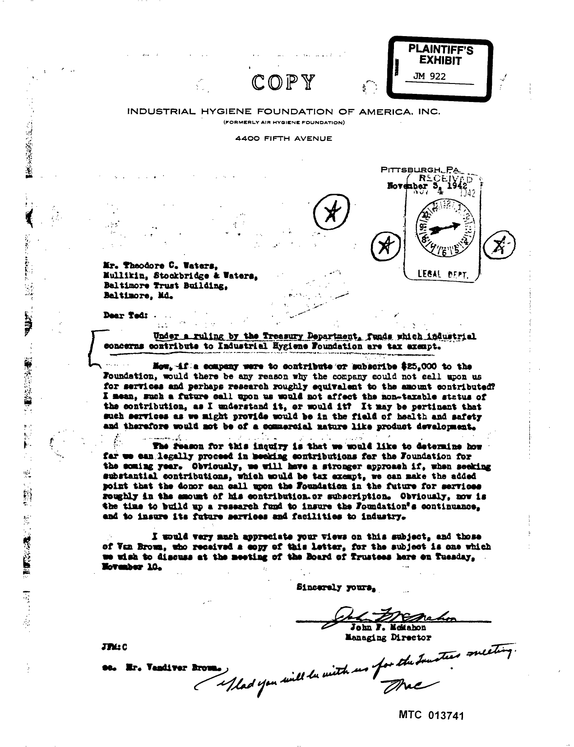
INDUSTRIAL HYGIENE FOUNDATION OF AMERICA.
refid# j9p9yvr8x6r0VMZxEamxy5gp1 page
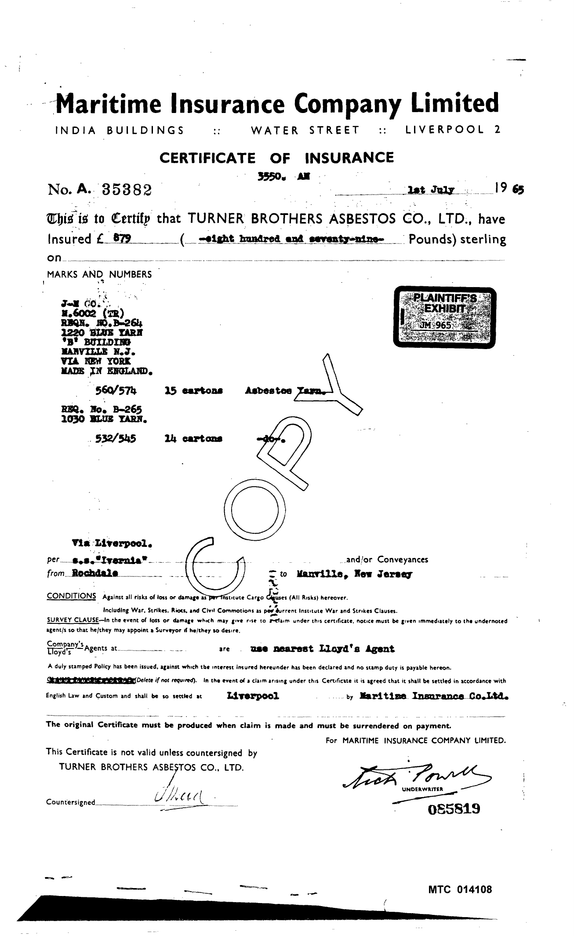
Maritime Insurance Company Limited INDIA BUILDINGS WATER STREET :: LIVERPOOL 2 CERTIFICATE OF INSURANCE No.
refid# 6w7kJDbLNxoLdkpGVpYYr2Qd2 pages
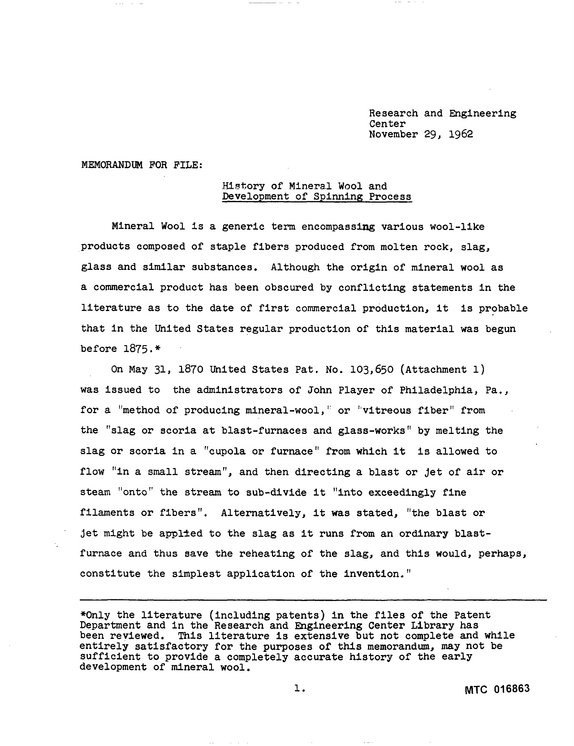
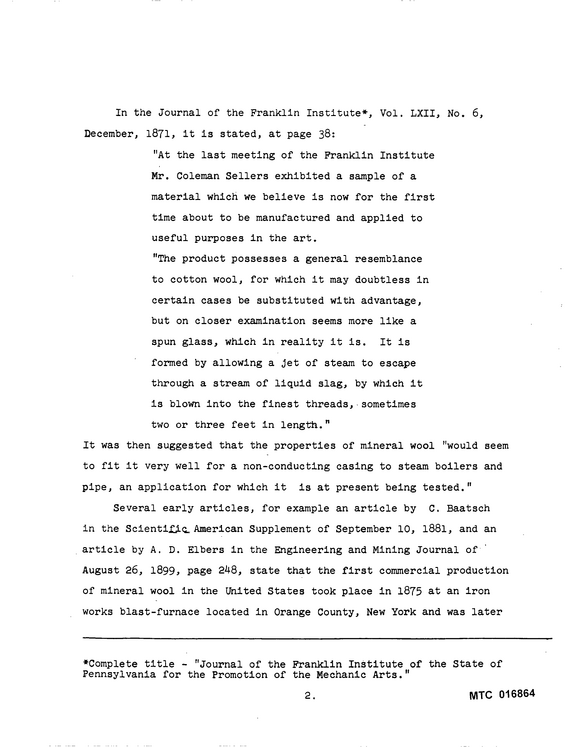
M IN ER AL WOOL - HISTORY OF ___ ___ ___ IN S U LA TIO N S - M INERAL WOO] MTC 016862 Research and Engineering Center November 29, 1962 MEMORANDUM FOR FILE: History of Mineral Wool and Development of Spinning Process Mineral Wool is a generic term encompassing various wool-like products composed of staple fibers produced from molten rock, slag, glass and similar substances.

refid# 3Qz7gMzxo0DXnM0pvkBeE0XJn33 pages
control More information on this subject is presented in the previous chapter Personal protective equipment When it is not feasible to render the en vironment completely safe, it may be neces sary to protect the worker from the environ ment Personal protective equipment is normally considered to be secondary to the controls mentioned previously Where it is not possible to enclose or isolate the process or equipment, provide ventilation, or other control measures, where there are short ex posures to hazardous concentrations of con taminants, where unavoidable spills may oc cur--personal protective equipment should be provided and used Personal protective devices have one seri ous drawback--they do nothing to reduce or eliminate the hazard Their failure means immediate exposure to the hazard, so the fact that a protective device may become in effective without the knowledge of the wearer is particularly senous Excellent equipment that follows accepted standards and specifica tions is commercially available in great va riety All such equipment, however, is in tended for emergency or temporary use only Only a bnef outline of the types of personal protective equipment is given m this section, because Chapter 19, `Tersonal Protective Equipment," give a complete discussion of each type Eye and face protection includes goggles, face shields, and similar items used to protect against corrosive solids, liquids and vapors, and foreign bodies Shaded lenses are used to screen out ultraviolet and infrared radia tions Of the many types of eye and face protection available, there is a correct type for each job and it should be worn at all times on that job Ear protection.
refid# jy9GvdENRqJ1O4VMmmnMGj4Dk1 page