Refine
Estimated Years UndatedClear
92,592 results foundRefine Search
refid# M7rj2233Rd7Gb3ZomQYvbbZk1 page
ASBESTOS & HEALTH MEETINGS n S'

refid# B8N9qKyVVgzVbMmy870XbzdVk1 page
Accident Prevention Manual for Industrial Operations
refid# oeY62eYwwDLaDd54Lmj6rRmLX1 page
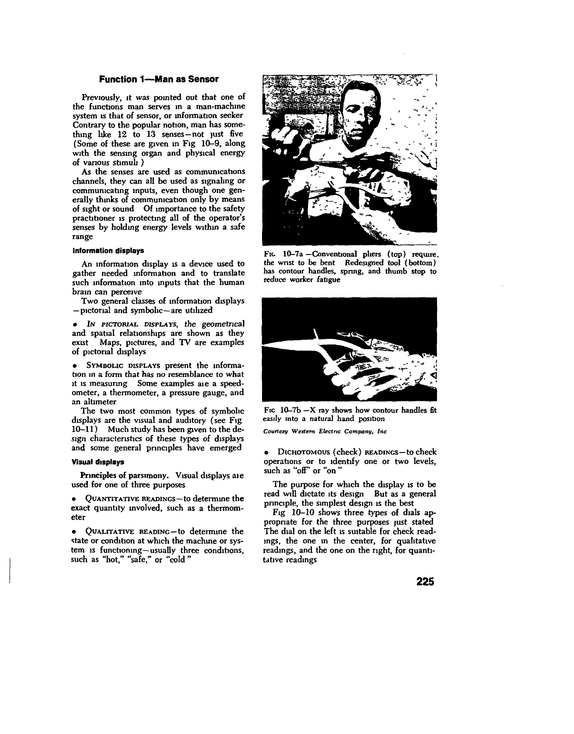
Function 1--Man as Sensor Previously, it was pointed out that one of the functions man serves in a man-machine system is that of sensor, or information seeker Contrary to the popular notion, man has some thing Idee 12 to 13 senses--not just five (Some of these are given m Fig 10-9, along with the sensing organ and physical energy of various stimuli ) As the senses are used as communications channels, they can all be used as signaling or communicating inputs, even though one gen erally thinks of communication only by means of sight or sound Of importance to the safety practitioner is protecting all of the operator's senses by holding energy levels within a safe range Information displays An information display is a device used to gather needed information and to translate such information into inputs that the human brain can perceive Two general classes of information displays --pictorial and symbolic--are utilized In pictorial, displays, the geometrical and spatial relationships are shown as they exist Maps, pictures, and TV are examples of pictorial displays Symbolic displays present the informa tion m a form that has no resemblance to what it is measuring Some examples aie a speed ometer, a thermometer, a pressure gauge, and an altimeter The two most common types of symbolic displays are the visual and auditory (see Fig 10-11) Much study has been given to the de sign characteristics of these types of displays and some general principles have emerged Visual displays Principles of parsimony.
refid# RJvam4xbKzjqe5v4BVg0xLvkE1 page
Large occasional meetings need even moie careful planning and tuning than do small meetings People who are to speak, includ ing company executives, should review what they intend to say with the person planning the meeting to assure that their remarks will serve the desired purpose Films and other visual aids should be checked m advance Persons responsible for employee meetings should observe them critically to see whether or not they are accomplishing the purpose for which they are run When meetings are held periodically, there is always danger that they will become dull routine Only continual ef fort and planning will prevent this A plan of action to develop a successful safety meeting includes these points Prepare in advance The preliminary ar rangement determines the results Do not conduct a meeting without preparation Select a major topic Make it timely and practical--one that the group can discuss Obtain facts and figures Be sure they are correct and complete Make up a visual aid, such as a simple chait or table, whenever possible Map the presentation Decide on the best way to present the subject of the meeting Try to anticipate the group's reaction and questions Outline results you hope to ac complish Set a timetable Allow adequate time, but set a reasonable limit Be sincere Your sincerity and your in terest in the employees' welfare must be un mistakable Introduce the topic Tell m simple terms what the meeting is all about Use a punch line or other good lead-in Present facts, arouse interest State highly pertinent facts m an interesting man ner Promote croup discussion Ask ques tions that cannot be answered "Yes" or "No " Prompt members of the group to think indi vidually and collectively Let them talk Agree on doing something Try for group agreement on methods of correction and improvement Write these down Summarize the meeting Review briefly what has been discussed and decided follow up m the various departments Contests Stimulate Interest Many safety professionals say that contests (such as housekeeping contests, mterdepartment contests, and many other types) are in adequate substitutes for management interest, safe procedures, and "built in" safety They will also agree that while a good accident prevention program is one and the same with good management, good training, and effi cient operation, some special effort may be needed to maintain interest m good house keeping, reporting hazards, and the like Moreover, the interest value of contests (such as maintaining a high level of good house keeping and efficiency) has direct bonus values m good pubhcity and improved em ployee morale A competition usually is held, therefore, only after the basic steps in a safety program have been taken--a policy statement made, a record system adopted, equipment safe guarded, a first aid department installed Such substantial demonstration of manage ment's interest, sincerity, and responsibdity greatly helps to obtain the active participation of foremen and workers in a contest Purpose and principles Safety contests are operated purely for their interest-creating value A contest that creates favorable interest is valuable, one that does not create interest is worthless In the usual type of contest, the competing groups are de partments of the same plant or divisions of the same company Generally, contests are based on accident experience and are operated over a stated period, with a prize for the group with the best record according to the contest rules Contests have been important almost from the time of the first safety programs, and a fairly well established group of operating principles has been developed 1 A contest should be planned and con ducted by a committee representative of the competing groups 2 Competing groups should be natural units, 275
refid# oDB6nvOMo5vOK4mYydQOOvxwE1 page
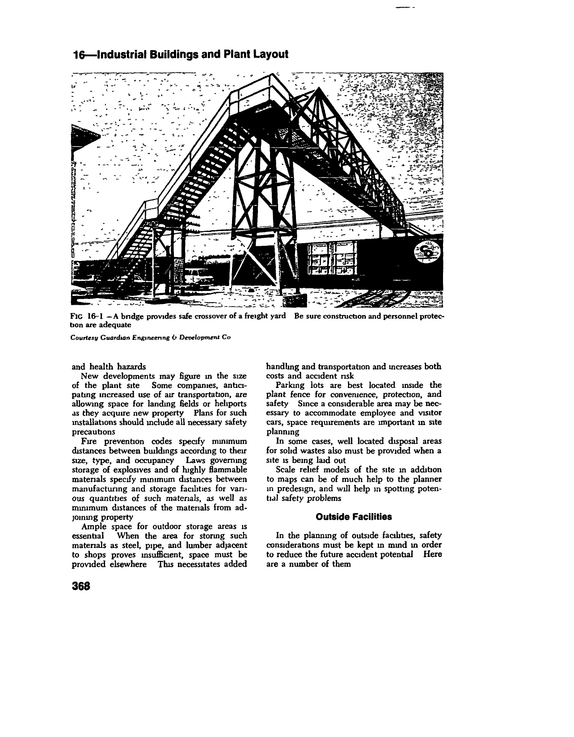
16--Industrial Buildings and Plant Layout Fig 16-1 --A bridge provides safe crossover of a freight yard Be sure construction and personnel protec tion are adequate Courtesy Guardian Engineering O Development Co and health hazards New developments may figure in the size of the plant site Some companies, antici pating increased use of air transportation, are allowing space for landing fields or heliports as they acquire new property Plans for such installations should include all necessary safety precautions Fire prevenbon codes specify minimum distances between buildings according to their size, type, and occupancy Laws governing storage of explosives and of highly flammable materials specify minimum distances between manufacturing and storage facilities for vari ous quantities of such materials, as well as minimum distances of the materials from ad joining property Ample space for outdoor storage areas is essenbal When the area for storing such materials as steel, pipe, and lumber adjacent to shops proves insufficient, space must be provided elsewhere This necessitates added 368 handling and transportahon and increases both costs and accident nsk Parking lots are hest located inside the plant fence for convenience, protecbon, and safety Since a considerable area may be nec essary to accommodate employee and visitor cars, space requirements are important in site planning In some cases, well located disposal areas for solid wastes also must be provided when a site is being laid out Scale relief models of the site in addibon to maps can be of much help to the planner in predesign, and will help in spotting poten tial safety problems Outside Facilities In the planning of outside facihbes, safety considerabons must be kept m mind m order to reduce the future accident potential Here are a number of them
refid# 15mq9rmgGkbgjRyVyaNGvoQjE1 page
. ' V^- ^S'iVr c - - ; *.r* . * , >|JI ?
refid# OE2b18kpdOoznEOQ97Vo8q2kX1 page
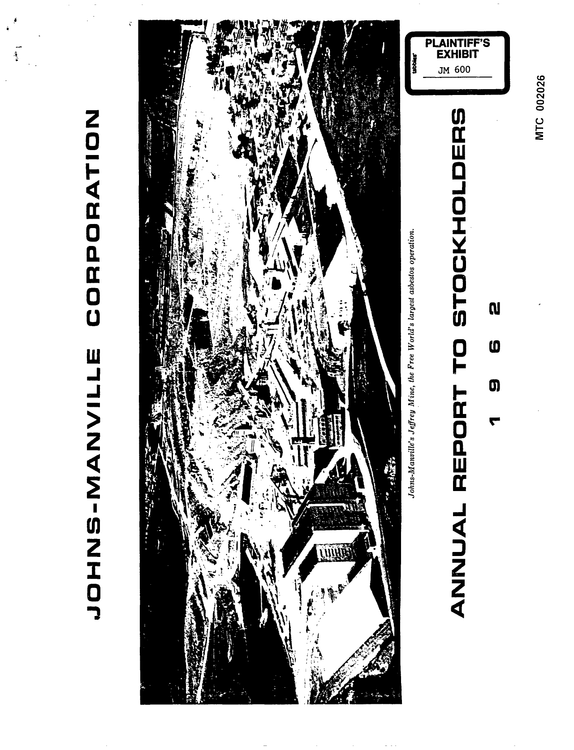
* PLAINTIFF'S EXHIBIT JM 600 MTC 002026 'j'T*?''
refid# o9y03V9KKD3VD05jpNR9MNXjr46 pages
.
refid# XR178KroY5xJzmE2dzjkkpD7d1 page
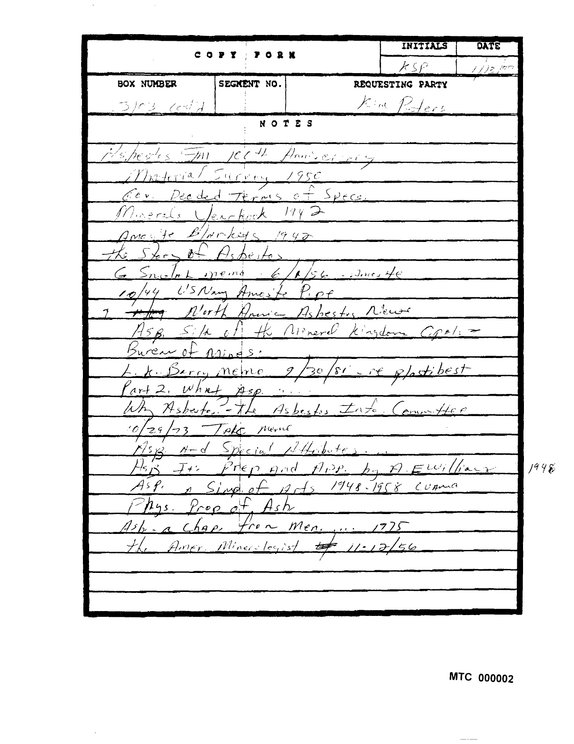
MTC 000001 MTC 000002 MTC 000004 Asbestos *t E.


refid# 3kQJVq0oRjqJBvKyMJkrJN1E53 pages
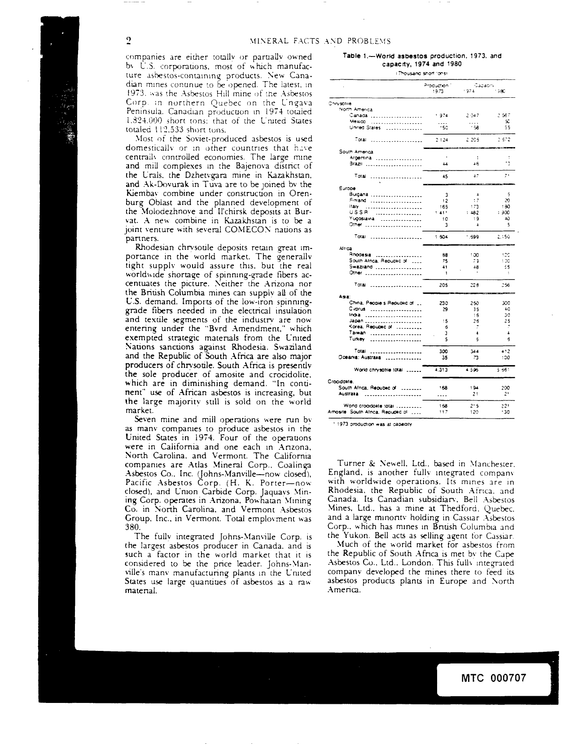
United States Department of the Interior Bureau of Mines The data base for forecasts and the long-term analysis of commodides terminates with 1973. the fast year for which reladvelv complete world wide data were available.
refid# e56MxYQz7v3BKLr11gQbgpzvg17 pages
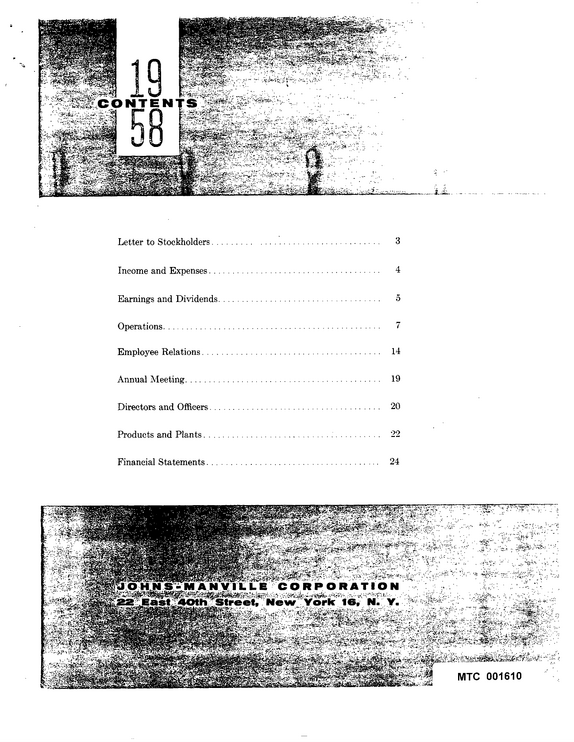
copy i roll BOX NUMBER S' IbYT NOTES /7}/YUACtft INITIALS DATE REQUESTING PARTY MTC 001607 i MTC 001609 Letter to Stockholders. .
refid# DMKdG6kv1Xj3B5YMmZJ6g1GG535 pages
c o v t rot SOX NUMBER jh - qqo H1 segxSnt no.

refid# mm62pYXbXGJx8vQnwqDykwDGO919 pages
MTC 010460 MTC 010461

refid# 3NzROVLd9GONak7yayYNRXGyn2 pages
Johns-Manville SEP i ?

refid# 5kjzL2RvBgJZd4yqqLnoDnpNz2 pages