Refine
Estimated Years UndatedClear
267,355 results foundRefine Search
START, COPY BOX NO.
refid# 1gBwnjMaZJVYedM71wx688y2m1 page
Organizing the Safety Program Safety program organization may be de fined as a method employed by management to share and to assign responsibility for acci dent prevention and to ensure performance under that responsibility A safety progiam is not something that is imposed on company organization Safety must be built into every process or product design and into every operation It must be an integral part of company operations The prevention of accidents and injuries is basically achieved through control of the work ing environment and control of people's ac tions Only management can implement such control A company that has an effective safety pro gram will have a working environment m which operations can be conducted economi cally, efficiently, and safely Safety beyond OSHA The OSHAct, discussed in the previous chapter, has stimulated many organizations to get into activities intended to bring the or ganization into compliance with the Act This new awareness of safety is beneficial if it results in a sincere effort by top management to take effective action to eliminate work mjunes Such organized activity goes beyond mere compliance with OSHA standards which largely mvolve equipment and physical con ditions The stated objective of the OSHAct is to reduce occupational injuries and illnesses Therefore, evidence of organized safety ac tivities and proof of injury reduction should be brought to the attention of the OSHA Compliance Officer at the time of the inspec tion This will demonstrate management's parallel objective to eliminate accidents Such evidence may also be the basis for a reduction in the number of OSHA citations or in the amount of the proposed jpenalbes, if any Conversely, superficial activities and mini mal compliance cannot be considered as a viable safety program Not only will such activities be ineffective in controlling accidents and occupational health hazards, but they will give a false sense of security and expose man agement's lack of control over more basic accident causes Basic elements of a safety organization Analysis of safety programs in plants or concerns with outstanding safety records shows that invariably the programs are built around the seven basic elements shown in the illustra tion (Fig 3-1) These elements or principles of accident prevention are the same m any industry and in any organization, large or small Thus, although there is wide variation in the methods used m individual organiza tions, each mcoiporates most if not all of the seven basic elements shown in Fig 3--1.
refid# KJmm5OqOyxjbgV7jEeZ5a2ngw1 page
ments with unions provide for elections or appointments by the union Selection of qualified persons is assured by the appointive method.
refid# 9JV9dYeV3wJrdneJpwNpOO5Mp1 page
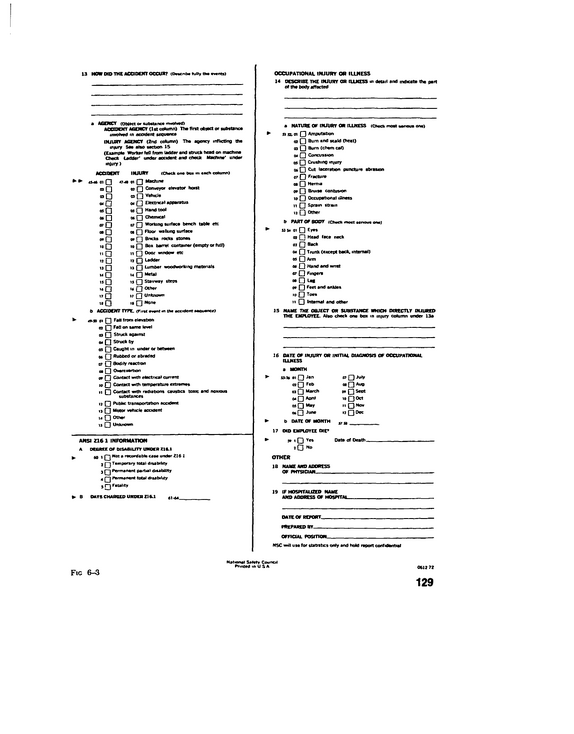
13 HOW DID THE ACCIDENT OCCUR?
refid# 6BogDkz5eX8Vy23QyjOvR7N241 page
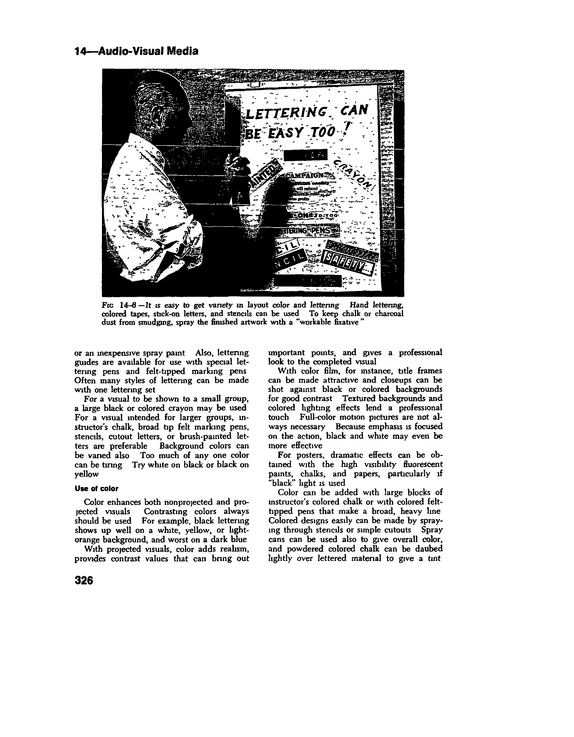
14--Audio-Visual Media Fig 14-6 --It is easy to get variety in layout color and lettering Hand lettering, colored tapes, stack-on letters, and stencils can be used To keep chalk or charcoal dust from smudging, spray the finished artwork with a "workable fixative " or an inexpensive spray paint Also, lettering guides are available for use with special let tering pens and felt-tapped marking pens Often many styles of lettering can be made with one lettering set For a visual to be shown to a small group, a large black or colored crayon may be used For a visual intended for larger groups, in structor's chalk, broad tip felt marking pens, stencils, cutout letters, or brush-painted let ters are preferable Background colors can be varied also Too much of any one color can be tinng Try white on black or black on yellow Use of color Color enhances both nonprojected and pro jected visuals Contrasting colors always should be used For example, black lettering shows up well on a white, yellow, or bghtorange background, and worst on a dark blue With projected visuals, color adds realism, provides contrast values that can bnng out 326 important points, and gives a professional look to the completed visual With color film, for instance, title frames can be made attractive and closeups can be shot against black or colored backgrounds for good contrast Textured backgrounds and colored lighting effects lend a professional touch Full-color motion pictures are not al ways necessary Because emphasis is focused on the action, black and white may even be more effective For posters, dramatic effects can be ob tained with the high visibility fluorescent paints, chalks, and papers, particularly if "black" light is used Color can be added with large blocks of instructor's colored chalk or with colored felttapped pens that make a broad, heavy line Colored designs easily can be made by spray ing through stencils or simple cutouts Spray cans can be used also to give overall color, and powdered colored chalk can be daubed lightly over lettered material to give a tint
refid# 65EXYbBoB7ob9kxng18JpwXg1 page
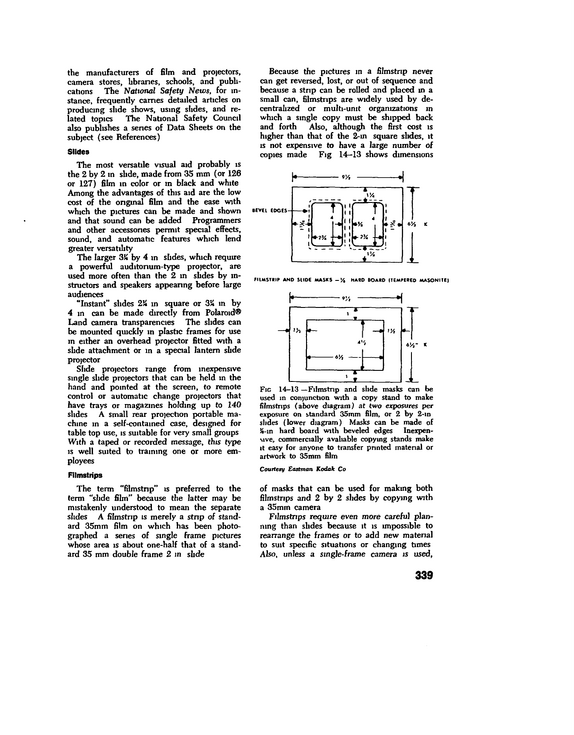
the manufacturers of film and projectors, camera stores, libraries, schools, and publi cations The National Safety News, for in stance, frequently carries detailed articles on producing slide shows, using slides, and re lated topics The National Safety Council also publishes a senes of Data Sheets on the subject (see References) Slides The most versatile visual aid probably is the 2 by 2 m shde, made from 35 mm (or 126 or 127) film in color or m black and white Among the advantages of this aid are the low cost of the ongmal film and the ease with which the pictures can be made and shown and that sound can be added Programmers and other accessones permit special effects, sound, and automatic features which lend greater versatility The larger 35* by 4 in slides, which require a powerful auditonum-type projector, are used more often than the 2 m slides by in structors and sjieakers appeanng before large audiences "Instant" slides 211 m square or 351 in by 4 m can be made directly from Polaroid Land camera transparencies The slides can be mounted qmckly in plastic frames for use m either an overhead projector fitted with a shde attachment or in a special lantern shde projector Shde projectors range from inexpensive single slide projectors that can be held m the hand and pointed at the screen, to remote control or automatic change projectors that have trays or magazines holding up to 140 slides A small rear projection portable ma chine in a self-contained case, designed for table top use, is suitable for very small groups With a taped or recorded message, this type is well suited to training one or more em ployees Filmstrips The term "filmstnp" is preferred to the term "shde film" because the latter may be mistakenly understood to mean the separate shdes A filmstrip is merely a strip of stand ard 35mm film on which has been photo graphed a series of single frame pictures whose area is about one-half that of a stand ard 35 mm double frame 2 in shde Because the pictures in a filmstrip never can get reversed, lost, or out of sequence and because a strip can be rolled and placed in a small can, filmstrips are widely used by de centralized or multi-unit organizations in which a single copy must be shipped back and forth Also, although the first cost is higher than that of the 2-rn square shdes, it is not expensive to have a large number of copies made Fig 14--13 shows dimensions h----------------------*1 FILMSTRIP AND SLIDE MASKS - HARD BOARD (TEMPERED MASONITE) (------------------------- H Fig 14-13 --Filmstnp and slide masks can be used m conjunction with a copy stand to make filmstnps (above diagram) at two exposures per exposure on standard 35mm film, or 2 by 2-m slides (lower diagram) Masks can be made of K-in hard board with beveled edges Inexpen sive, commercially available copying stands make it easy for anyone to transfer pnnted material or artwork to 35mm film Courtesy Eastman Kodak Co of masks that can be used for making both filmstnps and 2 by 2 shdes by copying with a 35mm camera Filmstnps require even more careful plan ning than shdes because it is impossible to rearrange the frames or to add new material to suit specific situations or changing times Also, unless a single-frame camera is used. 339
refid# 6B3y3Z9njgJbJ2EQjQ2mknwz61 page
16--Industrial Buildings and Plant Layout 230- and 250-volt circuits are available in wattages from 100 to 1500 Some types are available m 260, 277, and 300-volt design High-voltage lamps necessarily have filaments that are less rugged, require more supports and are considerably less efficient than those of equal wattage 120-volt lamps "Infrared" lamps are available in vanous types and sizes up to 1000 watts These lamps are used m baking, drying, and heat processing, as well as for therapeutic pur poses They also have fire protection value a great amount of heat can be exchanged without Same Such lamps cannot be used in hazardous locahon applications Fluorescent lamps.
refid# JNOJNyDmvbbGdzd9Emr35oZX1 page
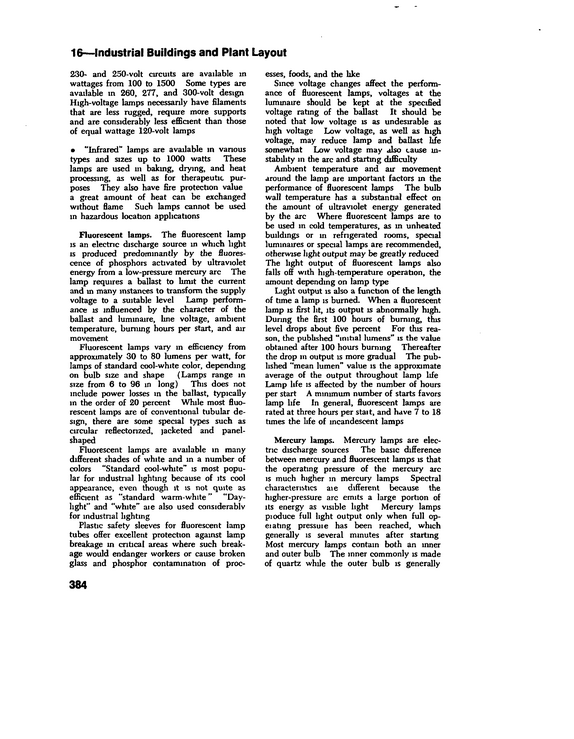
19--Personal Protective Equipment Fic 19-55 --Various types of thermal knit cotton materials used for regular style cold weather underwear Note the air pockets which give materials their insulating properties clothing are much moie desirable For protection against exposure to oil and the various other compounds which rapidly attack ordinary rubber, all the equipment dis cussed can be obtained in plastic and synthetic rubbers Women's clothing and protection Women require practically the same safety features m protective clothing and equip ment as men do, but styles of clothing may differ considerably m appearance It is desirable to have women wear the same type of dress, uniform, or smock Sknts and loose, frilly clothing are easily caught in moving machinery Where this danger is present, slacks and short-sleeved shirts are commonly wom Tie strings for aprons should be of a type that can be easily broken The possibility of senous scalp injury is 524 present when women work near moving ma chinery Hair covering is desirable for clean liness, particularly m food products industries Caps to be used near sparks or flame should be flame-resistant A cap should have a stiff brim long enough and rigid enough to provide some warning before the head itself comes m contact with moving objects Any fad of wearing cap visors turned up should be com batted When stnng-tied caps are wom, the bow in the back should be tucked under the cap Hair-nets and turbans do not give suf ficient protection against moving machinery Additional details on women's caps were given under Hair Protection Shoes with high or run-over heels, sneakers, and toeless shoes or sandals are not suitable for factory work, particularly where heavy materials or hot liquids are handled Many companies require women employees to wear
refid# jgEXpy9d9QarxRk9kb0mV3dQ21 page
DOCUMENTS PULLED AS PRODUCIBLE DURING PRIVILEGE REVIEW PRIVILEGE BOX f____ > .M PO- PRODUCTION BOX f T){3- \i PILE ____________ PILE NAME C^rl-il.

refid# QX1VJx0ed4r2NwnQKrw56xNpk4 pages
COVER SHEET FOR B-LEVEL DOCUMENTS REMOVED IN PRIVILEGE REVIEW ORIGINAL B-LEVEL BOX NO._____________ PRODUCTION BOX KO.
refid# 0gr24exK6DQxQywVBoQwdMRam11 pages
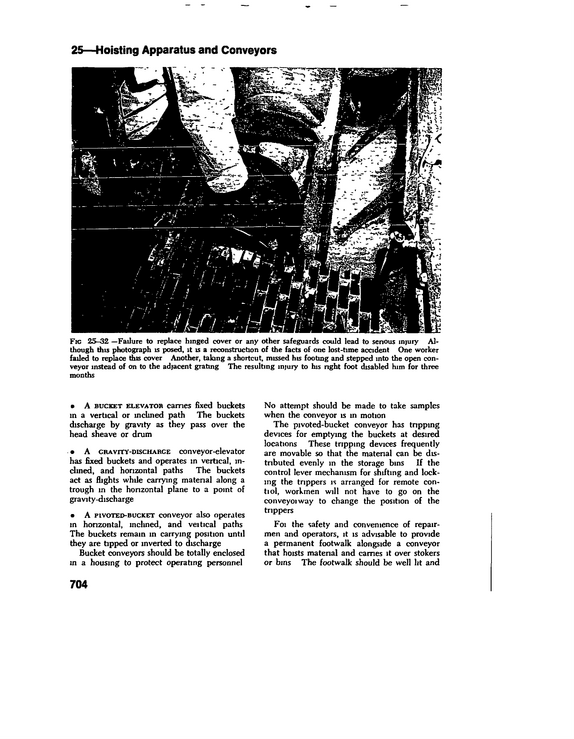
25--Hoisting Apparatus and Conveyors Fic 25-32 --Failure to replace hinged cover or any other safeguards could lead to serious injury Al though this photograph is posed, it is a reconstruction of the facts of one lost-time accident One worker failed to replace this cover Another, taking a shortcut, missed his footing and stepped into the open con veyor instead of on to the adjacent grating The resulting injury to his right foot disabled him for three months A bucket elevator carries fixed buckets m a vertical or inclined path The buckets discharge by gravity as they pass over the head sheave or drum A cravity-discharce conveyor-elevator has fixed buckets and operates m vertical, in clined, and horizontal paths The buckets act as flights while carrying matenal along a trough m the horizontal plane to a point of gravity-discharge A pivoted-bucket conveyor also operates m horizontal, inclined, and veitical paths The buckets remain in carrying position until they are tipped or inverted to discharge Bucket conveyors should be totally enclosed m a housing to protect operating personnel 704 No attempt should be made to take samples when the conveyor is m motion The pivoted-bucket conveyor has tripping devices for emptying the buckets at desired locations These tripping devices frequently are movable so that the material can be dis tributed evenly m the storage bins If the control lever mechanism for shifting and lock ing the tnppers is arranged for remote contiol, workmen will not have to go on the conveyoiway to change the position of the tnppers Foi the safety and convenience of repair men and operators, it is advisable to provide a permanent footwalk alongside a conveyor that hoists material and cames it over stokers or bins The footwalk should be well lit and
refid# dnxqDNyy075Mm82Xxxo6gJKD61 page
28--Elevators and Plant Railways side and limits the sum of the clearances on the two sides to M in, unless skirt switches are installed The Elevator Code requires that each balustrade have a handrail moving m the same direction and at substantially the same speed as the steps Each moving handrail is to extend at normal handrail height (not less than 12 in beyond the points of the combplate teeth at the upper and lower landings) Hand or finger guards are to be provided at the point where the handrail enters the balustrade In some localities, barefoot passengers have been injured, and signs warning bare foot persons not to ride the escalator have been posted Umbrella tips frequently are caught between the grooves and the combplate, and this type of accident occasionally results in minor injuries and in damage to equipment Many accidents have resulted from attempts to handle baggage on escalators Suitcases and handbags should not be placed on the steps and, if earned by hand, always should be held parallel to the run of the escalator Escalator treads and landings should be of incombustible material affording secure foot hold.
refid# 4V2jR53aX70pG5zRaZKV2BpR1 page
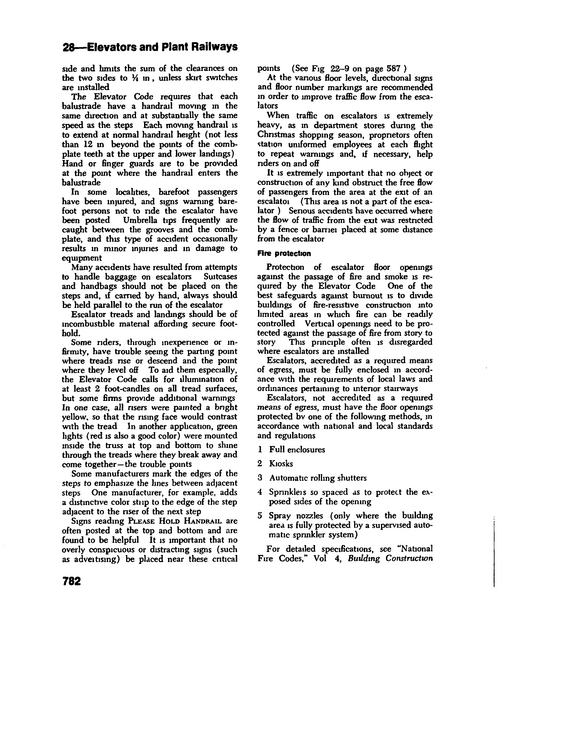
Low-Cost Universal Barrier Guard The upper guard is positioned on the die with the aid of a ram template Press guarding is simplified by designing universal barrier guards The finished guard is made in two sections that completely enclose the danger zone The upper guard will enclose any operation done on the press, the lower guard conforms to the upper guard, the feed device, and the lower die contour An opening, standardized to the widest feeding arrangement anticipated, is now made in the upper guard This will allow flexibility of the upper guard in all press operations of similar size '/,-in diameter steel rods are spot welded (7/-in center-to-center) on a frame made of 3/a-in diameter steel rods Height should be sufficient to cover the ram at the top of the stroke The design of the lower guard is made to conform to the upper guard, the feed device, and the lower die contour The framing and webbing are angled or bent to permit easy loading and eliminate finger entry into danger zone 875
refid# 3NQ1bXa42JppVrkOGxJbjvwR31 page
at Pstnti * (Ov*r), _ or CCHIKSCJ.
refid# 10v6YaG9DDKNLaVLZVkVNxD9d12 pages
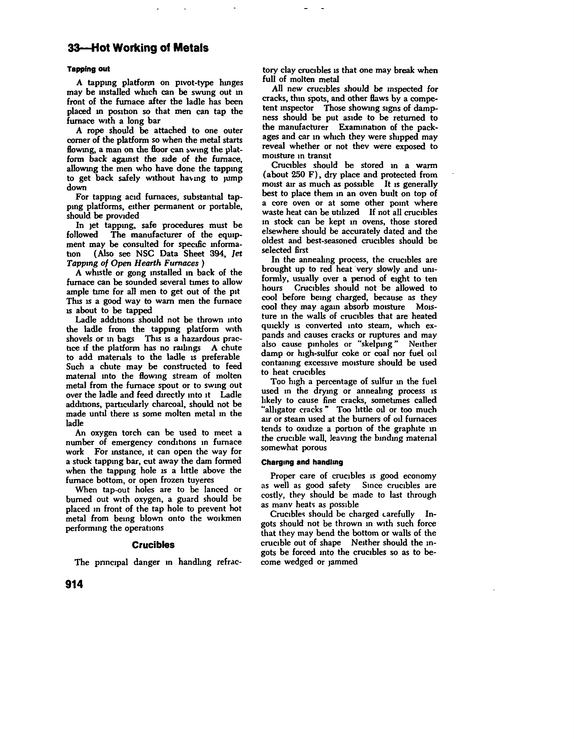
33--Hot Working of Metals Tapping out A tapping platform on pivot-type hinges may be installed which can be swung out m front of the furnace after the ladle has been placed in position so that men can tap the furnace with a long bar A rope should be attached to one outer comer of the platform so when the metal starts flowing, a man on rhe floor can swing the plat form back against the side of the furnace, allowing the men who have done the tapping to get back safely without havmg to jump down For tapping acid furnaces, substantial tap ping platforms, either permanent or portable, should be provided In jet tapping, safe procedures must be followed The manufacturer of the equip ment may be consulted for specific informa tion (Also see NSC Data Sheet 394, Jet Tapping of Open Hearth Furnaces ) A whistle or gong installed in back of the furnace can be sounded several times to allow ample time for all men to get out of the pit This is a good way to warn men the furnace is about to be tapped Ladle additions should not be thrown into the ladle from the tapping platform with shovels or in bags This is a hazardous prac tice if the platform has no railings A chute to add matenals to the ladle is preferable Such a chute may be constructed to feed material into the flowing stream of molten metal from the furnace spout or to swing out over the ladle and feed directly into it Ladle additions, particularly charcoal, should not be made until there is some molten metal m the ladle An oxygen torch can be used to meet a number of emergency conditions in furnace work For instance, it can open the way for a stuck tapping bar, cut away the dam formed when the tapping hole is a little above the furnace bottom, or open frozen tuyeres When tap-out holes are to be lanced or burned out with oxygen, a guard should be placed m front of the tap hole to prevent hot metal from being blown onto the woikmen performing the operations Crucibles The principal danger in handling refrac 914 tory clay crumbles is that one may break when full of molten metal All new crucibles should be inspected for cracks, thin spots, and other flaws by a compe tent inspector Those showmg signs of damp ness should be put aside to be returned to the manufacturer Examination of the pack ages and car in which they were shipped may reveal whether or not thev were exposed to moisture m transit Crucibles should be stored in a warm (about 250 F), dry place and protected from moist air as much as possible It is generally best to place them in an oven built on top of a core oven or at some other point where waste heat can be utilized If not all crucibles m stock can be kept in ovens, those stored elsewhere should be accurately dated and the oldest and best-seasoned crucibles should be selected first In the annealing process, the crucibles are brought up to red heat very slowly and uni formly, usually over a period of eight to ten hours Crucibles should not be allowed to cool before being charged, because as they cool they may again absorb moisture Mois ture in the walls of crucibles that are heated quickly is converted into steam, which ex pands and causes cracks or ruptures and may also cause pinholes or "skelping " Neither damp or high-sulfur coke or coal nor fuel oil containing excessive moisture should be used to heat crucibles Too high a percentage of sulfur in the fuel used m the drying or annealing process is likely to cause fine cracks, sometimes called "alligator cracks " Too little oil or too much air or steam used at the burners of oil furnaces tends to oxidize a portion of the graphite m the crucible wall, leaving the binding material somewhat porous Charging and handling Proper care of crucibles is good economy as well as good safety Since crucibles are costly, they should be made to last through as manv heats as possible Crucibles should be charged carefully In gots should not be thrown m with such force that they may bend the bottom or walls of the crucible out of shape Neither should the in gots be forced into the crucibles so as to be come wedged or jammed
refid# 854mrxQD2wVVVVOKqM51GJLze1 page