Refine
Estimated Years UndatedClear
92,592 results foundRefine Search
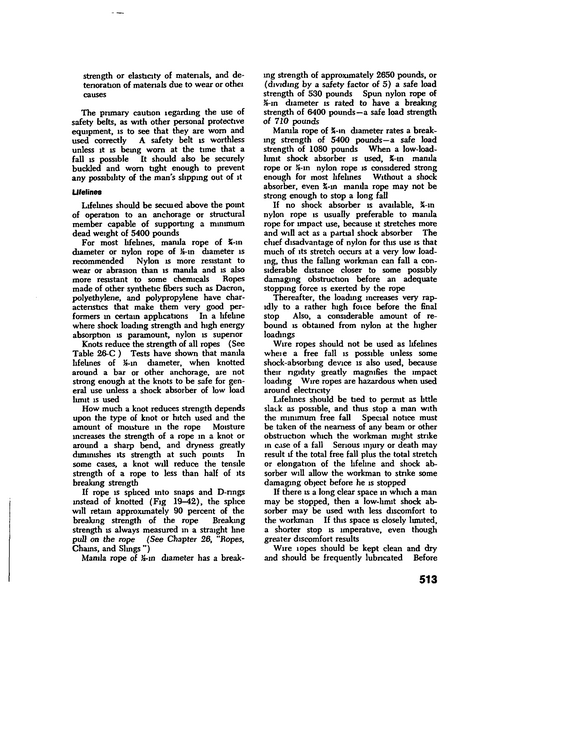
strength or elasticity of materials, and de terioration of materials due to wear or othei causes The primary caution legardmg the use of safety belts, as with other personal protective equipment, is to see that they are worn and used correctly A safety belt is worthless unless it is being worn at the time that a fall is possible It should also be securely buckled and worn tight enough to prevent any possibility of the man's slipping out of it Lifelines Lifelines should be seemed above the point of operation to an anchorage or structural member capable of supporting a minimum dead weight of 5400 pounds For most lifelines, mamla rope of X-in diameter or nylon rope of Ji-in diameter is recommended Nylon is more resistant to wear or abrasion than is mamla and is also more resistant to some chemicals Ropes made of other synthetic fibers such as Dacron, polyethylene, and polypropylene have char acteristics that make them very good per formers in certain applications In a lifeline where shock loading strength and high energy absorption is paramount, nylon is superior Knots reduce the strength of all ropes (See Table 26-C ) Tests have shown that mamla lifelines of 3-in diameter, when knotted around a bar or other anchorage, are not strong enough at the knots to be safe for gen eral use unless a shock absorber of low load limit is used How much a knot reduces strength depends upon the type of knot or hitch used and the amount of moisture in the rope Moisture increases the strength of a rope in a knot or around a sharp bend, and dryness greatly diminishes its strength at such points In some cases, a knot will reduce the tensile strength of a rope to less than half of its breaking strength If rope is spliced mto snaps and D-nngs instead of knotted (Fig 19-42), the splice will retain approximately 90 percent of the breaking strength of the rope Breaking strength is always measured m a straight line pull on the rope (See Chapter 26, "Ropes, Chains, and Slings ") Manila rope of &-in diameter has a break ing strength of approximately 2650 pounds, or (dividing by a safety factor of 5) a safe load strength of 530 pounds Spun nylon rope of %nn diameter is rated to have a breaking strength of 6400 pounds--a safe load strength of 710 pounds Manila rope of X-m diameter rates a break ing strength of 5400 pounds--a safe load strength of 1080 pounds When a low-loadlimit shock absorber is used, X-in mamla rope or X-in nylon rope is considered strong enough for most lifelines Without a shock absorber, even X-in mamla rope may not be strong enough to stop a long fall If no shock absorber is available, X-in nylon rope is usually preferable to mamla rope for impact use, because it stretches more and will act as a partial shock absorber The chief disadvantage of nylon for this use is that much of its stretch occurs at a very low load ing, thus the falling workman can fall a con siderable distance closer to some possibly damaging obstruction before an adequate stopping force is exerted by the rope Thereafter, the loading increases very rap idly to a rather high foice before the final stop Also, a considerable amount of re bound is obtained from nylon at the higher loadings Wire ropes should not be used as lifelines wheie a free fall is possible unless some shock-absorbing device is also used, because their rigidity greatly magnifies the impact loading Wire ropes are hazardous when used around electricity Lifelines should be bed to permit as little slack as possible, and thus stop a man with the minimum free fall Special notice must be taken of the nearness of any beam or other obstruebon which the workman might sbike in case of a fall Serious injury or death may result if the total free fall plus the total stretch or elongation of the lifeline and shock ab sorber will allow the workman to sbike some damaging object before he is stopped If there is a long clear space m which a man may be stopped, then a low-limit shock ab sorber may be used with less discomfort to the workman If this space is closely limited, a shorter stop is imperative, even though greater discomfort results Wire lopes should be kept clean and dry and should be frequently lubricated Before 513
refid# EJa6Y66o8qp5GRLy34wZYk2N1 page
I MTC 009709 COVER SHEET FOR B-LEVEL DOCUMENTS REMOVED IN PRIVILEGE REVIEW ORIGINAL B-LEVEL BOX NO._____ _ PRODUCTION BOX NO.
refid# zQnB1ZqRYM9NMd29KGngMvNeB52 pages
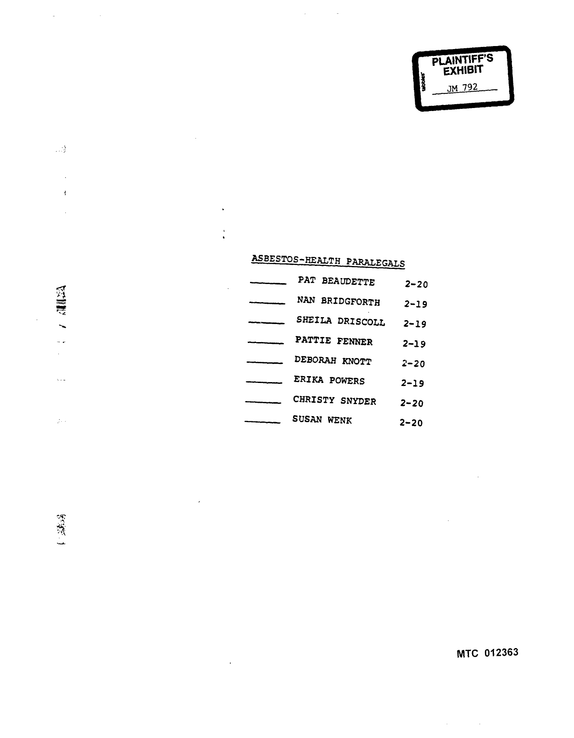
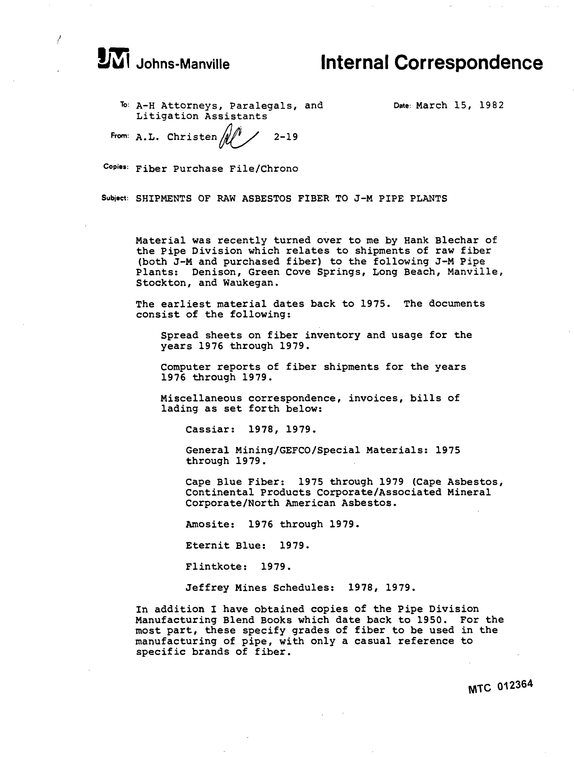
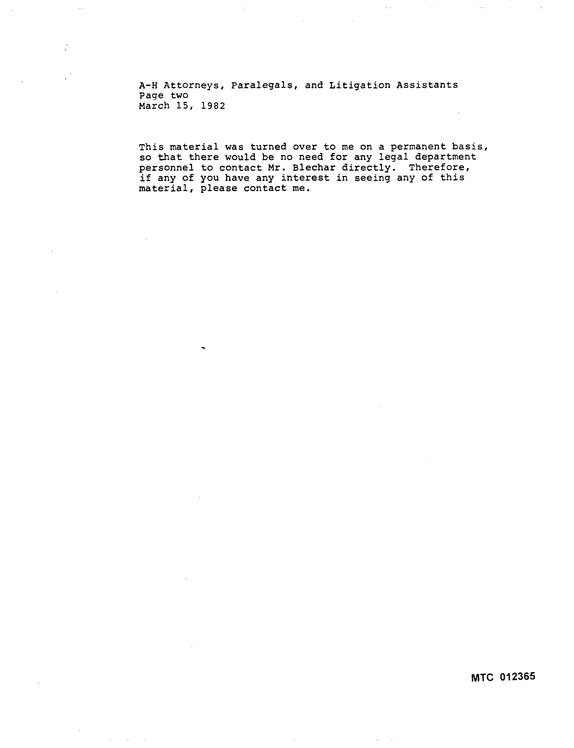
ASBESTOS-HEALTH PARAT.Bflar.c PAT BEAUDETTE NAN BRIDGFORTH SHEILA DRISCOLL PATTIE FENNER DEBORAH KNOTT ERIKA POWERS CHRISTY SNYDER SUSAN WENK 2-20 2-19 2-19 2-19 2-20 2-19 2-20 2-20 MTC 012363 I Johns-Manville Internal Correspondence T: A-H Attorneys, Paralegals, and kyLitigation Assistants From: A.L.
refid# JGRonMGa4w3M1owdy4ZbG8G63 pages
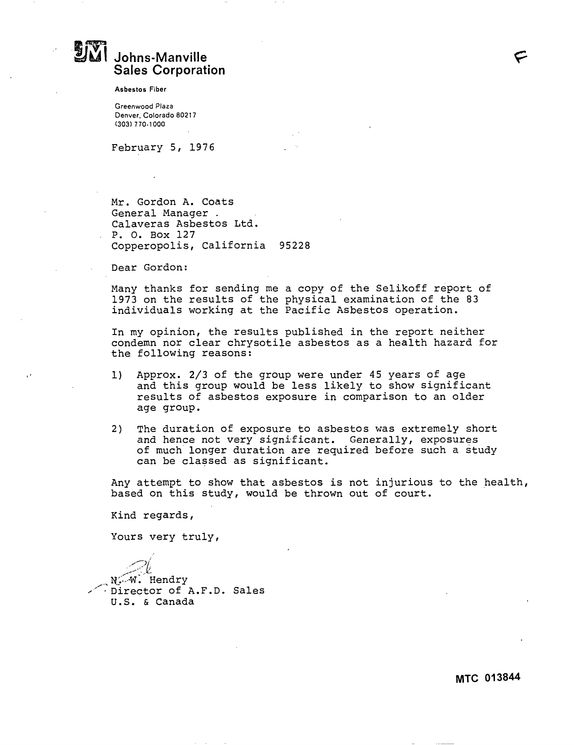
PLAINTIFFS EXHIBIT JM 931 f CP c>\ MTe 013843 Johns-Manville Sales Corporation Asbestos Fiber Greenwood Plaza Denver, Colorado 80217 (303) 770-1000 February 5, 1976 Mr.
refid# by6GNkroMJJXMbjgjbnqjrmvg2 pages
THERMOBESTOS SCORED BLOCK INSULATION IN)?
refid# gDwbaXv5ZyVYnOMGVY8r2Qn5q2 pages
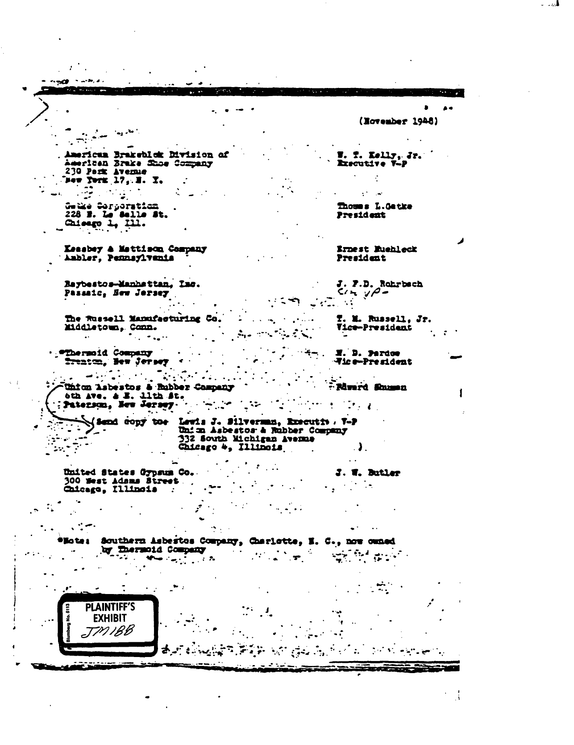
7** (Soreamber 19*4) Aasrleu BraAeblok Dirtsion of American Brake Shoe Sss^asy 230 Pszft Areoue **# T*rtt .17, .a.
refid# x1BENnB7dLL3Z0JvnDR9XOa5E1 page
PtAW$ W1EXHIBIT *} / 3B, XM T. 1 1 I
refid# V3Ne6zR2vKdVk4qvmMN78ydq81 page
KxwfTtvi: Ori'u ks Ion ns - Many j u.k Ooui'ow.vnoN t* i:\rv-r*t mwTti rn stiikkt Nt.W VIIKK t>>.
refid# MM2RwVDmeDNGeXq5y3okrmjmk1 page
lie's* 12, 251*3 H.
refid# zoo5LwGrx3kReXdk6rJdmpoO01 page
n ; !
refid# MGo8Xjq3KKzRg8GNKx2qK4jnj1 page
"3 2 CO <3 U 8 CM a, o CO 0 a e u oog aO8 VfIN o c o L, u l "8 o5* O P 8 0 CU &M n o 3 &M 8 oo.
refid# v6NGa6BNVz4Oj5OG6k8x6g7Lw2 pages
(lupin: ?
refid# VJBMBMeo38YXjwbomGjDvK7Zo2 pages
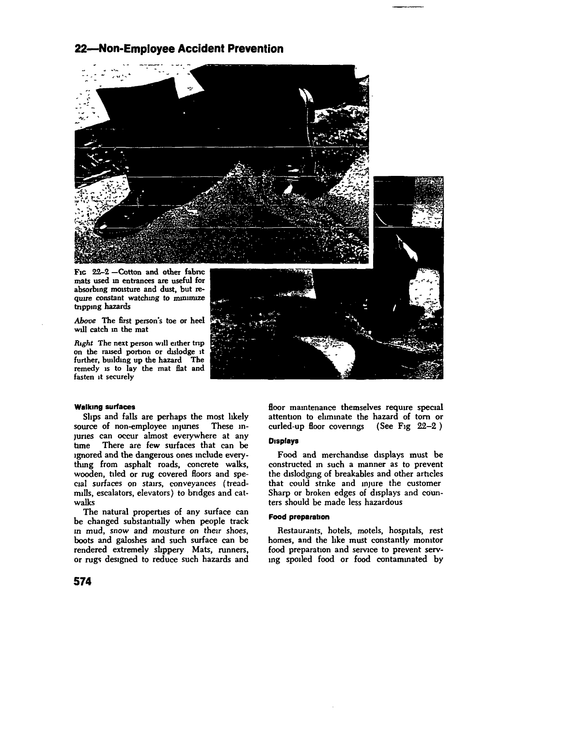
22--Non-Employee Accident Prevention Fic 22-2 --Cotton and other fabnc mats used m entrances are useful for absorbing moisture and dust, but re quire constant watching to minimize tripping hazards Above The first person's toe or heel will catch in the mat Right The next person will either trip on the raised portion or dislodge it further, building up the hazard The remedy is to lay the mat flat and fasten it securely Walking surfaces Slips and falls are perhaps the most likely source of non-employee injuries These in juries can occur almost everywhere at any time There are few surfaces that can be ignored and the dangerous ones include every thing from asphalt roads, concrete walks, wooden, tiled or rug covered floors and spe cial surfaces on stairs, conveyances (tread mills, escalators, elevators) to bridges and catwalks The natural properties of any surface can be changed substantially when people track in mud, snow and moisture on their shoes, boots and galoshes and such surface can be rendered extremely slippery Mats, runners, or rugs designed to reduce such hazards and 574 floor maintenance themselves require special attention to eliminate the hazard of tom or curled-up floor coverings (See Fig 22-2 ) Displays Food and merchandise displays must be constructed m such a manner as to prevent the dislodging of breakables and other articles that could strike and injure the customer Sharp or broken edges of displays and coun ters should be made less hazardous Food preparation Restaurants, hotels, motels, hospitals, rest homes, and the like must constantly monitor food preparation and service to prevent serv ing spoiled food or food contaminated by
refid# daoLBVdy3O5Qbewqx14vz29jq1 page
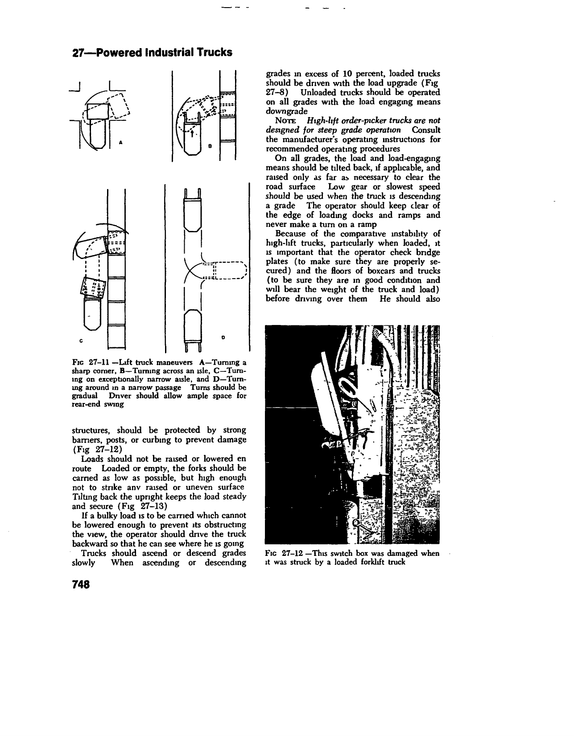
27--Powered Industrial Trucks grades in excess of 10 percent, loaded trucks should be driven with the load upgrade (Fig 27-8) Unloaded trucks should be operated on all grades with the load engaging means downgrade Note High-ltft order-picker trucks are not designed for steep grade operation Consult the manufacturer's operating instructions for recommended operating procedures On all grades, the load and load-engaging means should be tilted back, if apphcable, and raised only as far as necessary to clear the road surface Low gear or slowest speed should be used when the truck is descending a grade The operator should keep clear of the edge of loading docks and ramps and never make a turn on a ramp Because of the comparative instability of high-hft trucks, particularly when loaded, it is important that the operator check bndge plates (to make sure they are properly se cured) and the floors of boxcars and trucks (to be sure they are in good condition and will bear the weight of the truck and load) before driving over them He should also Fic 27-11 --Lift truck maneuvers A--Turning a sharp comer, B--Turning across an isle, C--Turn ing on exceptionally narrow aisle, and D--Turn ing around m a narrow passage Turns should be gradual Driver should allow ample space for rear-end swing structures, should be protected by strong barriers, posts, or curbing to prevent damage (Fig 27-12) Loads should not be raised or lowered en route Loaded or empty, the forks should be earned as low as possible, but high enough not to strike anv raised or uneven surface Tilting back the upright keeps the load steady and secure (Fig 27-13) If a bulky load is to be carried which cannot be lowered enough to prevent its obstructing the view, the operator should dnve the truck backward so that he can see where he is going Trucks should ascend or descend grades slowly When ascending or descending 748 Fic 27-12 --This switch box was damaged when it was struck by a loaded forklift truck
refid# 827njz8pmx0dnaDQxYZrQ1OrB1 page
Point-of-Operation and Transmission Guards Guarding Under OSHA Guarding terminology Built-in guards guarding Types of guards Checklists for Point-of-Operation Guards Guard openings .
refid# Mq3d5B109vMkbwYYKpM0YXpM1 page