Refine
Estimated Years UndatedClear
92,592 results foundRefine Search
/~yO 00 C=3 Indintrlal Hyglona ftwndation cnsumai no rttpontlblllty for ttotamanti In artldat abitroctad in Ihlt D go> Of for molorlol from othor organization which may bo ton!
refid# evBqD2VwyVNnkpwD37jJV5nM1 page
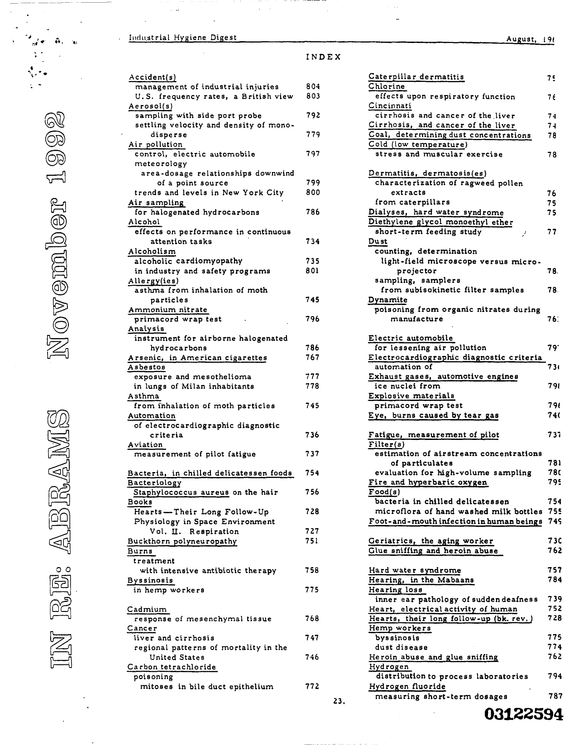
it, '91 sf=3 P=3 1551 J--------- 1 ' C=fl Industrial Hygiene Digest INDEX Accident(s) management of industrial injuries U.S. frequency rates, a British view Aerosol(s) sampling with side port probe settling velocity and density of monodisperse Air pollution control, electric automobile meteorology area-dosage relationships downwind of a point source trends and levels in New York City Air sampling for halogenated hydrocarbons Alcohol effects on performance in continuous attention tasks Alcoholism alcoholic cardiomyopathy in industry and safety programs Allergy(ies) asthma from inhalation of moth particles Ammonium nitrate primacord wrap test Analysis instrument for airborne halogenated hydrocarbons Arsenic, in American cigarettes A sbestos exposure and mesothelioma in lungs of Milan inhabitants Asthma from inhalation of moth particles Automation of electrocardiographic diagnostic criteria Aviation measurement of pilot fatigue 804 803 792 779 797 799 800 786 734 735 801 745 796 786 767 777 778 745 736 737 Bacteria, in chilled delicatessen foods Bacteriology Staphylococcus aureus on the hair Books Hearts--Their Long Follow-Up Physiology in Space Environment Vol.
refid# JJJ7deO1X0qVqzBwYodn7d53B1 page
INDUSTRIAL HYGIENE FOUNDATION 4400 FIFTH AVSNUE : PITTSBURGH, PA. 1S213 SCF-ALLF-03040

refid# V3p86wyokJr1y4km6ZoxyrD7w1 page
INTERPRETATION OF RESULTS OF QUESTIONNAIRE The questionnaire focuses upon the history of respiratory and chest illness, lifelong and recent, as recalled by the subject.
refid# jydbOBKxqbQNQr5z5b6drX91y1 page
'INODOMX 0* * St ,a .
refid# 0g07xMJQReQXb52J9m4DwRqrV1 page
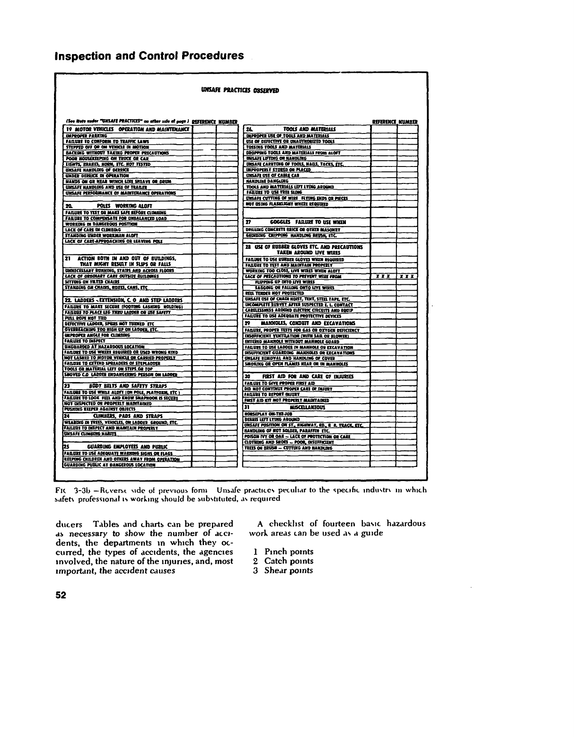
Inspection and Control Procedures UNSAff PfiACnOS observed (S-- IPWt mHf THm/1 ytACTOP* co affcgy d el pap J fffratXCl NUMBER. 19 MOTOR VEHICLES OPERATION AND MAINTENANCE empropo parking FAILURE ro CONFORM TO TRAFFIC UM STEPPED OFF 0* ON VfMIOI IN MOTION BAOUMC WITHOUT TAXING PROPER PRECAUTIONS POOS HOUSEKEEPING CM TBUCK OS CAS ItSNtt, BRAKES, HORN, ETC TOT TESTED UNSAFE MARBURG OP 009KS UNDO DERRICK M OPERATION HANDS ON 08 NIAS WINCH UME SHEAVE OS 08UM UNSAFE HANDLING AND UU OP TRAILER ONSAPC PERFORMANCE OP MAINTENANCE OPfSATMMS 20.
refid# xzK2jpkgE6qVamG87YYgkY33b1 page
agement has spent much time and money to determine the attitudes of workers Meas uring, developing, and changing attitudes constitute a major problem for personnel men and psychologists --one of extreme impor tance to the safety professional Learning processes.
refid# NNpNp53MKXxdQDzmZ6EGb2zYp1 page
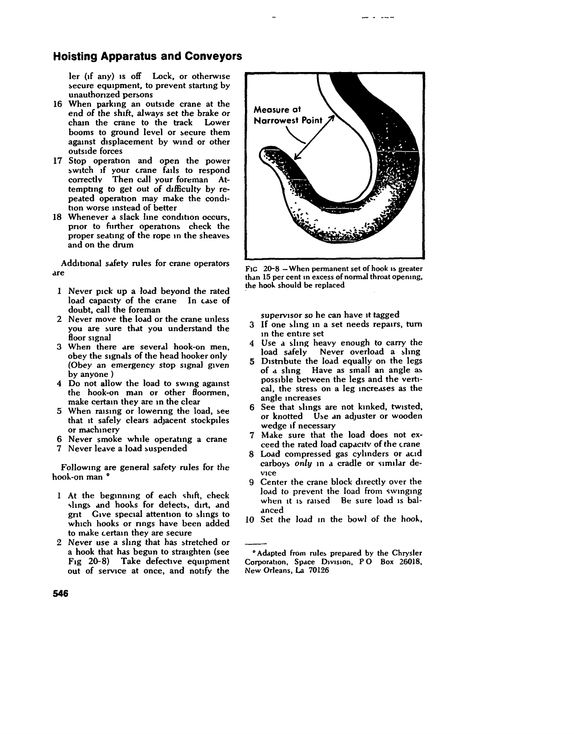
Hoisting Apparatus and Conveyors ler (if any) is off Lock, or otherwise secure equipment, to prevent starting by unauthorized persons 16 When parking an outside crane at the end of the shift, always set the brake or chain the crane to the track Lower booms to ground level or secure them against displacement by wind or other outside forces 17 Stop operation and open the power switch if your crane fails to respond correctly Then call your foreman At tempting to get out of difficulty by re peated operation may make the condi tion worse instead of better 18 Whenever a slack line condition occurs, pnor to further operations check the proper seating of the rope in the sheaves and on the drum Addibonal safety rules for crane operators are 1 Never pick up a load beyond the rated load capacity of the crane In case of doubt, call the foreman 2 Never move the load or the crane unless you are sure that you understand the floor signal 3 When there are several hook-on men, obey the signals of the head hooker only (Obey an emergency stop signal given by anyone ) 4 Do not allow the load to swing against the hook-on man or other floormen, make certain they are in the clear 5 When raising or lowering the load, see that it safely clears adjacent stockpiles or machinery 6 Never smoke while operating a crane 7 Never leave a load suspended Following are general safety rules for the hook-on man 0 1 At the beginning of each shift, check slings and hooks for defects, dirt, and grit Give special attention to slings to which hooks or rings have been added to make certain they are secure 2 Never use a sling that has stretched or a hook that has begun to straighten (see Fig 20-8) Take defective equipment out of service at once, and notify the Fig 20-8 -- When permanent set of hook is greater than 15 per cent in excess of normal throat opening, the hook should be replaced supervisor so he can have it tagged 3 If one sling in a set needs repairs, turn m the entire set 4 Use a sling heavy enough to carry the load safely Never overload a sling 5 Distribute the load equally on the legs of a sling Have as small an angle as possible between the legs and the verti cal, the stress on a leg increases as the angle increases 6 See that slings are not kinked, twisted, or knotted Use an adjuster or wooden wedge if necessary 7 Make sure that the load does not ex ceed the rated load capacity of the crane 8 Load compressed gas cylinders or acid carboys only in a cradle or similar de vice 9 Center the crane block directly over the load to prevent the load from swinging when it is raised Be sure load is bal anced 10 Set the load in the bowl of the hook.
refid# n91e7Yp9qem3XNDZa5QX7VxV81 page
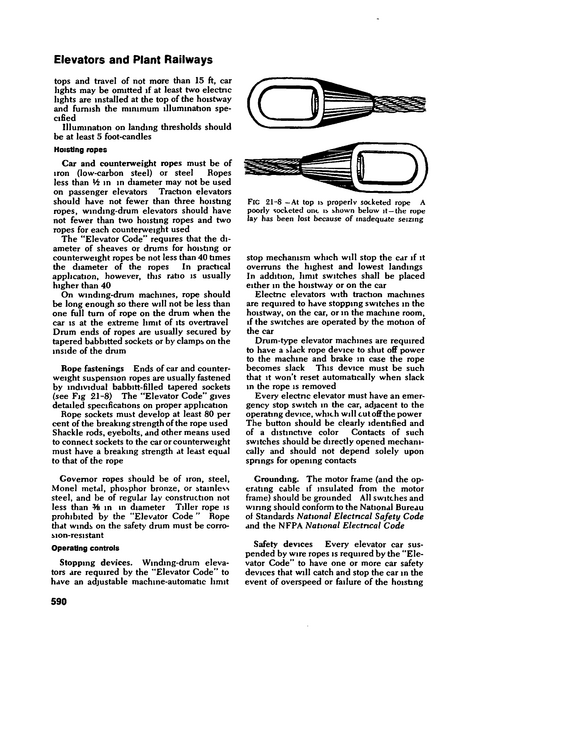
Elevators and Plant Railways tops and travel of not more than 15 ft, car lights may be omitted if at least two electric lights are installed at the top of the hoistway and furnish the minimum illumination spe cified Illumination on landing thresholds should be at least 5 foot-candles Hoisting ropes Car and counterweight ropes must be of iron (low-carbon steel) or steel Ropes less than Vz in in diameter may not be used on passenger elevators Traction elevators should have not fewer than three hoisting ropes, winding-drum elevators should have not fewer than two hoisting ropes and two ropes for each counterweight used The "Elevator Code" requires that the di ameter of sheaves or drums for hoisting or counterweight ropes be not less than 40 times the diameter of the ropes In practical application, however, this ratio is usually higher than 40 On winding-drum machines, rope should be long enough so there will not be less than one full turn of rope on the drum when the car is at the extreme limit of its overtravel Drum ends of ropes are usually secured by tapered babbitted sockets or by clamps on the inside of the drum Rope fastenings Ends of car and counter weight suspension ropes are usually fastened by individual babbitt-filled tapered sockets (see Fig 21-8) The "Elevator Code" gives detailed specifications on proper application Rope sockets must develop at least 80 per cent of the breaking strength of the rope used Shackle rods, eyebolts, and other means used to connect sockets to the car or counterweight must have a breaking strength at least equal to that of the rope FlC 21-8 -- At top is properlv socketed rope A poorly socketed one is shown below it --the rope lay has been lost because of inadequate seizing stop mechanism which will stop the car if it overruns the highest and lowest landings In addition, limit switches shall be placed either m the hoistway or on the car Electric elevators with traction machines are required to have stopping switches m the hoistway, on the car, or in the machine room, if the switches are operated by the motion of the car Drum-type elevator machines are required to have a slack rope device to shut off power to the machine and brake in case the rope becomes slack This device must be such that it won't reset automatically when slack m the rope is removed Every electric elevator must have an emer gency stop switch in the car, adjacent to the operating device, which will cut offthe power The button should be clearly identified and of a distinctive color Contacts of such switches should be directly opened mechani cally and should not depend solely upon spnngs for opening contacts Governor ropes should be of iron, steel.
refid# v125o5RdodRLKZX12n9EqMeMZ1 page
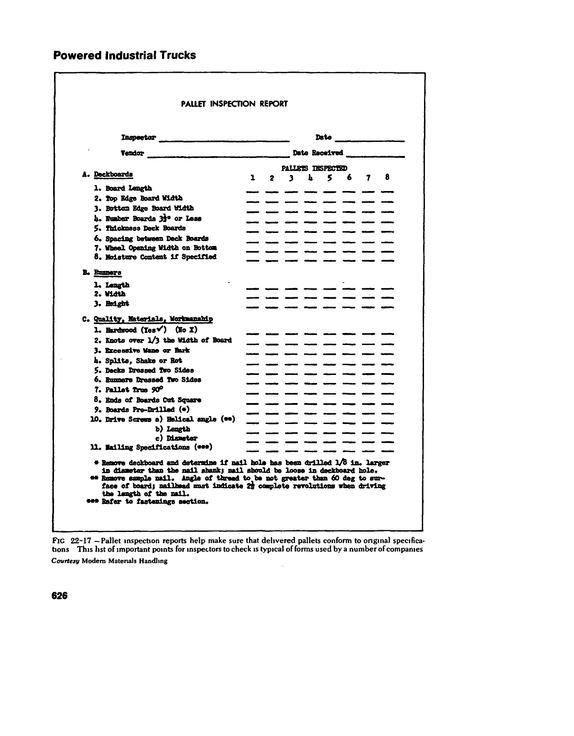
Powered Industrial Trucks FlC 22-17 --Pallet inspection reports help make sure that delivered pallets conform to original specifica tions This list of important points for inspectors to check is typical of forms used by a number of companies Courtesy Modem Materials Handling 626
refid# x5rnzOo4bKJxv5536vxKVga2E1 page
is regained on cooling to normal temperature At an increased initial cost, nylon of higher melting point can be secured Nylon more than any other rope material, will absorb and store energy m the same manner as a spring This energy, released at break, will make the moving ends as danger ous as a projectile Caution must therefore be exercised when working lines around comers, capstans, timber heads, and the like crossed ropes must be avoided because of a very rapid friction sawing with even modest loads as well as other types of abrasion They are unaffected by rot, mildew and fungus growth and are highly resistant to a wide variety of acids (except mtnc) and alkalis, as well as to alcohol-type solvents and bleach ing solutions They swell and soften by hydrocarbons, particularly at temperatures above 150 F There are two types Polyester makes probably the best generalpurpose rope available, especially for critical uses Polyesters stretch about half that of ROPE CHECKLIST Strength Stretch with load Permanent stretch Recovery from stretch Length Size Yardage Floatability Flexibility Twist direction and torque Flex life in bending Slippenness Texture Water repellency Hygroscopicity Toughness against wear Ruggedness m shape Temperature resistance Fnction melting Combustibility Sunlight resistance Marine growth resistance Rot resistance Chemical resistance Color Ageing Contamination Uniformity Service Cost Fig 23-1 --Factors that may be of significance when specifying rope for a specific use nylon, so energy absorption is also about half It is not weakened by rot, mildew, or pro longed exposure to sea water It retains its full strength when wet and shows little deterioration from long exposure to sunlight It has good resistance to abrasive wear and to most alkalis and acids, except benzoic acid Polyolefin ropes, in general, are strong and inexpensive, they float and are unaffected by water Polyolefins, like the polyesters, are not hygroscopic, therefore, they do not shnnk or swell with water Movement of Polypropylene, with a specific gravity of 0 91 and a softening point of300 F, is made in several different size filaments and from film with or without longitudinal fracturing Polypropylene rope is about 50 per cent stronger than manila, size for size Pure polypropylene ropes have relatively poor rendering properties Polyethylene, with a specific gravity of 0 95 and a softening point of 250 F, is char acteristically slippery and has very little spnnginess Stretch is low and strength is good It has a comparative low softening point and low coefficient of friction Composite ropes (combining several types of synthetic fibers or synthetic and natural fibers) are available in all sizes They result from attempts to give the surface of the rope or strand more wear resistance, internal tensile strength, or structural strength to resist deformation Many of these ropes are made to match the requirements of specific jobs These ropes can be expected to perform to the ends their makers declare Other types of rope are available but enjoy only a small percentage of the market for reasons of cost, limited use, or short supply These ropes include in vanous modifications paper, glass, acrylic, rayon, polyvinyl chlonde, fluorocarbon, rubber, cellulose acetate, and polyurethane Table 23-A lists breaking strengths and safe loads (working load limits) for manila and synthetic ropes Fig 23-1 gives a check list of factors that may be of significance in a specific application Inspection New rope should be thoroughly inspected along its entire length to determine that no part of it is damaged or defective before being 637
refid# evoq5LdG26OMzDVk4eGqrLmM41 page
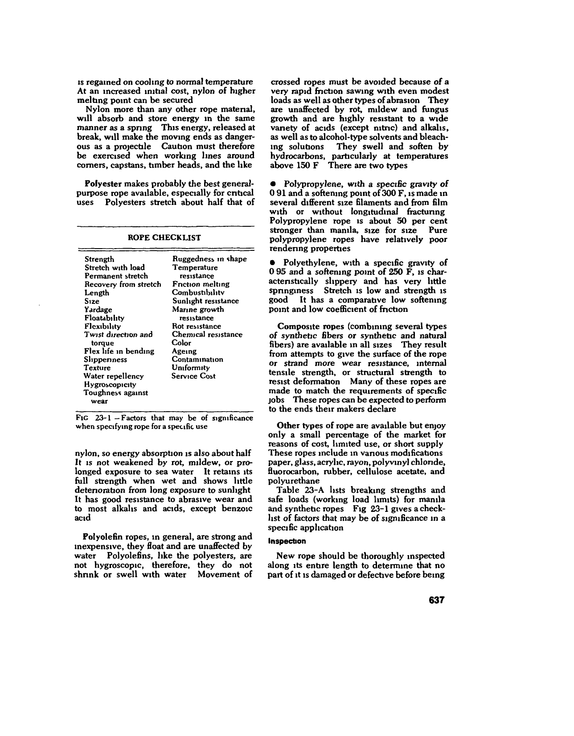
The basic principles of safeguarding equip ment are 1 Engineer the hazard out of the job 2 Guard the hazard 3 Educate personnel to use the safeguards provided Engineer Hazards Out of the Job A great deal may be done to eliminate the hazards endangering operators of mechanical equipment by anticipating such hazards when plans are being made for the department layout The following principles should be observed 1 Allow sufficient space for easy mainte nance and repair and for incoming and outgoing stock 2 Mark off machine areas the same as aisles or storage areas 3 Place machines so that the operator is not exposed to aisle traffic or install a substan tial railing for his protection 4 Supply racks or containers for tools, jigs, and fixtures 5 Supply seats, makeshift arrangements should not be allowed to substitute for seats 6 Supply containers for the disposal of waste materials Do not allow waste material to accumulate on floors, and empty con tainers promptly when they are filled 7 Supply automatic or semiautomatic feeds for machines, if possible 8 Supply area with adequate lighting In- This chapter was revised bv John Mark, based upon reviews by selected members of the National Safety Council 659
refid# ykLLpD33qkNez4k9ROp8Qd5Bn1 page
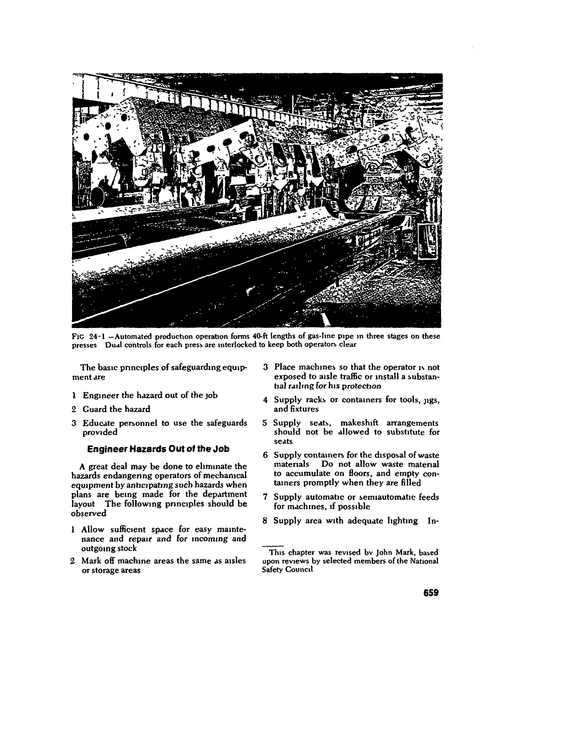
Maximum Peripheral Speed (sfpm) Matenal 7,000 Cast Iron (min tensile strength 20,000 psi) Class 20 9,000 Malleable Iron (min tensile strength 50,000 psi) Grade 32510 14,200 Steel Castings (min tensile strength 60,000 psi) Grade V60-30 14,200 Maximum Thickness of Grinding Wheel (m) 3 to 6 in AB (m) 7 to 12 m AB (in ) GRINDING WHEEL DIAMETERS J3 to 16 In AB (in ; 17 to 20 in AB (m) 21 to 24 m AB (in ) 2 '/a Va V. '/.
refid# 4vjLj6KyGoaEz3aVD8EBK5jJa1 page
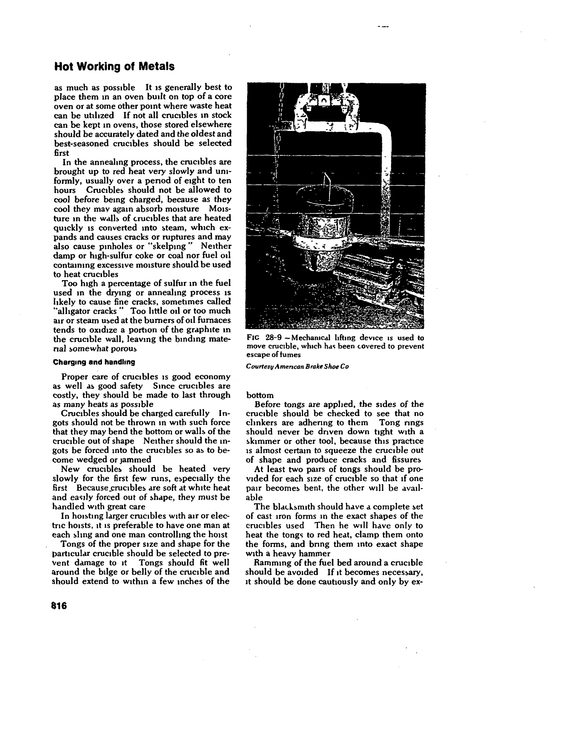
Hot Working of Metals as much as possible It is generally best to place them m an oven built on top of a core oven or at some other point where waste heat can be utilized If not all crucibles in stock can be kept in ovens, those stored elsewhere should be accurately dated and the oldest and best-seasoned crucibles should be selected first In the annealing process, the crucibles are brought up to red heat very slowly and uni formly, usually over a period of eight to ten hours Crucibles should not be allowed to cool before being charged, because as they cool they mav again absorb moisture Mois ture in the walls of crucibles that are heated quickly is converted into steam, which ex pands and causes cracks or ruptures and may also cause pinholes or "skelping " Neither damp or high-sulfur coke or coal nor fuel oil containing excessive moisture should be used to heat crucibles Too high a percentage of sulfur in the fuel used m the drying or annealing process is likely to cause fine cracks, sometimes called "alligator cracks " Too little oil or too much air or steam used at the burners of oil furnaces tends to oxidize a portion of the graphite in the crucible wall, leaving the binding mate rial somewhat porous Charging and handling Proper care of crucibles is good economy as well as good safety Since crucibles are costly, they should be made to last through as many heats as possible Crucibles should be charged carefully In gots should not be thrown in with such force that they may bend the bottom or walls of the crucible out of shape Neither should the in gots be forced into the crucibles so as to be come wedged or jammed New crucibles should be heated very slowly for the first few runs, especially the first Because^rucibles are soft at white heat and easily forced out of shape, they must be handled with great care In hoisting larger crucibles with air or elec tric hoists, it is preferable to have one man at each sling and one man controlling the hoist Tongs of the proper size and shape for the particular crucible should be selected to pre vent damage to it Tongs should fit well around the bilge or belly of the crucible and should extend to within a few inches of the FlC 28-9 --Mechanical lifting device is used to move crucible, which has been covered to prevent escape of fumes CourtesyAmencan Brake Shoe Co bottom Before tongs are applied, the sides of the crucible should be checked to see that no clinkers are adhering to them Tong rings should never be dnven down tight with a skimmer or other tool, because this practice is almost certain to squeeze the crucible out of shape and produce cracks and fissures At least two pairs of tongs should be pro vided for each size of crucible so that if one pair becomes bent, the other will be avail able The blacksmith should have a complete set of cast iron forms m the exact shapes of the crucibles used Then he will have only to heat the tongs to red heat, clamp them onto the forms, and bnng them into exact shape with a heavy hammer Ramming of the fuel bed around a crucible should be avoided If it becomes necessary, it should be done cautiously and only by ex- 816
refid# 6wZVyqED6Q0K0JnoonoxGOGpg1 page
twou ST1 Muol 1 s1 V ^ own *' 1 D ecu EL RAN 5E OF 1 "EPICAL IFIDUSTRIJEL SIGNALS 19' 1 1 VOtA mo urn 4 1 r- r IMAU r SKINS.
refid# 0gNV2ozea6zLZGMREN874OVLO1 page