Refine
Estimated Years UndatedClear
92,592 results foundRefine Search
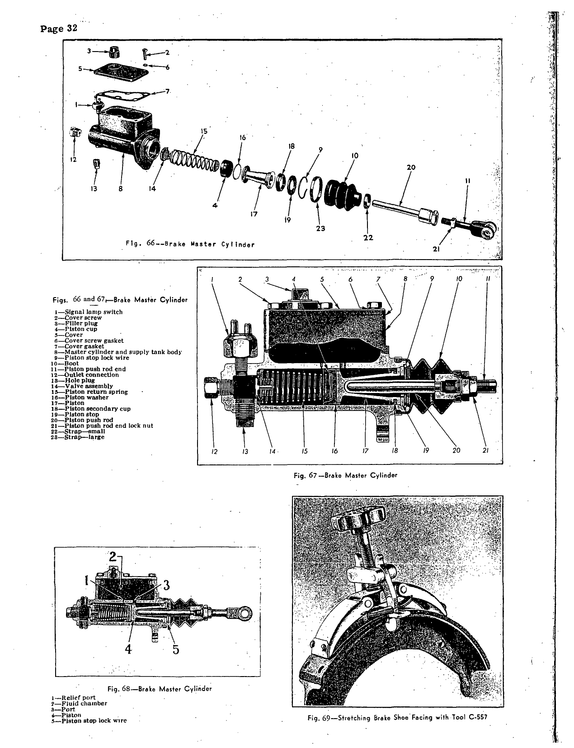
Page 32 8 ' 9 /0 II Figs. 66 and 67(--Brake Master Cylinder 1-- Signal lamp switch 2-- Cover screw a--Filler plug 4-- Piston cup 5-- Cover fl--Cover screw gasket 7-- Cover gasket 8-- Master cylinder and supply tank body 9-- Piston stop lock wire 10-- Boot 11-- Piston push rod end 12-- Outlet connection 18--Hole plug 14-- Valve assembly 15-- Piston return spring 16-- Piston washer 17-- Piston 18-- Piston secondary cup 19-- Piston stop 20-- Piston push rod 21-- Piston push rod end lock nut 22-- Strop--small 28--Strop--large 12 13 14 15 16 17 (8 19 20 21 Fig. 67--Brake Master Cylinder } ) Fig. 68--Brake Master Cylinder 1-- Relief port 2-- Fluid chamber a--Port 4-- Piston 5-- Piston stop lock wire Fig. 69--Stretching Brake Shoe Facing with Tool C-557
refid# G6VGJdVaoobVQNRdqw7JExDKx1 page
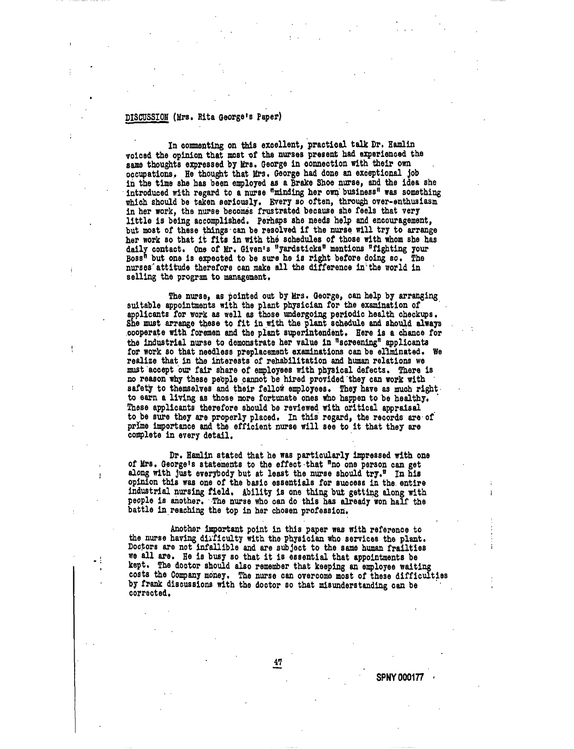
DISCUSSION (Mrs.
refid# Y3LQrGNzKmDwrXpxdEdxwGgV1 page
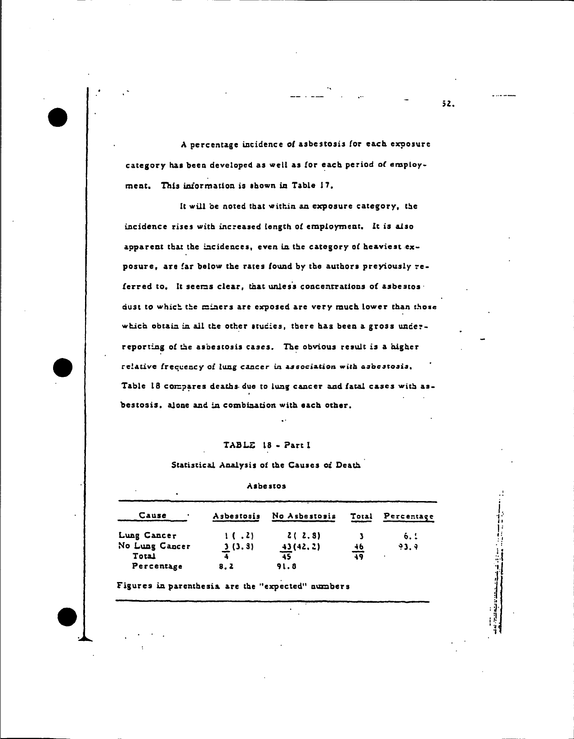
52 A percentage incidence of asbestosis for each exposure category has been developed as well as for each period of employ ment.
refid# V3ZvzZ4oxG6ONjr31QogNMxOg1 page
t) Yoik i Oe* iford.
refid# gb5dXEqp7nLjw76akXJ5K2rpa1 page
Iftdatarltl KvfUSr a: .
refid# 1OyKqL0QZRMDd22NOnjzY8Nm1 page
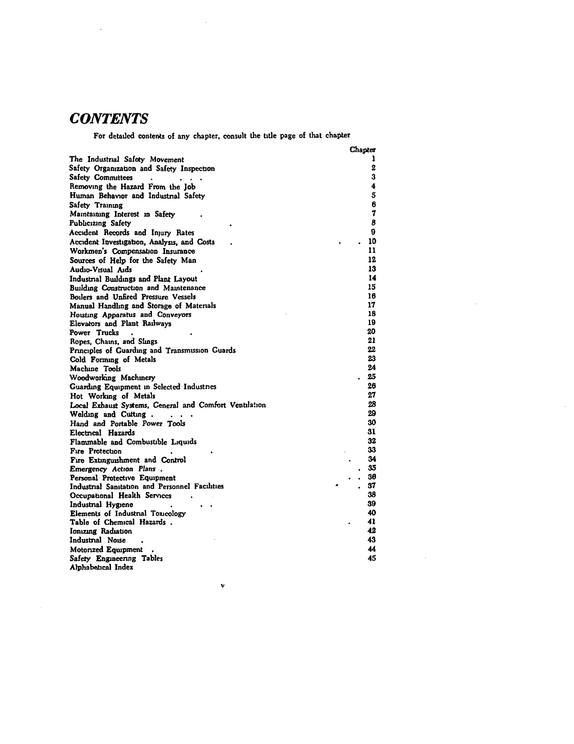
CONTENTS For detailed contents of any chapter, consult the title page of that chapter The Industrial Safety Movement Safety Organization and Safety Inspection Safety Committees ....
refid# 70JJ6376GwO3gn6YD43YdZ4ke1 page
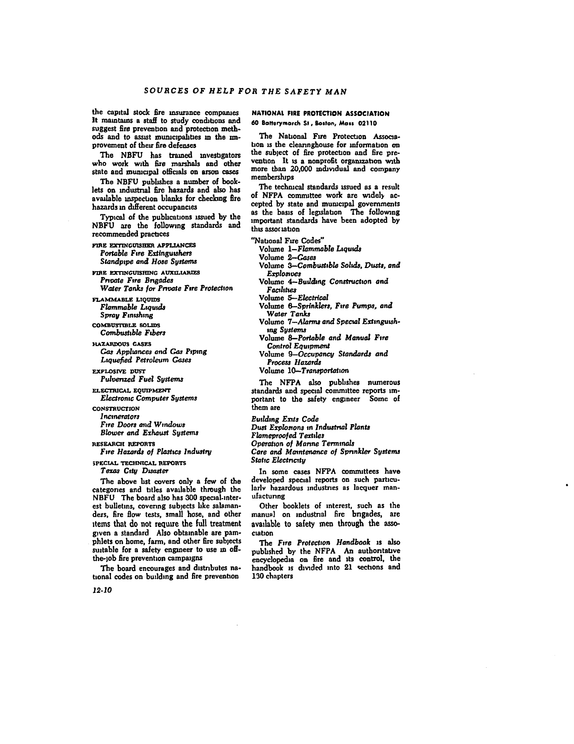
SOURCES OF HELP FOR THE SAFETY MAN the capital stock fire insurance companies It maintains a staff to study conditions and suggest fire prevention and protection meth ods and to assist municipalities in the im provement of their fire defenses The NBFU has trained investigators who work with fire marshals and other state and municipal officials on arson cases The NBFU publishes a number of book lets on industrial fire hazards and also has available inspection blanks for checking fire hazards in different occupancies Typical of the publications issued by the NBFU are the following standards and recommended practices FIRE EXTINGUISHER APPLIANCES Portable Fire Extinguishers Standpipe and Hose Systems FIRE EXTINGUISHING AUXILIARIES Private Fire Brigades Water Tanks for Private Fire Protection FLAMMABLE LIQUIDS Flammable Liquids Spray Finishing COMBUSTIBLE SOLIDS Combustible Fibers HAZARDOUS CASES Gas Appliances and Cos Piping Liquefied Petroleum Gases EXPLOSIVE DUST Pulverized Fuel Systems ELECTRICAL EQUIPMENT Electronic Computer Systems CONSTRUCTION Incinerators Fire Doors and Windows Blower and Exhaust Systems RESEARCH REPORTS Fire Hazards of Plastics Industry SPECIAL TECHNICAL REPORTS Texas City Disaster The above bst covers only a few of the categories and titles available through the NBFU The board also has 300 special-inter est bulletins, covering subjects like salaman ders, fire flow tests, small hose, and other items that do not require the full treatment given a standard Also obtainable are pam phlets on home, farm, and other fire subjects suitable for a safety engineer to use in offthe-job fire prevention campaigns The board encourages and distributes na tional codes on building and fire prevention 12-10 NATIONA1 FIRE PROTECTION ASSOCIATION 60 Bolterymorch Si, Bolton, Mon 02110 The National Fire Protection Associa tion is the clearinghouse for information on the subject of fire protection and fire pre vention It is a nonprofit organization with more than 20,000 individual and company memberships The technical standards issued as a result of NFPA committee work are widely ac cepted by state and municipal governments as the basis of legislation The following im[x>rtant standards have been adopted by this association "National Fire Codes" Volume 1--Flammable Liquids Volume 2--Gases Volume 3--Combustible Solids, Dusts, and Explosives Volume 4--Budding Construction and Facilities Volume 5--Electrical Volume 6--Sprinklers, Fire Pumps, and Water Tanks Volume 7--Alarms and Special Extinguish ing Systems Volume 8--Portable and Manual Fire Control Equipment Volume 9--Occupancy Standards and Process Hazards Volume 10--Transportation The NFPA also pubbshes numerous standards and special committee reports im portant to the safety engineer Some of them are Building Exits Code Dust Explosions in Industrial Plants Flameproofed Textiles Operation of Marine Terminals Care and Maintenance of Sprinkler Systems Static Electricity In some cases NFPA committees have developed special reports on such particu larly hazardous industries as lacquer man ufacturing Other booklets of interest, such as the manual on industrial fire brigades, are available to safety men through the asso ciation The Fire Protection Handbook is also pubbshed by the NFPA An authoritative encyclopedia on fire and its control, the handbook is divided into 21 sections and 130 chapters
refid# mmL0npG5oRDabZvvgk9LyVvzB1 page
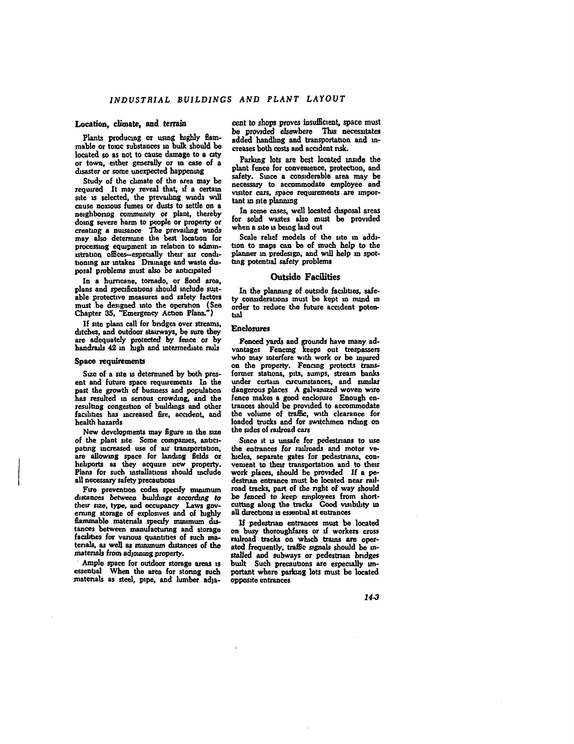
INDUSTRIAL BUILDINGS AND PLANT LAYOUT Location, climate, and terrain Plants producing or using highly flam mable or tone substances in bulk should be located so as not to cause damage to a city or town, either generally or m case of a disaster or some unexpected happening Study of the climate of the area may be required It may reveal that, if a certain site is selected, the prevailing winds will cause noxious fumes or dusts to settle on a neighboring community or plant, thereby doing severe harm to people or property or creating a nuisance The prevailing winds may also determine the best location for processing equipment in relabon to admin istration offices--especially their air condi tioning air intakes Drainage and waste dis posal problems must also be anticipated In a hurricane, tornado, or flood area, plans and specifications should include suit able protective measures and safety factors must be designed into the operation (See Chapter 35, "Emergency Action Plans.")
refid# O30kzbo72wjMLRQoN1pMwgD6X1 page
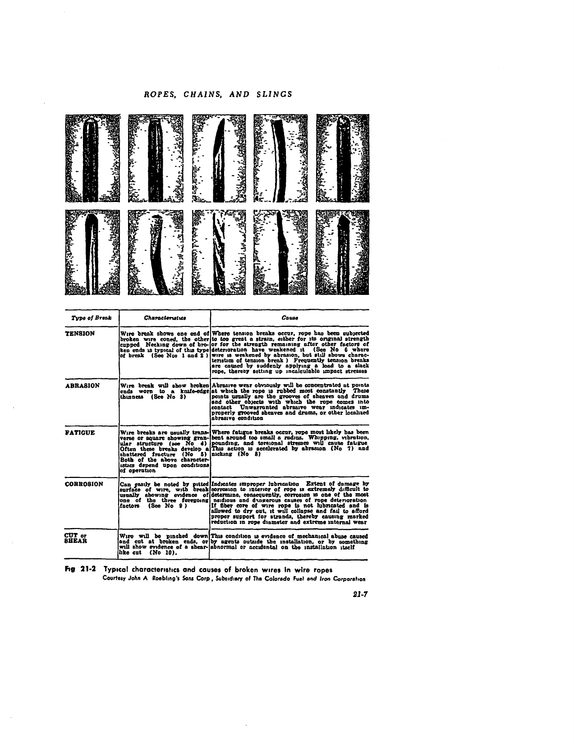
ROPES, CHAINS, AND SLINGS Typo 0/ Break Characteristic* Cause tension Wire break shows one end of Where tension breaks oecur, rope has been subjected broken wire coned, the other to too greet a strain* either for its original strength cupped Necking down of bro or for the strength remaining after other factors of ken ends is typical of this type deterioration have weakened it (See No 6 where of break (See Nos 1 and 2 ) wire is weakened by abrasion, but still shows charac teristics of tension break ) Frequently tension breaks are caused by suddenly applying a load to a slack rope, thereby setting up incalculable impact stresses abrasion Wive break will show broken Abrasive wear obviously will be concentrated at points ends worn to a knife-edge at which the rope is nibbed most constantly These thinness (See No 8) points usually are the grooves of sheaves and drums and other objects with which the rope comes into contact Unwarranted abrasive wear indicates im properly grooved sheaves and drums, or other localised abrasive condition FATIGUE COBBOSION CUT or BHEAR Wire breaks are usually trans Where fatigue breaks occur, rope most likely has been verse or square showing gran bent around too small a radios.
refid# QJ77zx5BQQ1zME3bLJVDYDLZk1 page
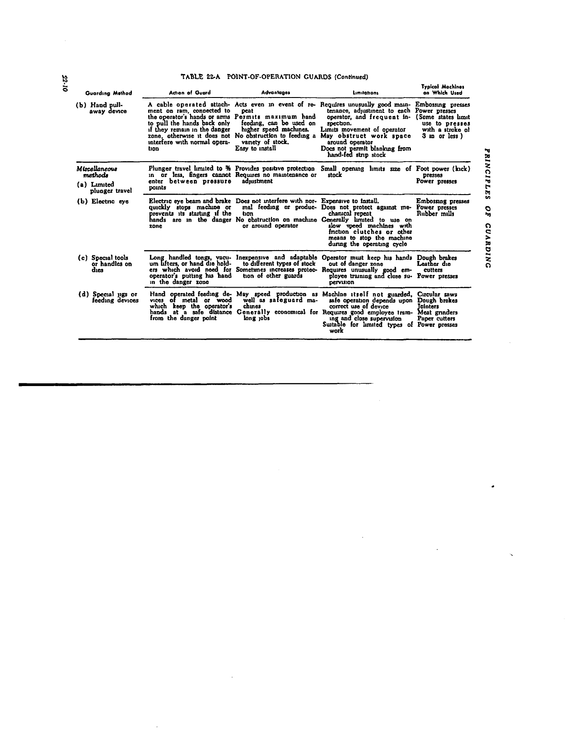
P R IN C IP LE S OF CC/ARDINC 22-10 Guordmg Method (b) Hand pullaway device TABLE fcfc-A P01NT-0F-0PERAT10N GUARDS (Continued) Action of Guard Advantage* limitation!
refid# NGQDqBmbqxLOr1r9Do3kx1ngp1 page
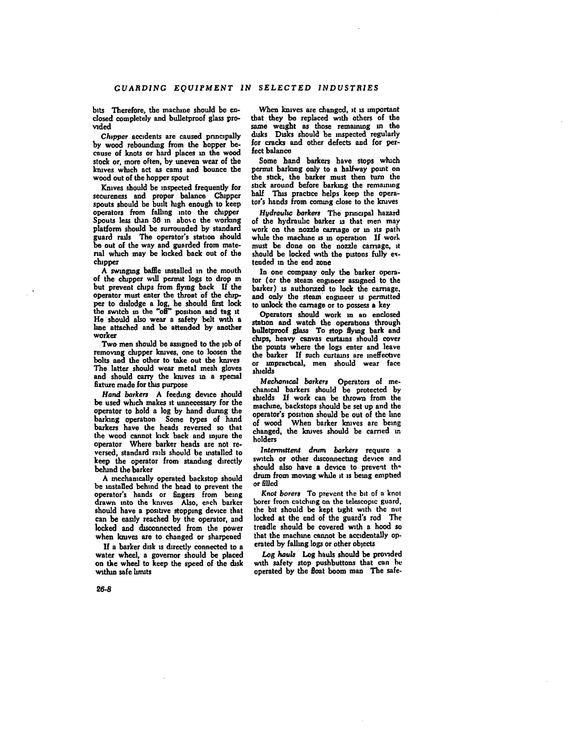
GUARDING EQUIFMENT IN SELECTED INDUSTRIES bits Therefore, the machine should be en closed completely and bulletproof glass pro vided Chipper accidents are caused principally by wood rebounding from the hopper be cause of knots or hard places in the wood stock or, more often, by uneven wear of the knives which act as cams and bounce the wood out of the hopper spout Knives should be inspected frequently for secureness and proper balance Chipper spouts should be built high enough to keep operators from falling into the chipper Spouts less than 30 m above the working platform should be surrounded by standard guard rails The operator's station should be out of the way and guarded from mate rial which may be kicked back out of the chipper A swinging baffle installed in the mouth of the chipper will permit logs to drop m but prevent chips from flying back If the operator must enter the throat of the chip per to dislodge a log, he should first lock the switch in the "off" position and tag it He should also wear a safety belt with a line attached and be attended by another worker Two men should be assigned to the job of removing chipper knives, one to loosen the bolts and the other to take out the knives The latter should wear metal mesh gloves and should carry the knives in a special fixture made for this purpose Hand barken A feeding device should be used which makes it unnecessary for the operator to hold a log by hand during the barking operation Some types of hand barkers have the heads reversed so that the wood cannot kick back and injure the operator Where barker heads are not re versed, standard rails should be installed to keep the operator from standing directly behind the barker A mechanically operated backstop should be installed behind the head to prevent the operator's hands or fingers from being drawn into the knives Also, each barker should have a positive stopping device that can be easily reached by the operator, and locked and disconnected from the power when knives are to changed or sharpened If a barker disk is directly connected to a water wheel, a governor should be placed on the wheel to keep the speed of the disk within safe limits When knives are changed, it is important that they bo replaced with others of the same weight as those remaining in the disks Disks should be inspected regularly for cracks and other defects and for per fect balance Some hand barkers have stops which permit barking only to a halfway point on the stick, the barker must then tum the stick around before barking the remaining half This practice helps keep the opera tor's hands from coming close to the knives Hydraulic barken The principal hazard of the hydraubc barker is that men may work on the nozzle carnage or in its path while the machine is in operation If work must be done on the nozzle carnage, it should be locked with the pistons fully ex tended in the end zone In one company only the barker opera tor (or the steam engineer assigned to the barker) is authorized to lock the carnage, and only the steam engineer is permitted to unlock the carnage or to possess a key Operators should work in an enclosed station and watch the operations through bulletproof glass To stop flying bark and chips, heavy canvas curtains should cover the points where the logs enter and leave the barker If such curtains are ineffective or impractical, men should wear face shields Mechanical barkers Operators of me chanical barkers should be protected by shields If work can be thrown from the machine, backstops should be set up and the operator's position should be out of the lme of wood When barker knives are being changed, the knives should be earned m holders Intermittent drum barkers require a switch or other disconnecting device and should also have a device to prevent th drum from moving while it is being emptied or filled Knot borers To prevent the bit of a knot borer from catching on the telescopic guard, the bit should be kept tight with the nut locked at the end of the guard's rod The treadle should be covered with a hood so that the machine cannot be accidentally op erated by falling logs or other objects Log hauls Log hauls should be provided with safety stop pushbuttons that can be operated by the float boom man The safe- 86-8
refid# BRq85DdME0LMK6NR5wYYKGpdo1 page
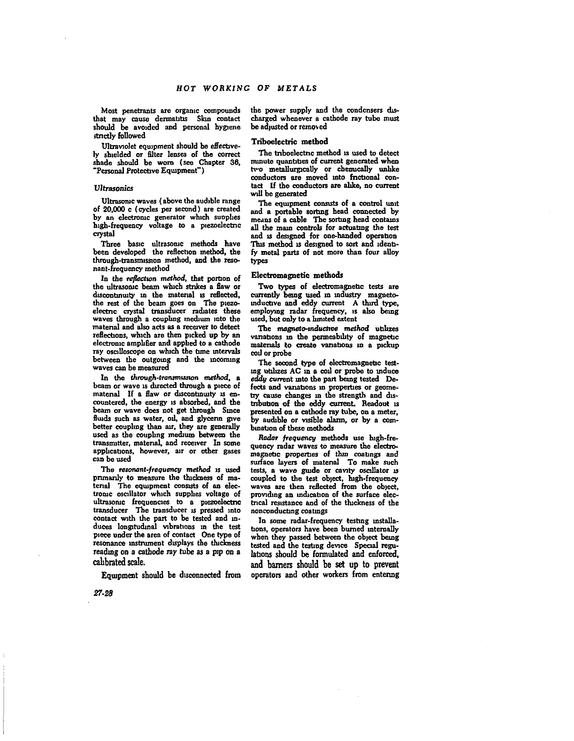
HOT WORKING OF METALS Most penetrants are organic compounds that may cause dermatitis Sian contact should be avoided and personal hygiene strictly followed Ultraviolet equipment should be effective ly shielded or filter lenses of the correct shade should be worn (see Chapter 36, 'Personal Protective Equipment") Ultrasonics Ultrasonic waves (above the audible range of 20,000 c (cycles per second) are created by an electronic generator which suDphes high-frequency voltage to a piezoelectric crystal Three basic ultrasonic methods have been developed the reflection method, the through-transmission method, and the reso nant-frequency method In the reflection method, that portion of the ultrasonic beam which strikes a flaw or discontinuity in the material is reflected, the rest of the beam goes on The piezo electric crystal transducer radiates these waves through a coupling medium into the material and also acts as a receiver to detect reflections, which are then picked up by an electronic amplifier and applied to a cathode lay oscilloscope on which the time intervals between the outgoing and the incoming waves can be measured In the through-transmission method, a beam or wave is directed through a piece of material If a flaw or discontinuity is en countered, the energy is absorbed, and the beam or wave does not get through Since fluids such as water, oil, and glycerin give better coupling than air, they are generally used as the coupling medium between the transmitter, material, and receiver In some applications, however, air or other gases can be used The resonant-frequency method is used primarily to measure the thickness of ma terial The equipment consists of an elec tronic oscillator which supplies voltage of ultrasonic frequencies to a piezoelectric transducer The transducer is pressed into contact with the part to be tested and in duces longitudinal vibrations in the test piece under the area of contact One type of resonance instrument displays the thickness reading on a cathode ray tube as a pip on a calibrated scale.
refid# gEYrBoBeQae6Jged3xyMo3VXQ1 page
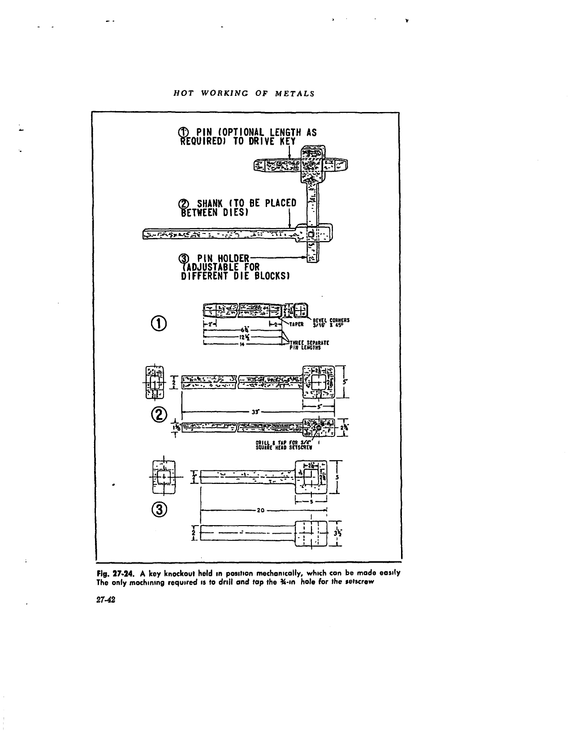
HOT WORKING OF METALS (T) PIN (OPTIONAL LENGTH AS REQUIRED) TO DRIVE KEY (2) SHANK (TO BE PLACED ,3-i.
refid# O1n6eDdNLrQb1JbQvqVqpE5oj1 page
FLAMMABLE AND COMBUSTIBLE LIQUIDS If the inside of the container is clean and steam is available, the easiest method is to steam it.
refid# bBa08xr1LBnaZqqE3K81yDNJ01 page
PLAINTIFFS EXHIBIT y ':!"'

refid# z25Me17eL0mmyjO8Qx9V6xXm38 pages