Refine
Estimated Years UndatedClear
92,592 results foundRefine Search
gii^fM|g^ ; wtt :K >kAu&\ 4/v^.- r*-o vt* ,cn ' ' ' ` -- - '-** ehn^.
refid# 6bppYr09kLzKwk6rk90R07yYo2 pages
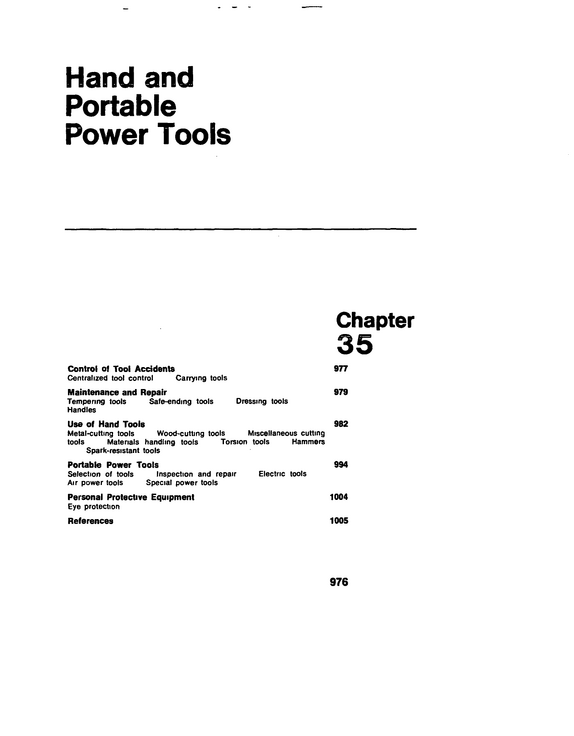
Hand and Portable Power Tools Chapter 35 Control of Tool Accidents Centralized tool control Carrying tools 977 Maintenance and Repair Tempering tools Safe-ending tools Handles Dressing tools 979 Use of Hand Tools Metal-cutting tools Wood-cutting tools Miscellaneous cutting tools Materials handling tools Torsion tools Hammers Spark-resistant tools 982 Portable Power Tools Selection of tools Inspection and repair Air power tools Special power tools Electric tools 994 Personal Protective Equipment Eye protection 1004 References 1005 976
refid# 70MRdb99jXGza5Jp2vezM3KmV1 page
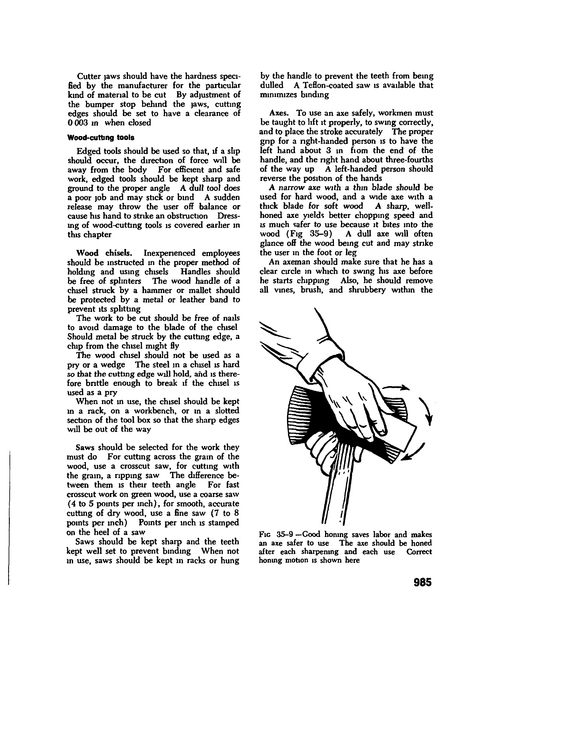
Cutter jaws should have the hardness speci fied by the manufacturer for the particular kind of material to be cut By adjustment of the bumper stop behind the jaws, cutting edges should be set to have a clearance of 0003 m when closed Wood-cutting tools Edged took should be used so that, if a slip should occur, the direction of force will be away from the body For efficient and safe work, edged tools should be kept sharp and ground to the proper angle A dull tool does a poor job and may stick or bind A sudden release may throw the user off balance or cause his hand to strike an obstruction Dress ing of wood-cutting tools is covered earlier m this chapter Wood chisek.
refid# R2JbvJ2mBE1kQVkRbreEev2yn1 page
37--Industrial Hygiene Definition of terms The safety professional must be aware of the precise meanings of certain words com monly used in industrial hygiene if he is going to effectively communicate with other workers in this area A fume respirator, for instance, is worthless as protection against gases or vapors Too frequently, terms (such as gases, vapors, fumes, and mists) are used interchangeably Each term has a definite meaning and describes a certain state of matter which can be achieved only by certain physical changes to the substance itself Basic to the industrial hygiene vocabulary are states of matter As defined by the Amer ican National Standards Institute, these are as follows Dusts Solid particles generated by han dling, crushing, grinding, rapid impact, det onation, and decrepitation of organic or in organic materials, such as rock, ore, metal, coal, wood, and gram Dusts do not tend to flocculate except under electrostatic forces, they do not diffuse in air but settle under the influence of gravity Dust is a term used m industry to describe airborne solid particles that range m size from 0 1 to 25/i(l,i = 1/10,000 cm = 1/25,000 in ) (/i is the abbreviation for micron) Dusts above 5/i in size usually will not remain air borne long enough to present an inhalation problem Dust may enter the air from various sources It may be dispersed when a dusty material is handled, such as when lead oxide is dumped into a mixer or a product is dusted with talc When solid materials are reduced to small sizes in processes such as grinding, crushing, blasting, shaking, and drilling, the mechanical action of the grinding or shaking device supplies a source of energy to disperse the dust formed Fumes Solid particles generated bv con densation from the gaseous state, generally after volatilization from molten metals This physical change is often accompanied by a chemical reaction, such as oxidation Fumes flocculate and sometimes coalesce A fume is formed when a volatilized solid, such as a metal, condenses m cool air The solid particles that make up a fume are ex 1040 tremely fine, usually less than 10/a In most cases, the hot material reacts with the air to form an oxide Examples are lead oxide fume from smelting, and iron oxide fume from arc welding A fume can also be formed when a matenal such as magnesium metal is burned or when weldmg or gas cutting is done on galvanized metal Odorous gases and vapors are not fumes Newspaper columnists commonly misuse this term and refer to carbon monoxide as a fume Smoke Carbon or soot particles less than 0 l/i in size which result from the incomplete combustion of carbonaceous materials such as coal or oil Smoke generally contains droplets as well as dry particles Tobacco, for instance, produces a wet smoke composed of minute tarry droplets The size of the particles contained in tobacco smoke is about 0 25/i Aerosols Liquid droplets or solid par ticles dispersed in air, that are of fine enough particle size to remain so dispersed for a period of time Mists Suspended liquid droplets gen erated by condensation from the gaseous to the liquid state or by breaking up a liquid into a dispersed state, such as by splashmg, foam ing, or atomizing Mist is formed when a finely divided liquid is suspended in air Examples are the oil mist produced during cutting and grinding operations, acid mists from electroplating, acid or alkali mists from pickling operations, paint spray mist from spraying operations and the condensation of water vapor to form a fog or rain Gases Normally formless fluids which occupy the space of enclosure and which can be changed to the liquid or solid state only by the combined effect of increased pressure and decreased temperature Gases diffuse Examples are weldmg gases, ex haust gases, and air Vapors The gaseous form of substances which are normally in the solid or liquid state (at room temperature and pressure) The vapor can be changed back to the solid or liquid state either by increasing the pressure
refid# DG1MMn9vN3r4LyzwRaGnjVaVM1 page
Noise and Hearing Conservation Chapter 40 Properties of Noise The decibel Frequency Noise Effects on Man Mechanics of hearing Loss of hearing industrial Noise Exposure Noise measurement .
refid# vV42BOxwpEpBDob16y1bGZ5zb1 page
41--Electrical Hazards the loss immediately to your supervisor and get a new padlock Removing fuses When it is necessary to remove a fuse, the operating switch should be opened to re move the load and the fuse should be ex tracted with an insulated fuse puller If the fuse is not protected with a switch, the supply end of the fuse should be pulled out first When the fuse is replaced, the supply end should be put m first It is important that a fuse be replaced by one of the same type and size and that a cop per wire or- other conductor never be sub stituted For work on lines carrying over 600 volts, the sources of energy can be opened by trip ping the circuit breaker and then opening the disconnects The conductors should be tagged, and, if possible, a substantial grounded conductor should be clamped to each leg of the circuit before the work is started The gioundmg conductors should be removed just before the circuit is re energized As an added precaution, tests should be made with a voltmeter or other standard approved tester to make sure the circuit is clear In emergencies where the areas around fuse boxes are wet, wood platforms, insulated stools, or lubber boots should be used by maintenance woikers Wiring Electrical installations should be made in accordance with the National Electrical Code as a minimum standard, and each job should be pioperly inspected The use of temporary wiring should be discouraged even though it may be reasonably safe when first put m As a job progresses and repairs or installa tions are made, temporary wiring mav be come unsafe because it is not properly pro tected from mechanical injury Maintenance men should make it a prac tice to inspect plugs and connections on portable electric equipment to see that the thud wire frame ground is properlv con nected, the grounding prong has not been re moved, and the cord is properly connected to the terminals Where there is any doubt about the safe operation of a tool, it should 1284 be removed from service, tagged, and returned to the tool room for repairs When additional equipment is being in stalled or operated under temporary condi tions, no taps should be made into an existing circuit unless an individual switch is installed in the branch line, with provision being made for locking the switch "off" and tagging it Tliis precaution will prevent service interrup tions m the main circuit when power must be shut off in the branch circuit, and it will also prevent accidental starting of extra equipment that is tapped in Employee Training Few plants experience difficulty m selec tion and installation, but in maintenance and use of electrical equipment, deviation from safe practices is sometimes tolerated, with the usual result that unnecessary hazaids are created and men ai e injured and killed There fore, for maximum effectiveness, the safety program should include thorough training of all employees who work with the electrical installation of the plant or operate electrical equipment In addition to instructions on the hazards of electricity, employees should be trained m first aid, the use of warning signs, guards, and other protective devices, and in safe operational procedures It is essential that they be trained in the mouth-to-mouth method of i esuscitation and, in some cases, external cardiac massage The training program should be based on the plant's electrical system and applied spe cifically to plant operations Supervisors should be given such instruc tions as may be necessary to acquaint them with existing or probable electrical hazards, and they should be required to maintain close supervision over all operations which involve the use of electrical equipment They should encourage employees to report immediately anv electrical defects observed and this equip ment should be repaired or replaced at once It is recommended that members of the organization's safety department familiarize themselves with the codes and standards which apply to their equipment and operation and that someone from the electrical mainte nance staff be an active member of the plant safety committee
refid# R63EQzLVYNbwyowzKv55newk1 page
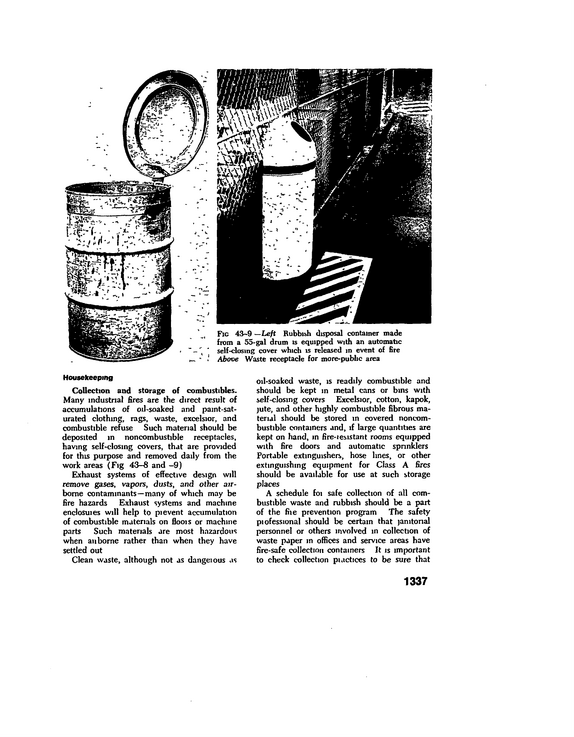
Fic 43-9 --Left Rubbish disposal container made from a 55-gal drum is equipped with an automatic self-closing cover which is released in event of fire Above Waste receptacle for more-public area Housekeeping Collection and storage of combustibles.
refid# aBgOGNLaK4q9BwrrLkpVOXDNa1 page
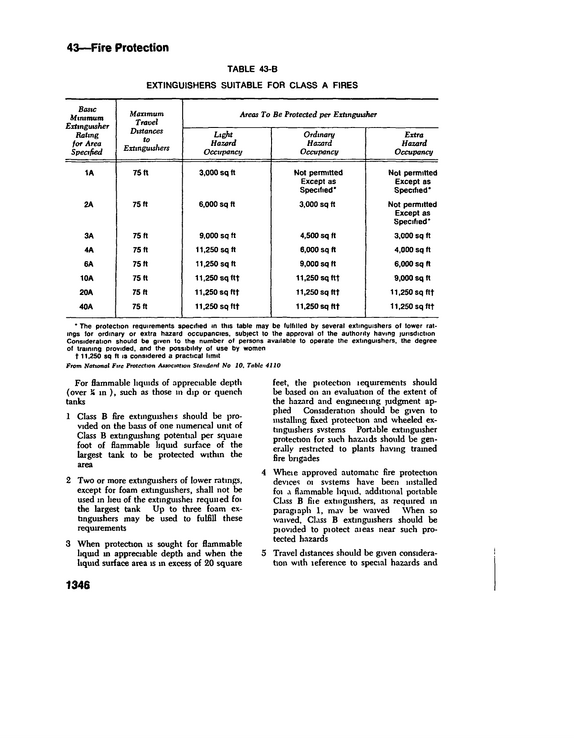
43--Fire Protection TABLE 43-B EXTINGUISHERS SUITABLE FOR CLASS A FIRES Baste Minimum Extinguisher Rating for Area Specified Maximum Travel Distances to Extinguishers Areas To Be Protected per Extinguisher Light Hazard Occupancy Ordinary Hazard Occupancy Extra Hazard Occupancy 1A 75 ft 2A 75 ft 3A 75 ft 4A 75 ft 6A 75 ft 10A 75 ft 20A 75 ft 40A 75 ft 3,000 sq ft 6,000 sq ft 9,000 sq ft 11,250 sq ft 11,250 sq ft 11,250 sqftt 11,250 sqftf 11,250 sqftt Not permitted Except as Specified* 3,000 sq ft 4,500 sq ft 6,000 sq ft 9,000 sq ft 11,250 sqftt 11,250 sq ftt 11,250 sqftt Not permitted Except as Specified* Not permitted Except as Specified* 3,000 sq ft 4,000 sq ft 6,000 sq ft 9,000 sq ft 11,250 sqftt 11,250 sqftt * The protection requirements specified in this table may be fulfilled by several extinguishers of lower rat ings for ordinary or extra hazard occupancies, subject to the approval ot the authority having jurisdiction Consideration should be given to the number of persons available to operate the extinguishers, the degree of training provided, and the possibility of use by women 111,250 sq ft is considered a practical limit From National Fire Protection Association Standard No 10, Tabic 4110 For flammable liquids of appreciable depth (over K in ), such as those m dip or quench tanks 1 Class B fire extinguisheis should be pro vided on the basis of one numerical unit of Class B extinguishing potential per squaie foot of flammable liquid surface of the largest tank to be protected within the area 2 Two or more extinguishers of lower ratings, except for foam extinguishers, shall not be used in lieu of the extinguishei requn ed foi the largest tank Up to three foam ex tinguishers may be used to fulfill these requirements 3 When protection is sought for flammable liquid in appreciable depth and when the liquid surface area is in excess of 20 square feet, the piotection lequirements should be based on an evaluation of the extent of the hazard and engineeting judgment ap plied Consideration should be given to installing fixed protection and wheeled ex tinguishers svstems Portable extinguisher protection for such hazaids should be gen erally restricted to plants having trained fire brigades 4 Wheie approved automatic fire protection devices 01 svstems have been installed foi a flammable liquid, additional portable Class B file extinguishers, as required m paragiapli 1, mav be waived When so waived.
refid# qko2yQEQqVwK1OdyrDxQqpod51 page
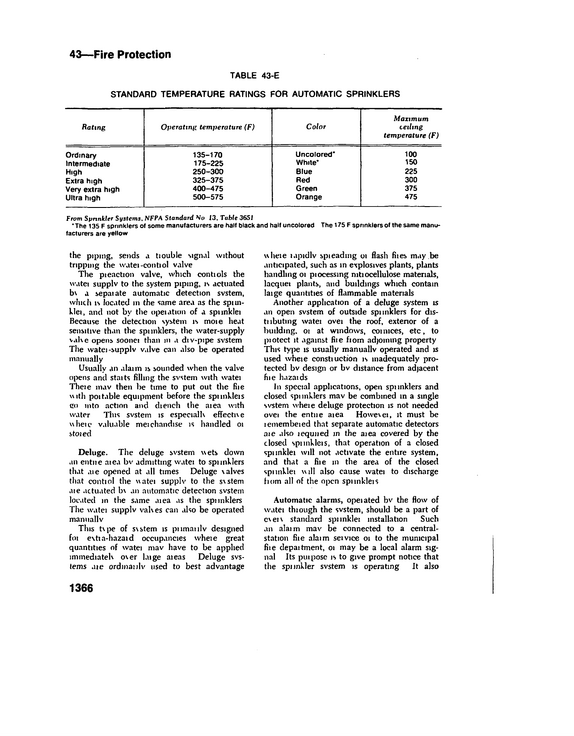
43--Fire Protection TABLE 43-E STANDARD TEMPERATURE RATINGS FOR AUTOMATIC SPRINKLERS Rating Operating temperature (F) Color Maximum ceiling temperature (F) Ordinary Intermediate High Extra high Very extra high Ultra high 135-170 175-225 250-300 325-375 400-475 500-575 Uncolored* White* Blue Red Green Orange 100 150 225 300 375 475 From Sprinkler Systems, NFPA Standard No 13, Table 3651 'The 135 F sprinklers of some manufacturers are half black and half uncolored The 175 F sprinklers of the same manu facturers are yellow the piping, sends a tiouble signal without tripping the watei-contiol valve The pieaction valve, which contiols the watei supplv to the system piping, is actuated bv a sepai ate automatic detection svstem, which is located in the same area as the spimklei, and not by the opeiation of a spunklei Because the detection system is moie heat sensitive than the spnnklers, the water-supply valse opens soonei than m a div-pipe svstem The watei-supplv valve can also be operated manually Usually an alaim is sounded when the valve opens and staits filling the svstem with watei Theie mav then be time to put out the fiie with poitable equipment before the spunkleis co into action and chench the aiea with water Tins svstem is especialh effective wheic valuable meichandise is handled oi stoied Deluge.
refid# rx3gDzBKxm82D822LMR01xEke1 page
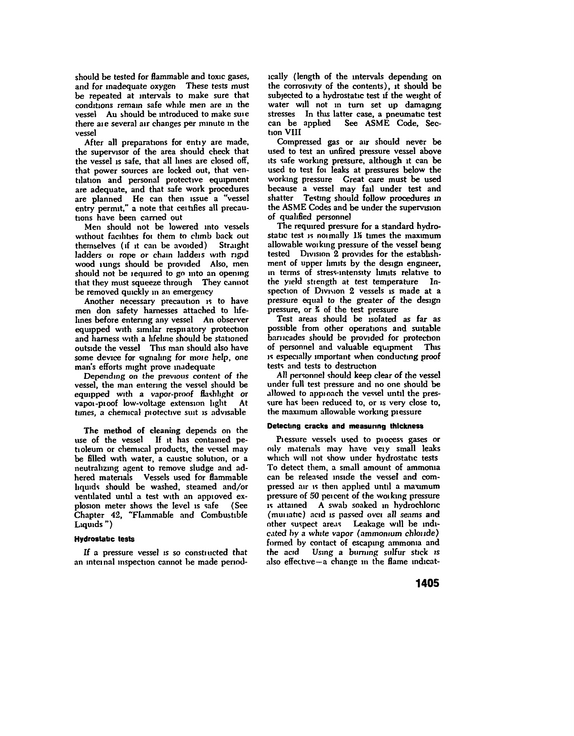
should be tested for flammable and toxic gases, and for inadequate oxygen These tests must be repeated at intervals to make sure that conditions remain safe while men are in the vessel Au should be introduced to make suie there aie several air changes per minute m the vessel After all preparations for entiy are made, the supervisor of the area should check that the vessel is safe, that all lines are closed off, that power sources are locked out, that ven tilation and personal protective equipment are adequate, and that safe work procedures are planned He can then issue a "vessel entry permit," a note that ceitifies all precau tions have been earned out Men should not be lowered into vessels without facilities foi them to climb back out themselves (if it can be avoided) Straight ladders 01 rope or chain laddeis with rigid wood lungs should be provided Also, men should not be tequired to go into an opening that they must squeeze through They cannot be removed quickly in an emergency Another necessary precaution is to have men don safety harnesses attached to life lines before entering any vessel An observer equipped with similar respnatory protection and harness with a lifeline should be stationed outside the vessel This man should also have some device for signaling for mote help, one man's efforts might prove inadequate Depending on the previous content of the vessel, the man entering the vessel should be equipped with a vapor-proof flashlight or vapoi-pioof low-voltage extension light At times, a chemical piotective suit is advisable The method of cleaning depends on the use of the vessel If it has contained peti oleum or chemical products, the vessel may be filled with water, a caustic solution, or a neutralizing agent to remove sludge and ad hered materials Vessels used for flammable liquids should be washed, steamed and/or ventilated until a test with an appioved ex plosion meter shows the level is safe (See Chapter 42, "Flammable and Combustible Liquids ") Hydrostatic tests If a pressure vessel is so constiucted that an intei nal inspection cannot he made period ically (length of the intervals depending on the corrosivity of the contents), it should be subjected to a hydrostatic test if the weight of water will not m turn set up damaging stresses In this latter case, a pneumatic test can be applied See ASME Code, Sec tion VIII Compressed gas or air should never be used to test an unfired pressure vessel above its safe working pressure, although it can be used to test foi leaks at pressures below the working pressure Great care must be used because a vessel may fail under test and shatter Testing should follow procedures in the ASME Codes and be under the supervision of qualified personnel The required pressure for a standard hydro static test is noimally 13* times the maximum allowable woiking pressure of the vessel being tested Division 2 provides for the establish ment of upper limits by the design engineer, in terms of stress-intensity limits relative to the yield stiength at test temperature In spection of Division 2 vessels is made at a pressure equal to the greater of the design pressure, or of the test pressure Test areas should be isolated as far as possible from other operations and suitable barncades should be provided for protection of personnel and valuable equipment This is especially important when conducting proof tests and tests to destruction All personnel should keep clear of the vessel under full test pressure and no one should be allowed to appioach the vessel until the pres sure has been reduced to, or is very close to, the maximum allowable working piessure Detecting cracks and measuring thickness Piessure vessels used to piocess gases or oily materials may have veiy small leaks which will not show under hydrostatic tests To detect them, a small amount of ammonia can be released inside the vessel and com pressed air is then applied until a maximum pressure of 50 peicent of the woiking pressure is attained A swab soaked m hydrochloric (muuatic) acid is passed ovei all seams and other suspect areas Leakage will be indi cated by a white vapor (ammonium chloude) formed by contact of escaping ammonia and the acid Using a burning sulfur stick is also effective--a change in the flame mdicat- 1405
refid# 9Jwn9Yv3p5b6zw5mpp6pb0KV51 page
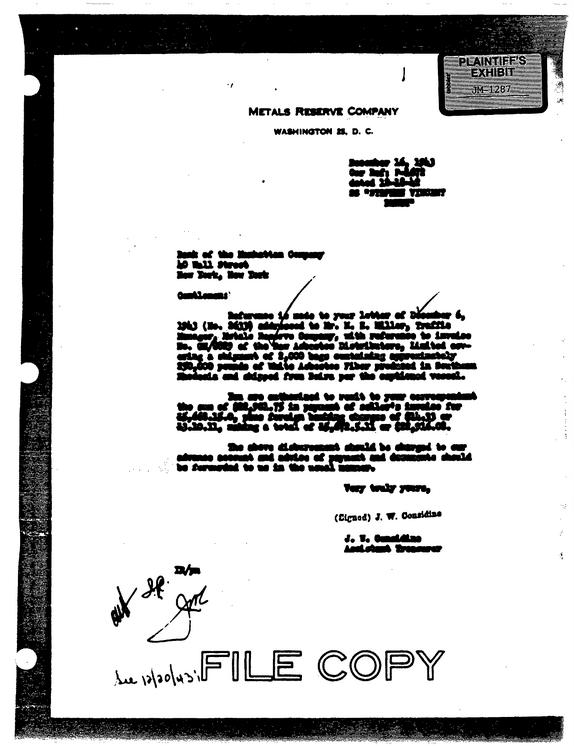
J / METALS RESERVE COMPANY WASHINGTON IS, D.
refid# 32JLgerpbqGmEq7Qy2eG4XBn1 page
G> 4 Sjm9uiC.
refid# Ne3b4YNYL7aVpKkgEEeXoogvD9 pages
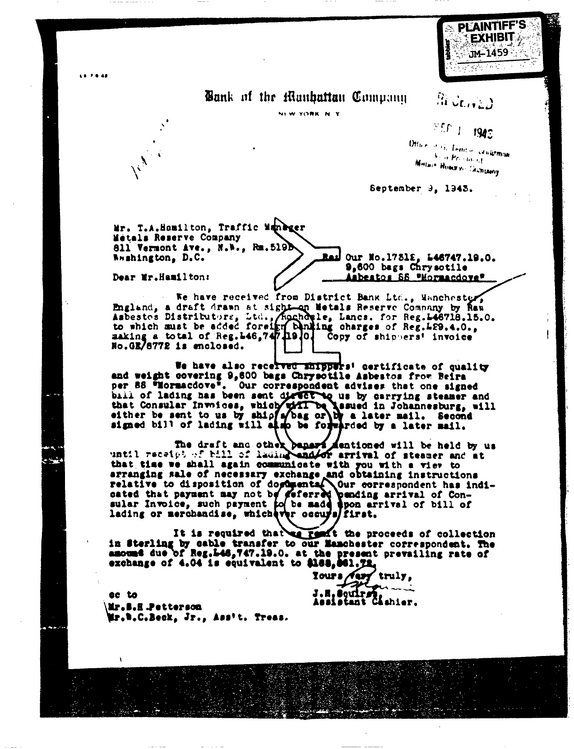
4* \ V Sank nf thr itiuttljattmi (Euiihkiiui Nt W YORK N Y or. rrr i 94- |l .
refid# DYXBYjbx789kzdMaoE2oJMx41 page
f\ r'TP-n V ItU!
refid# OEJGJxG0dkzLmxnBqYjXXvYOp5 pages
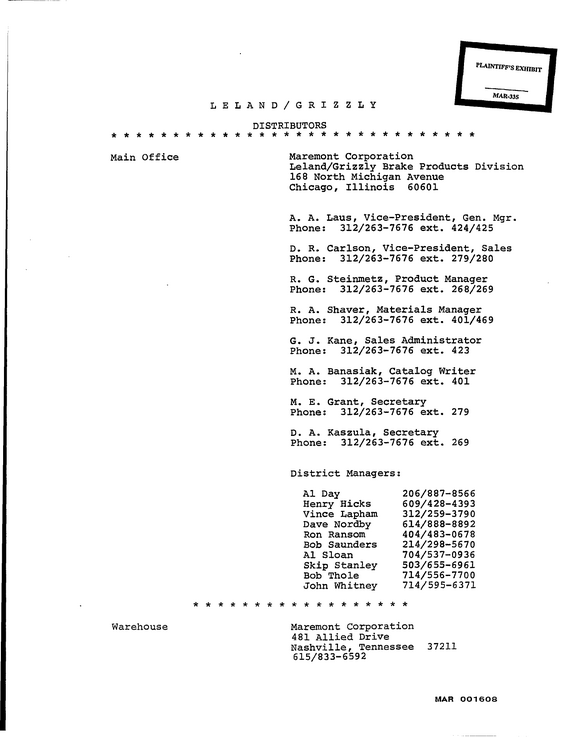
LELAND/GRIZ ZLY DISTRIBUTORS ********* ********************* Main Office Maremont Corporation Leland/Grizzly Brake Products Division 168 North Michigan Avenue Chicago, Illinois 60601 A.
refid# oMeMNEZxEXraNmMd0pgz4NmDX34 pages