Refine
Estimated Years UndatedClear
92,592 results foundRefine Search
COMMITTEES CHEMICAL-TOXICOLOGICAL Chairman Dr.
refid# jyED45wVGrkE5ng6goJ3ENaEZ1 page
Human Behavior and Industrial Safety complicates the analysis of behavior People are seldom mobvated by just one thing-- many forces operate at any single moment For example at lunch bme, one may eat be cause he is in need of food, or just because it is the usual bme However, an individual might delay his lunch thirty minutes so that he can join several friends and have lunch with them Thus, he combines the satisfacbon of his need to belong and to eat In another case an employee could desire recognition from his fellow workers and so might engage m practical jokes At the same time, he may be seeking recognibon from his foreman by working hard on the safety com mittee The need is the same but the means of sabsfacbon are in direct conflict This is mulbple motivation It would be to the safety director's advantage, m the second case, to recognize what the need is that the worker is trying to satisfy, and find ways to channel the behavior so he can achieve recognition from fellow employees and the foreman Caution must be emphasized re peatedly in approaching this problem of be havior analysis Behavior analysis is chal lenging, and is important to a successful safety program Hierarchical motivabon means simply that some needs take a higher priority--there is a hierarchy of motivabonal factors It has been pointed out that the psychosocial needs take precedence over the biological ones when the latter are relatively well satisfied This is but one aspect of the hierarchy of needs concept The safety professional who plans carefully and takes each detail of his program to his boss for approval mav be exhibiting an over whelming desire for achievement and recog nition, a desire much stronger than his need for affection This is true particularly if he forgets his human relations skills m dealing with workers He may be so impressed with his own personal achievements, and perhaps the recognition given for them, that he forces plans upon workers which they would not accept from free choice Another example is the worker who con siders recognition as the major need that he must satisfy This individual perhaps would go all out to become a strong militant leader of the union if he were to lose a promobon in the company The safety director may him self be in conflict with this individual who may not care about the safety director's dis approval and instead values the affecbon and recognition of his fellow workers This hierarchy changes over the years What is desired more early m life may as sume less importance later The need for achievement and recognibon perhaps is greatest in youth, thus giving a dnve toward accomplishment Later in life, perhaps, the warm affecbon of friends or the security of belonging to groups may assume major im portance if one has already had recognition for past work Conflicting motives constitute another major problem m motivation --needs them selves can be m conflict with one another Seeking affection could lead to behavior which might be different with fellow workers than with supervisors It may be necessary to determine which source of affection is the more important before doing anything People can internalize these problems to such a degree that the resultant physical stress, worry, anxious periods, or even be havior is completely inconsistent with that expected of them normally For example, a young man who is assistant safety director in a given company may strongly desire to become the safety director and yet at the same bme be fearful of the dubes, the responsibilibes, and obligabons of the job The promo bon would mean more prestige, more money -- in all, a better way of life Here then is a serious conflict The young man's answer will depend greatly on his background ex periences One of the things he might do would be to quit his job and seek employ ment elsewhere He might, on the other hand, seek training to better qualify for the posibon These are but two of the many choices available The same applies to the worker on the line He mav strongly desire the approval of his supervisor and at the same bme desire to re main an accepted member of his work group If the work group makes fun of or minimizes the importance of the safety program, this worker now is in conflict He may follow the group or he may seek the approval of the management He may do one or the other, or he may do something enhrely inconsistent with either 130
refid# QXbm8LrerG10OMa8vRzrBnXx51 page
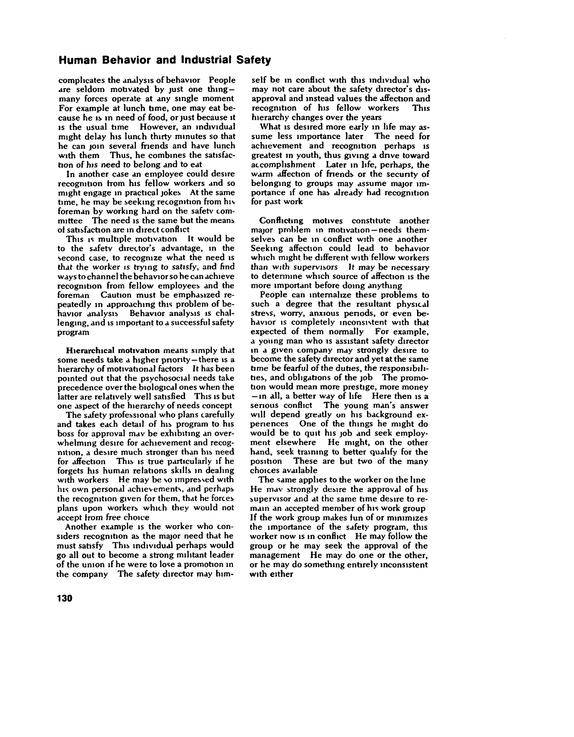
Fig 17-20 -- Heavy pipe and angle railing extend about 18 in from the floor to prevent damage to door jambs, walls, and building columns Stand ard 3- or 4-inth black iron pipe is welded to angle iron and fastened to the floor with heavy strap iron brackets Courtesy Kraft Foods Company repair Unusual sag should be investigated immediately and corrected If sag is found in a suspended ceiling, hangers and fastenings should be checked However, the sag may be the result of excessive loading of the floor above, which should be corrected Floors Accidents due to inadequate maintenance of floors are a major source of injuries in many plants Slippery conditions, particularly, ac count for numerous falls by workers Holes and other irregularities in wood and concrete floors, both inside and outside plant build ings, result in frequent injuries from stum bling and falling and, m addition, cause many truck accidents Repair procedures Wood flooring should be inspected for rot, wear, and unusual stress as indicated by sag In many cases, a section of wood flooring may need to be replaced New flooring should be installed flush with the existing flooring Badly worn or loose wood block flooring should be replaced by anchored wood blocks To anchor loose wood finish flooring, holes are drilled at an angle through the finished floor into the subfloor and flooring nails larger than the holes then are driven into the sub floor For concrete floors, the damaged area should be chipped out, cleaned thoroughly, and wet down Cement mortar (1 part portland cement and 3 sand) is troweled in Min imum patch thickness is 1 in Patches 2 in thick or more may require wire mesh or rein forcing steel For finishing, a wood float gives a less slippery surface than does a steel trowel For proper curing, traffic should be kept off the patch for at least three days, unless a quick-setting cement has been used If mixed and applied properly, epoxy resin repair materials give excellent results A thickness of as little as Vk to 3/i8 in will give an extremely tough wearing surface Be sure to take adequate precautions when using these mixes (See National Safety Council's Epoxy Restn Systems, Data Sheet 533 ) Maintenance procedures.
refid# gDr8eaL4NaYOJ0D1KdwKNr74a1 page
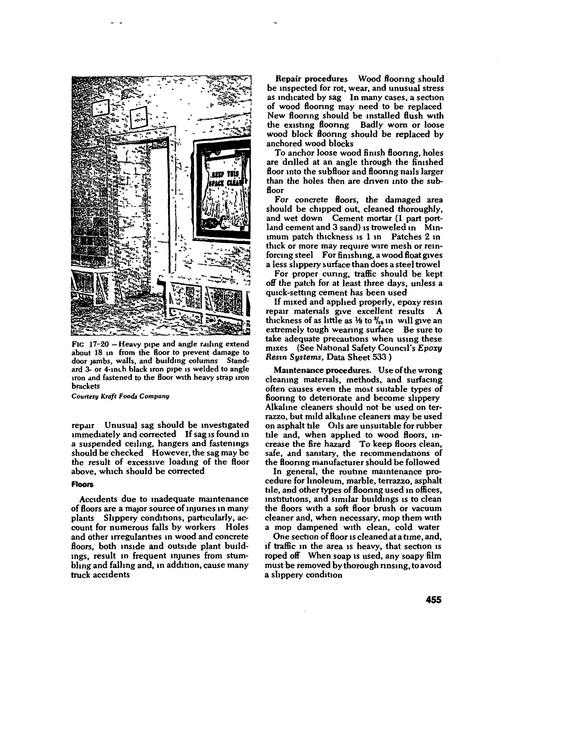
Building Construction and Maintenance Ordinary wax for polishing wood, tile, and similar floor surfaces is unsuitable because of its inherently slippery nature However, ac cording to the manufacturers, floor oils and waxes can be used to surface various types of floors without adding unduly to their slippenness, provided that instructions regarding their application are followed Oils and greases, water, paper, sawdust, and numerous other foreign materials on floors create slipping hazards Leaks of oil horn machines and of water and other liquids from pipelines and spillage from processing equip ment often can be eliminated by good main tenance of the equipment, such as promptly tightening loose connections Pans and absorbent materials can be used when leakage cannot be readily eliminated at the source However, a study of such sources often reveals ways ofkeepmg slippery materials from getting on the floors, such as the installation of splash guards on machines using cutting oils Slippery materials spilled on floors should be cleaned up promptly To remove gTease and oils, the area can be covered with airslaked lime to a depth of about V* in After two or three hours, the lime then is removed with a scraper or stiff brush Sand and various commercial cleaners also can be used Even as innocuous a substance as coffee can cause an accident if spilled m a high traffic area In National Safety Council offices, cups containing beverages must either be covered or be on a tray ifearned to an employee's desk Aisles should be kept clear of machinery, equipment, raw and manufactured matenals In many cases, the allowable floor loading has been figured on clear aisle space with no allowance made for power trucks using aisles It is advisable for efficient, safe operation to determine whether floors and aisles are capa ble of sustaining loads of power trucks Lines to indicate aisle width should be well main tained Overloading of floors, which may be caused by the installation of heavy equipment, ex cessive weight and unequal distribution of stored raw and finished matenals, and heavy truck transportation, is particularly hazardous Signs stating allowable floor loads and honzontal lines showing the maximum height to which matenals may be piled should be painted on the walls (Fig 17-21) FlC 17-21 --Where the same type of material is stored regularly, a line can be marked on the wall to indicate the height to which matenal can be piled without exceeding the allowable floor load In addition to safe floor load limit signs, a warning sign reading Do Not Pile Above Line can also be placed on the wall Strength and load determinations.
refid# reZYd94n6pk0O1vj5eop9eGJa1 page
Principles of Materials Handling and Storing chines are tilted Spillage of residual oil should be wiped up immediately When a jack develops any defect, it should be repaired by qualified workmen and tested under load before being returned to service Handtrucks, dollies, and wheelbarrows Many t>pes of handtrucks and dollies are available, such as two-wheeled, flat, platform, fox, special racks or dollies, and lift trucks Trucks can be purchased or designed for ob jects of various sizes and kinds Operators should wear gloves and safety shoes Two-wheeled trucks and wheelbarrows should be equipped with knuckle guards to protect against the jamming of hands against door frames or other obstructions Two-wheeled trucks should have brakes Fig 19-7 --Foot brake keeps wheels from slipping while truck is being loaded Springs (arrow) hold brake away from wheels when it is not needed (Fig 19-7) so that the worker need not hold the truck with a foot on the wheel or axle The latter practice causes manv injuries To decrease hazards to toes and feet, wheels should be as far under the truck as possible Wheel guards can be installed on manv types of trucks Tongues of flat trucks should be provided with counterweights, springs, or hooks to hold them vertical when not m use If this is not possible, workers should be trained to leave handles in such a position that they will not be a tripping hazard Equipment should be inspected daily and kept in good repair Repair and maintenance records should be kept to show the condition of each piece of equipment Axles should be kept well-greased The type of truck most suitable for the work at hand should be used No one truck is right for handling all types of material Two-wheeled trucks look as though they should be easy to handle, but there are safe procedures that must be followed 1 Keep the center of gravity of the load as low as possible Place heavy objects below lighter objects When loading trucks, truckers and loaders should keep their feet clear of the wheels 2 Place the load well forward so the weight will be carried by the axle, not by the handles 3 Place the load so it will not slip, shift, or fall Load only to a height that will allow a clear view ahead 4 When a two-wheeled truck or wheelbarrow is loaded in a horizontal position, raise it to traveling position by lifting with the leg muscles and keeping the back straight Ob serve the same principle in setting a loaded truck or wheelbarrow down--the leg mus cles should do the work 5 Let the truck carry the load The operator should only balance and push 6 Never walk backwards with a hand truck 7 When going down an incline, keep truck ahead When going up, keep truck be hind (This advice applies to 4-wheeled as well as 2-wheeled trucks ) 8 Move trucks at a safe speed Do not run Keep truck constantly under control Four-wheeled truck operation follows rules similar to those for two-wheeled trucks Extra emphasis should be placed on proper loading, however Four-wheeled trucks should be evenlv loaded to prevent their tipping Four-wheeled trucks should be pushed rather than pulled, except for a truck that has a fifth wheel and a handle for pulling Trucks should not be loaded so high that operators cannot see where they are going If there are high racks on the truck, two men should move the vehicle --one to guide the front end, the other to guide the back end Handles should be placed at protected places 512
refid# a4JazOxXXNNmmOmJzGX9Ga5V91 page
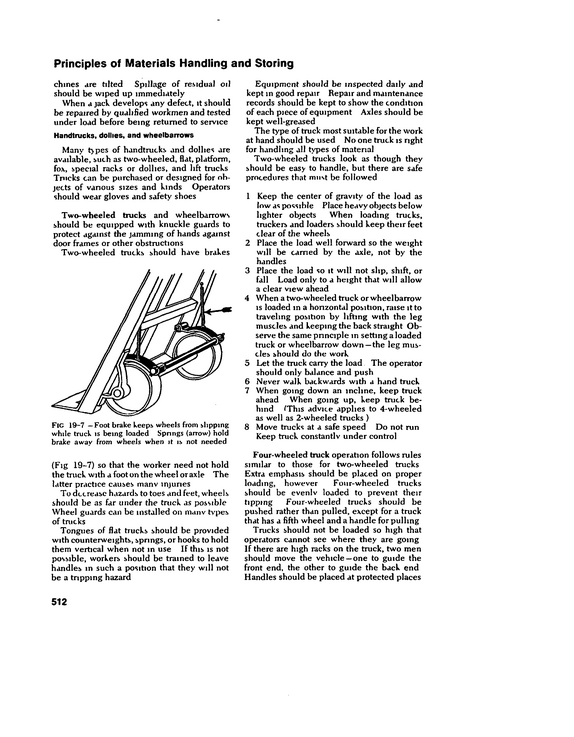
trol Special care is required at blind comers and doorways Properly placed mirrors can aid visibility at these places When not in use, trucks should be stored in a designated area, not parked in aisles or other places where they would be a tripping hazard or traffic obstruction Trucks with drawbar handles should be parked with handles up and out ofthe way Two-wheeled trucks should be stored on the chisel with handles leaning against a wall or the next truck Wheels of trucks not being used should be blocked Powered hand trucks and power bucks are discussed in Chapter 22 FlC 19-8 -- This man's hands are protected by sturdy gloves and by knuckle guards on the handles of this two-wheeled truck Such guards can be made and installed by maintenance personnel Conveyors, cranes, and hoists See Chap ter 20, "Hoishng Apparatus and Conveyors," for descnpbon of many types of lifting and transporting devices used to reduce physical strain and facilitate material handling Storage of Specific Materials on the racks or truck body so that passing traffic, walls, or other objects will not crush or scrape the operators' hands Truck contents should be arranged so they will not fall or be damaged in case the truck or the load is bumped "Fifth wheel" trucks, provided with a steer ing handle attached to a swiveling axle, should be pulled by the handle and never pushed, except to maneuver a truck into a certain position Handles should be hooked or chained up out of the way when trucks are parked or standing On a large truck of this type, such as a baggage truck, a wheel should be chained to the frame to prevent the truck from moving when it is standing, especially when it is outside where the wind might move it General precautions Truckers should be warned of three main hazards (a) running wheels off bndge plates or platforms, (b) colliding with other trucks or obstructions, and (c) jamming their hands between the truck and other objects (Figure 19-8) Workers should operate trucks at a safe speed and keep them constandy under con Both temporary and permanent storage must be neat and orderly Materials piled haphazardly or strewn about increase the possibility of accidents to employees and of damage to materials The warehouse supervisor must direct the storage of raw materials (and somebmes processed stock) that are kept in quanbty lots for some time The production super visor is usually responsible for storage of limited amounts of materials and stock for short periods close to the processing operabons Planned materials storage minimizes the handling necessary to bring materials into production, as well as remove finished pro ducts from production to shipping When planning materials storage, make sure that materials do not obstruct fire alarm boxes, sprinkler system controls, fire exbnguishers, first-aid equipment, lights, and electric switches and fuse boxes All exits and aisles must be kept clear at all times (See Fig 19-9) There should be at least 18 in clearance below spnnkler heads to reduce interference with water distnbubon This clearance should be increased if the material being stored is very flammable (See NFPA No 513
refid# K6Gwyzp5XxnKyEe6om8kkXED01 page
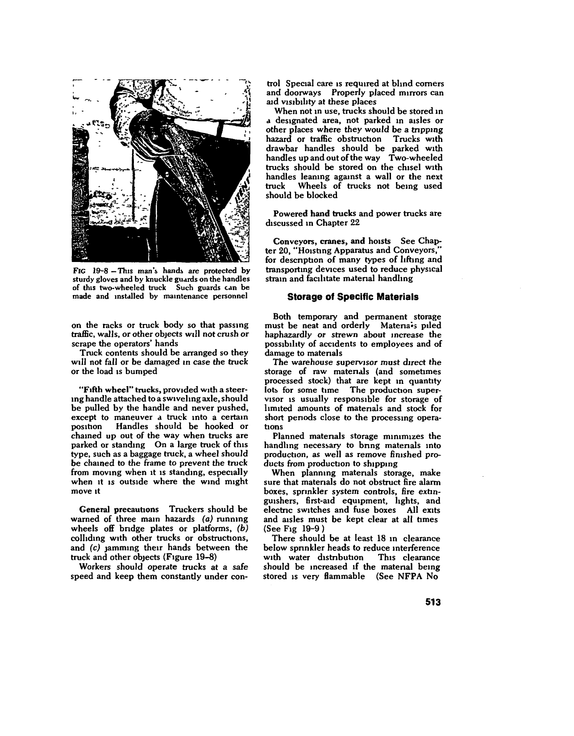
Hoisting Apparatus and Conveyors nal, slat and apron conveyors usually are in stalled flush with the floor to facilitate loading and unloading When so located, conveyors should be guarded by handrails (except at loading stations) so that workmen will not step onto the moving conveyor Openings in the floor at the loading platforms should be guarded or covered Flight conveyors The flight conveyor (Fig 20-27) is similar to the slat conveyor except that the metal flights are attached at right angles to the chain Types in which the chain itself directly moves the load are drag, rolling, and sliding chain conveyors Those consisting of an endless chain that is supported by trolleys from an overhead track or runs m a track above, flush with, or under the floor, with means for towing trucks, doll ies, or cars, are known as tow conveyors (Fig 20-30) Trolley conveyors Where an endless chain propels a senes of trolleys (Fig 20-29) sup ported from or within an overhead track, with FlC 20-28 --Two small apron conveyors used in conjunction with a bottling machine FlC 20-29 --Trolley can be used in trolley convey ors, overhead two conveyors, overhead chain con veyors, and on jibs and mononals to support hoists Courtesy Conveyor Equipment Manufacturer's Assn rather than parallel to it These equally spaced flights act as scrapers as they are pulled through a trough containing stone, coal, or other bulk material The flight conveyor uses one or two chains and may be operated at an incline Shearing and pinching hazards are similar to those on the slat conveyor and should be guarded Chain conveyors Cham conveyors take many forms, but they all carry, pull, push, haul, or tow the load either directly by the chain or by means of attachments, pushers, cars, or similar devices loads suspended from the trolleys, the assem bly is known as a trolley conveyor In modem manufactunng plants, vanous devices are used on chain conveyors operated on overhead tracks equally spaced hooks suspended directly from the endless chain or from trolleys carrv in automobile plants, for example, gears, fenders or other parts Smaller parts are earned m suspended wire baskets Suspended tongs often are used to carry boxes and similar objects If the parts are to be washed in a solvent or immersed in paint, the track is bent down ward as required immediately above the tank 570
refid# gdmaO25GqRY5wGYeg2gYK61e1 page
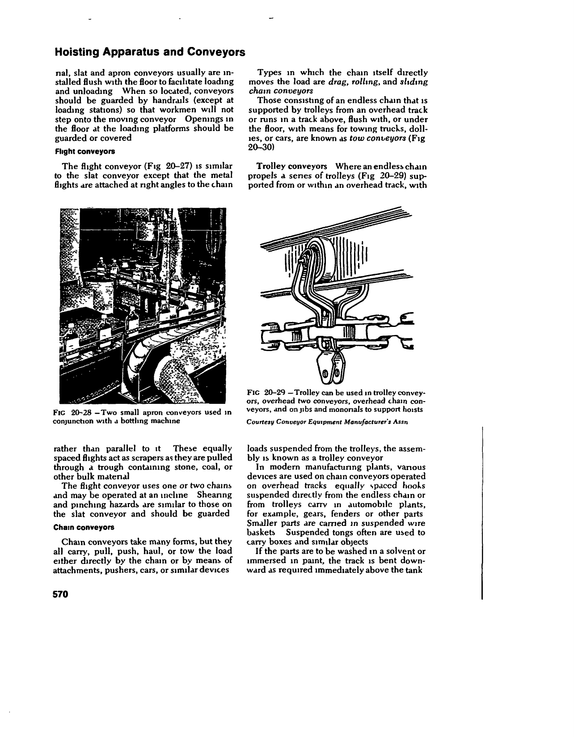
possibility of breakage, especially where multiple impressions or nesting methods are employed Preliminary or breakdown operations must be designed so that they accomplish the specific purpose and must be systematically arranged so that they do not create a hazard for the operator as he completes the forging cycle Radical bends or severe reductions in vol ume that might tend to jerk the tongs from the hands of the operator should be avoided Such operations should be modified or com pleted in additional operations The thickness and width of flash, gutter, and sprue should be ample so that flash or tong holds are not sheared off The size of the gates is important They should be de signed m relation to the size of the stock and the tongs used Cates should have enough width, depth, and clearance to allow safe handling Some dies, especially for smaller hammers, are designed with cutoffs which shear the completed forging from the end of the bar If possible, such cutoffs should be placed on one of the rear comers of the die for the operator's safety If cutoffs are placed on the front of the die and are used by placing the stock across the knife portion at an angle, enough clearance must be provided between the die and the hammer frame or gib Hammer die maintenance is important be cause of the nature of forging work and the abnormal abuse to which the dies are sub ject For example, fillet and comer radii in the impressions may be enlarged or sharpened by impact pressures, scale, abrasion, and wear It is therefore necessary to inspect these radii and correct any alteration that may be hazardous Sometimes the face of a forging die may be welded either to correct some defect or to maintain specifications A hard, brittle, or thin-skinned weld can become a flying hazard under impact The rod and the pre heating and postheating methods should be selected with extreme caution Provisions for storing dies, such as racks and rails, are essential to safety, good house keeping, and efficiency Dies preferably should be stored in an area separate from the forge shop and away from vibration Dote BOARD HAMMER MAINTENANCE CHECK Hummer No targfmw item CHECKED TIE BARS 8 SPRINGS NAME STUDS A SPRINGS DU KEYS A SKIMS SOW BLOCK KCT A SHUNS RAM CLEARANCE GUIDE BOLTS A ADJ MOTOR MOUNTS MOTOR COUPLING ROUSHAFT BEARINGS WIRING A CONTROLS FLYWHEEL A BEARINGS DRIVE GEARS ROU ADJUSTMENT LUBRICATION STEAM LINES BOARDS A WEDGES Alt LINES AIR FOOT SWITCH AIR CU A LINKAGE TREADLE A LINKAGE BOARD CLAMPS A LINKAGE DOGS A STOPS KNOCKOUT ARM FRICTION RODS SAFETY RODS REMARKS CONDITION TYPE OP REPAIR EST HRS TO REPAIR Fig 28-24 (upper left) -- Maintenance checklist for board drop hammers Maintenance and inspection A well-planned preventive maintenance program for forging hammers will help to reduce the number and seventy of accidents by minimizing part breakage and wear Reg ular inspections will disclose production units which are not operating up to standard so that repairs or adjustments can be made The results of a good maintenance pro gram can be measured in reduced operating costs which include 1 Cost of machine downtime, breakage, and lost production 2 Cost of replacement parts and labor 3 Cost of accidents due to faulty equipment Maintenance checklists for hammers (Figs 28-24 and 28-25) can be the basis for formulating a definite, planned inspection program A written checklist avoids the errors resulting from verbal reports that are often forgotten or misunderstood 843
refid# 3eEx59yj1X5nk0Ng3vbLZzaG01 page
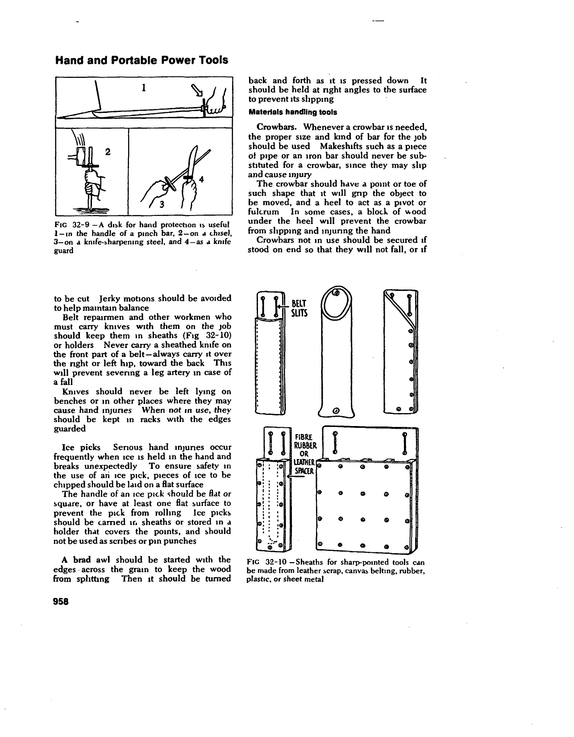
Hand and Portable Power Tools FiG 32-9 --A disk for hand protection is useful 1 --in the handle of a pinch bar, 2--on a chisel, 3--on a knife-sharpening steel, and 4 --as a knife guard back and forth as it is pressed down It should be held at nght angles to the surface to prevent its slipping Materials handling tools Crowbars.
refid# MJ8pa5pXr407V45aw0qJkZwey1 page
o HIGHWAY VEHICLE n SERVICE VJ MANUAL j MACK TRUCKS, INC. one of The Signal Companies RECORD COPY DO NOT REMOVE FROM OFFICE TECHNICAL SERVICES DEPT. * rvxL v, TS442 REV. 5/71 10M Printed in U.S.

refid# rpwZ3kjkYgBa6jp3paZ01N75V28 pages
Industrial Hygiene above 5p in size usually will not remain air borne long enough to present an inhalation problem Dust may enter the air from various sources It may be dispersed when a dusty material is handled, such as when lead oxide is dumped into a mixer or a product is dusted with talc When solid materials are reduced to small sizes in processes such as grinding, crushing, blasting, shaking, and drilling, the mechanical action of the grinding or shaking device supplies a source of energy to disperse the dust formed Fumes Solid particles generated by con densation from the gaseous state, generally after volatilization from molten metals This physical change is often accompanied by a chemical reaction, such as oxidation Fumes flocculate and sometimes coalesce A fume is formed when a volatized solid, such as a metal, condenses in cool air The solid particles that make up a fume are ex tremely fine, usually less than 1 0p.
refid# Dv2MY1MJx7LpoKmYVvyaoZXVO1 page
mental derangement or in impairment of the motor nerve function and in neuritis Re covery is likely to be good if exposure is terminated before the nervous system is senously injured See Industrial Data Sheet 341 and Hy gienic Guide Carbon monoxide is a colorless, odorless gas generated by combustion of the common fuels with an insufficient air supply or where combustion is incomplete because of a con dition such as impingement of burning gases on a cold surface In most industrial plants, carbon monoxide is released by accident or bv improper mainte nance or adjustment of burners or flues, by use of open salamanders in enclosed places, and by internal combustion engines Poisoning is entirely by inhalation of the gas and may come on practically without symptoms in an individual who is compara tively quiet The most common symptoms of complete asphvxia are pounding of the heart, dull headache, flashes before the eyes, dizziness, ringing in the ears, nausea, and sometimes (but not often) convulsions The injury is due to the combination of car bon monoxide with the available hemoglo bin This action tends to exclude oxygen and so suffocate the victim bv lowering the ability of the blood to carry oxygen The first aid required is to reduce the loss of heat from the body and to supply oxygen as rapidly as pos sible, by removal to fresh air and administer ing of artificial respiration if breathing has stopped The administration of oxygen or of oxygen mixed with 5 to 7 per cent carbon dioxide is the most useful measure See Industrial Data Sheet 415 and Hy gienic Guide Carbon tetrachloride is a halogenated hy drocarbon used as a degreaser, solvent, and chemical intermediate Acute poisoning follows a heavy exposure, such as one would get from the use of carbon tetrachloride as an anesthetic or from spread ing out a large area of a cement dissolved m carbon tetrachloride without the precaution of local exhaust Acute poisoning usually is characterized by very sudden unconsciousness, probably due to the effect of carbon tetrachloride on the heart, which speeds up enormously and then goes into disorganized twitching (fibril lation) with no effective beat at all If the victim regains consciousness, he is likely to suffer from headache, nausea, vomiting, and rapid heart beat for a short time The subacute form of poisoning has been of more importance in industry than the acute form In these cases there is ingestion of the liquid or exposure to a moderately large con centration of the vapor for a considerable time The major injury was thought for a long time to be to the liver More recently, it has been realized that the damage is at least as much to the kidneys as it is to the liver, and that m the fatal cases the deaths are as often due to uremic poisoning from kidnev failure as to liver failure In subacute cases, the complaints and signs are likely to be nausea, vomiting, pain in the abdomen, swelling of the feet and hands, headache, dizziness, loss ofappetite, diarrhea, fever, and nosebleeds or hemorrhage into the eyes It has also been demonstrated repeat edly that the chronic alcoholic or the person who has recently consumed a large amount of alcohol will be severely or fatally poisoned by carbon tetrachloride under conditions harmless for those who have not so indulged Chronic poisoning comes from long-con tinued absorption of fairly small amounts of carbon tetrachloride over a long period It is not so clear-cut as the other forms, but is characterized bv digestive distress, mental dullness, and cirrhosis of the liver A number of cases of poisoning have re sulted from the use of carbon tetrachloride as a fire-extinguishing fluid in confined spaces These cases are, of course, complicated by the products of combustion of the fire and also by the products of decomposition of the carbon tetTachlonde Usually they show the signs of lung injury which indicate that they are the result of one or the other of these factors rather than of the carbon tetrachloride, as such Carbon tetrachloride can be absorbed to some extent through the skin and can also cause a dermatitis by skin contact The major problem in prevention of injuries from carbon tetrachloride is that of prevention of inhalation of the solvent See Hygienic Gutde Cellosolve --see Ethylene glycol monoethyl ether. 1337
refid# 931JQm82MQyzVGQzY262YXJeR1 page
Elements of Industrial Toxicology filtration of the liver in the manner of the chlorinated hydrocarbons Methyl acetate is widel> used as a Iow-boilmg solvent in the perfume, cosmetic and paint industries It is irritating to the mucous mem branes of the eyes and the respiratory passage Animal studies indicate that there may be general poisoning and long-lasting aftereffects when methyl acetate is inhaled in concentra tions below that which produces narcosis If exposure is serious, pulmonary edema and hemorrhages may occur, along with injury to the blood vessels Symptoms of exposure are eye inflamma tion, nervousness, chest tightness, heart palpitation, exhaustion, and shortness of breath See Hygienic Guide Methyl acrylates are irritants for the skin, mucous membranes, and gastro-intestinal' tract They may be absorbed through the skin, gastro-intestinal system, or the lungs Systemic absorption may lead to the degener ative changes m the liver and the kidneys Accidental industrial exposure may occur m three ways 1 Acute exposure to high vapor concentra tions, 2 Liquid contamination of eyes or skin, and 3 Prolonged exposure to lower vapor con centrations Personnel should be instructed and equip ment designed to avoid contact with acrylates m liquid or vapor phase Where excessive contact is unavoidable, adequate personal protective devices should be used Adequate emergency showers, wash-up facilities and eye wash fountains should be available in accessible locations and areas where acrylates are handled The necessity for immediate emergency shower ing and prompt removal of all contaminated clothing following massive skin contact must be stressed Even minor splashes must be washed off promptly and contaminated wear ing apparel (particularly leather goods such as shoes and gloves) must be removed and thoroughly dried or laundered before wearing again Employees should be instructed to report promptly all symptoms such as irritation of eyes, nose, and throat or lung congestion Methyl alcohol --see Methanol.
refid# rBY4wnNVk3xo8Do3EBV4dReR71 page
Elements of Industrial Toxicology so as to produce anhydrous chloncacid should be prevented It is likely to be spontaneously explosive, as well as highly sensitive to con tact with reducing agents See Hygienic Guide Sodium cyanide is a white, slightly hygro scopic solid with a reaction sufficiently alka line to produce a severe dermatitis when the skin is exposed to its dust or its solutions Cyanide poisoning m industry is not com mon When it does occur, it is usually the result of inhalation of hydrogen cyanide gas, used as a fumigant or produced by contact of one of the metallic cyanides with acid, in cluding carbon dioxide gas and moisture from the atmosphere See Hydrogen cyanide The simple metallic cyanides are all ex tremely toxic if swallowed For sodium cya nide, the lethal dose is about 9 mg per kg of body weight or about 0 019 oz for a man Some authorities state that cyanide can be ab sorbed into the svstem through the skin or through the lesions of the toxic burn which it produces This is not, however, a common method of industrial poisoning Cyanide prevents oxygen exchange be tween the tissues and the blood The symp toms of poisoning are dizziness, headache, a feeling of oppression in the chest, dryness and irritation of the throat, palpitation of the heart, difficult breathing and sometimes vomiting, followed by loss of consciousness and convulsions A lethal dose produces rapid death and therefore can be counter acted only by immediate first aid A most effective single first aid measure for this type of internal asphyxia is the sup plying of oxygen or oxygen-carbon dioxide mixture for breathing The person admin istering first aid should also 1 Send for a doctor at once 2 Remove the victim to fresh air, without exposing the rescuer to poisoning 3 Remove clothing which mav contain hy drogen cyanide and wrap the victim in blankets or otherwise keep him warm 4 If breathing has stopped, apply artificial respiration 5 Supply oxygen or oxygen-carbon dioxide mixture for inhalation 6 Permit inhalation of the contents of an ampule of amyl nitnte, repeat after 15 minutes 7 If the victim has swallowed a cyanide com pound and is conscious, induce vomiting by giving him a large quantity of tepid water containing an emetic Never try to induce vomiting tn an unconscious person First aid supplies, as specified by the phy sician m charge, should be m readiness in all plants where cyanides are used Cyanides should be stored and used so that they will not come into contact with acids or be exposed to the air Where cya nides are used m bulk, men should not be permitted to work alone m an area with an open container The layout should provide for ready re moval of deposits of dust from the structure and equipment Dust and vapor incidental to the process should be removed at the source as completely as possible Local ex haust equipment for this purpose should be designed with special attention to accessi bility for cleaning, since hydrolysis of alkali cyanides leaves a deposit of alkali carbonates which form a sticky, tenacious coating on the equipment Employees who handle cyanides should be provided with protective clothing which will prevent skin contact with the solid or solu tion, and appropriate respirators, either can ister or supplied atmosphere, should be pro vided for emergency use Sodium dichromate -- see Chromic acid Sodium hydroxide--see Potassium hy droxide.
refid# aJyqK81Ma4EGop2BqJkgV5rXa1 page
hazardous as a carcinogen.
refid# qd84q7zZxo753yJ1kNBeDaND51 page