Refine
Estimated Years 1970-1979Clear
88,744 results foundRefine Search
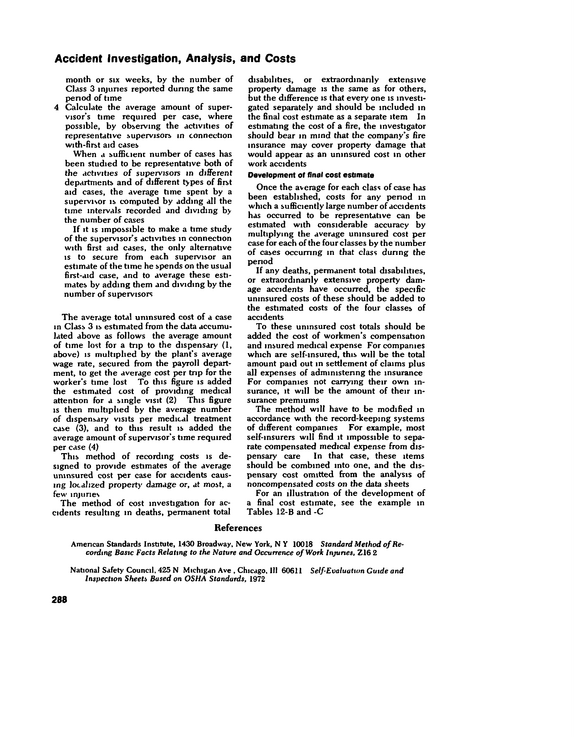
Accident Investigation, Analysis, and Costs month or six weeks, by the number of Class 3 injuries reported during the same period of time 4 Calculate the average amount of super visor's time required per case, where possible, by observing the activities of representative supervisors in connection with-first aid cases When a sufficient number of cases has been studied to be representative both of the activities of supervisors m different departments and of different types of first aid cases, the average time spent by a supervisor is computed by adding all the time intervals recorded and dividing by the number of cases If it is impossible to make a time study of the supervisor's activities m connection with first aid cases, the only alternative is to secure from each supervisor an estimate of the time he spends on the usual first-aid case, and to average these esti mates by adding them and dividing by the number of supervisors The average total uninsured cost of a case in Class 3 is estimated from the data accumu lated above as follows the average amount of time lost for a trip to the dispensary (1, above) is multiplied by the plant's average wage rate, secured from the payroll depart ment, to get the average cost per tnp for the worker's time lost To this figure is added the estimated cost of providing medical attention for a single visit (2) This figure is then multiplied by the average number of dispensary visits per medical treatment case (3), and to this result is added the average amount of supervisor's time required per case (4) This method of recording costs is de signed to provide estimates of the average uninsured cost per case for accidents caus ing localized property' damage or, at most, a few injuries The method of cost investigation for ac cidents resulting m deaths, permanent total disabilities, or extraordinarily extensive property damage is the same as for others, but the difference is that every one is investi gated separately and should be included in the final cost estimate as a separate item In estimating the cost of a fire, the investigator should bear in mind that the company's fire insurance may cover property damage that would appear as an uninsured cost in other work accidents Development of final cost estimate Once the average for each class of case has been established, costs for any period m which a sufficiently large number of accidents has occurred to be representative can be estimated with considerable accuracy by multiplying the average uninsured cost per case for each of the four classes by the number of cases occurring in that class during the period If any deaths, permanent total disabilities, or extraordinarily extensive property dam age accidents have occurred, the specific uninsured costs of these should be added to the estimated costs of the four classes of accidents To these uninsured cost totals should be added the cost of workmen's compensation and insured medical expense For companies which are self-insured, this will be the total amount paid out in settlement of claims plus all expenses of administering the insurance For companies not carrying their own in surance, it will be the amount of their in surance premiums The method will have to be modified in accordance with the record-keeping systems of different companies For example, most self-insurers will find it impossible to sepa rate compensated medical expense from dis pensary care In that case, these items should be combined into one, and the dis pensary cost omitted from the analysis of noncompensated costs on the data sheets For an illustration of the development of a final cost estimate, see the example in Tables 12-B and -C References Amencan Standards Institute, 1430 Broadway, New York, N Y 10018 Standard Method of Re cording Baste Facts Relating to the Nature and Occurrence of Work Injuries, Z16 2 National Safety Council, 425 N Michigan Ave , Chicago, III 60611 Self-Evaluation Guide and Inspection Sheets Based on OSHA Standards, 1972 288
refid# 7OdoJkO8a8jV05LO2nYERMLNa1 page
c) National Fire Codes.
refid# zM3kEjeROZRQzDxbQX1eeNvg1 page
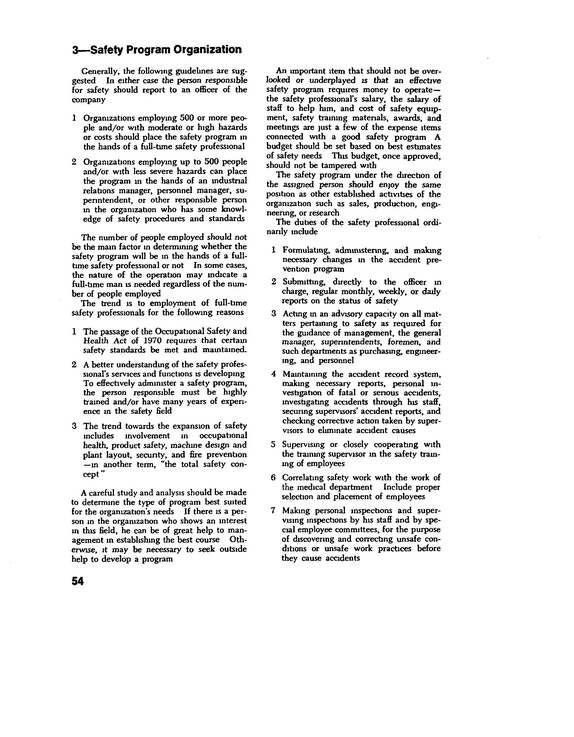
3--Safety Program Organization Generally, the following guidelines are sug gested In either case the person responsible for safety should report to an officer of the company 1 Organizations employing 500 or more peo ple and/or with moderate or high hazards or costs should place the safety program in the hands of a full-time safety professional 2 Organizations employing up to 500 people and/or with less severe hazards can place the program in the hands of an industrial relations manager, personnel manager, su perintendent, or other responsible person in the organization who has some knowl edge of safety procedures and standards The number of people employed should not be the main factor in determining whether the safety program will be in the hands of a full time safety professional or not In some cases, the nature of the operation may indicate a full-time man is needed regardless of the num ber of people employed The trend is to employment of full-time safety professionals for the following reasons 1 The passage of the Occupational Safety and Health Act of 1970 requires that certain safety standards be met and maintained. 2 A better understanding of the safety profes sional's services and functions is developing To effectively administer a safety program, the person responsible must be highly trained and/or have many years of experi ence in the safety field 3 The trend towards the expansion of safety includes involvement m occupational health, product safety, machine design and plant layout, security, and fire prevention --in another term, "the total safety con cept " A careful study and analysis should be made to determine the type of program best suited for the organization's needs If there is a per son in the organization who shows an interest in this field, he can be of great help to man agement in establishing the best course Oth erwise, it may be necessary to seek outside help to develop a program 54 An important item that should not be over looked or underplayed is that an effective safety program requires money to operate-- the safety professional's salary, the salary of staff to help him, and cost of safety equip ment, safety training materials, awards, and meetings are just a few of the expense items connected with a good safety program A budget should be set based on best estimates of safety needs This budget, once approved, should not be tampered with The safety program under the direction of the assigned person should enjoy the same position as other established activities of the organization such as sales, production, engi neering, or research The duties of the safety professional ordi narily include 1 Formulating, administering, and making necessary changes in the accident pre vention program 2 Submitting, directly to the officer in charge, regular monthly, weekly, or daily reports on the status of safety 3 Acting m an advisory capacity on all mat ters pertaining to safety as required for the guidance of management, the general manager, superintendents, foremen, and such departments as purchasing, engineer ing, and personnel 4 Maintaining the accident record system, making necessary reports, personal in vestigation of fatal or senous accidents, investigating accidents through his staff, securing supervisors' accident reports, and checkmg correcbve action taken by super visors to eliminate accident causes 5 Supervising or closely cooperating with the training supervisor in the safety train ing of employees 6 Correlating safety work with the work of the medical department Include proper selection and placement of employees 7 Making personal inspections and super vising inspections by his staff and by spe cial employee committees, for the purpose of discovering and correcting unsafe con ditions or unsafe work practices before they cause accidents
refid# 7MEDqNb188njGkv0LeOVvN8ao1 page
r.

refid# o9KNRkVL8dz4Y1Jg6bVYJEe683 pages
22--Non-Employee Accident Prevention mediately dispatch a representative to investi gate the trouble and notify proper representa tives of the property tinder surveillance If central station tie-in is not available.
refid# mq0gOwR4QM3npMb0zj37Da9yk1 page
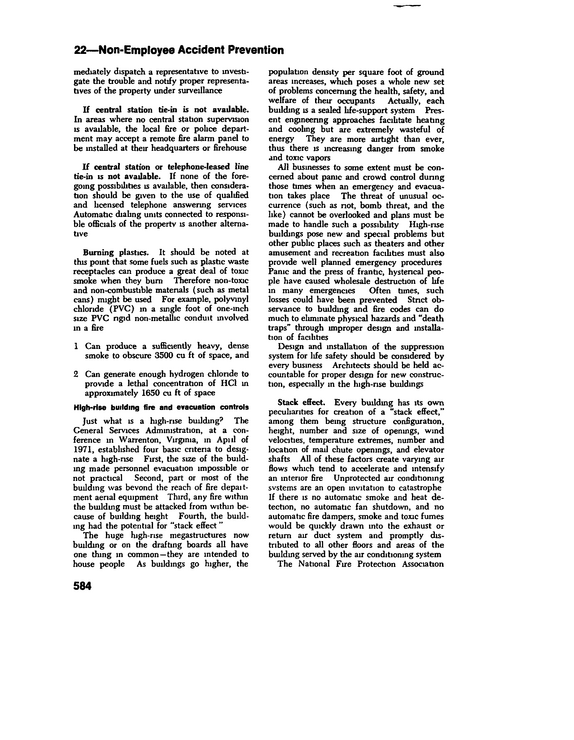
Of all the machines used by industry, prob ably none are more controversial than those used for cold forming metal--namely power presses and other related equipment The controversy arises primarily because of the many senous accidents associated with press operations, particularly at the point of opeia- tion For many years, concerned and knowledge able safety professionals have advocated a "hands out of dies" policy for press operations, reasoning that if the operator could not put his hands or other parts of his body between the dies, there could be no injury This policy was incorporated into the 1971 revision of the voluntary American National Standard Bll 1, Safety Requirements for Construction, Care, and Use of Mechanical Power Presses, which in turn m 1972 was made an OSH standard, section 1910 217 The policy thus passed from voluntary to mandatory--with widesweeping consequences for all power press users There is no useful purpose served m de bating the merits or faults of such a policy Both sides of the issue have presented many arguments supporting their position Neither side disputes the goals of the "no hands in dies" pohcy, which is the elimination of press injuries in the die area It is the means of accomplishing the goal which concerns every one.
refid# JY7JpbQjq5xJQEQjJYa3e4rZ1 page
r&MLUilUil .1A1 * + W A | t.tutss of the ?
refid# xzKy4MMN2xK0a7YN625yxwR2J8 pages
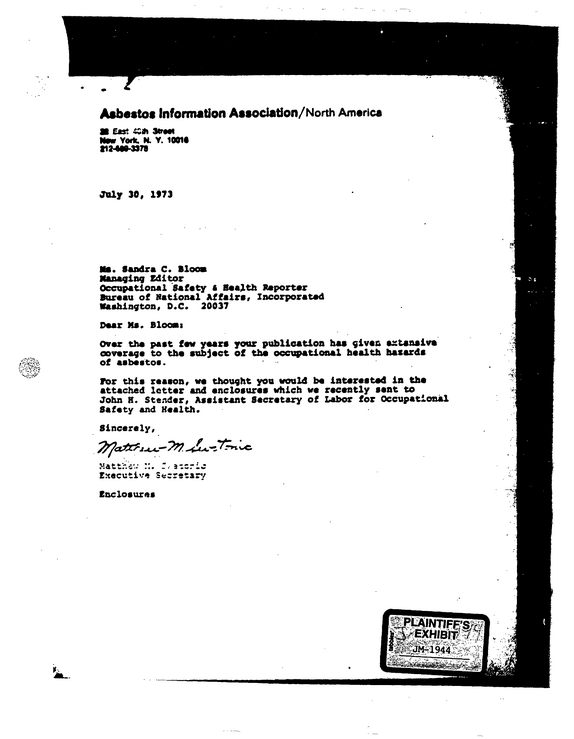
Asbestos Information Association/North America a East StrMt New YoA.
refid# G5qz4EvGpDyG4J39r8q1Mjxrr1 page
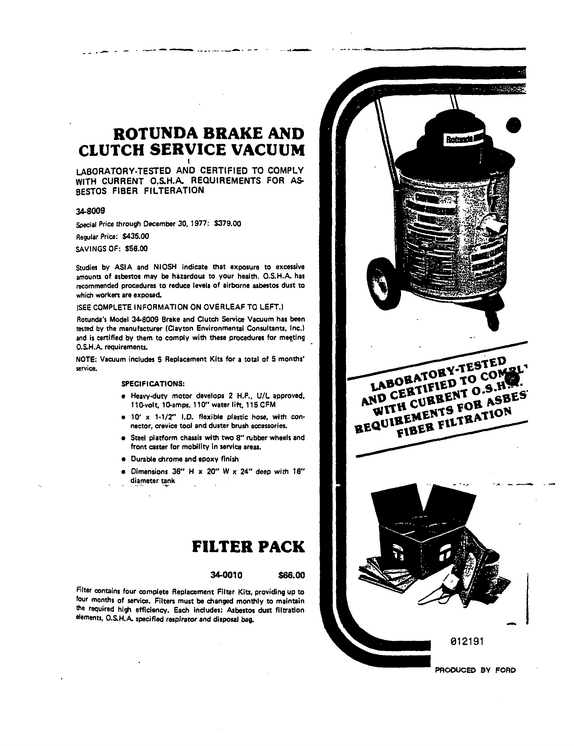
rotunda brake and CLUTCH SERVICE VACUUM t laboratory-tested and certified to comply WITH CURRENT O.S.H.A.
refid# K61RvjGY8r69K0393jnqQXevQ1 page
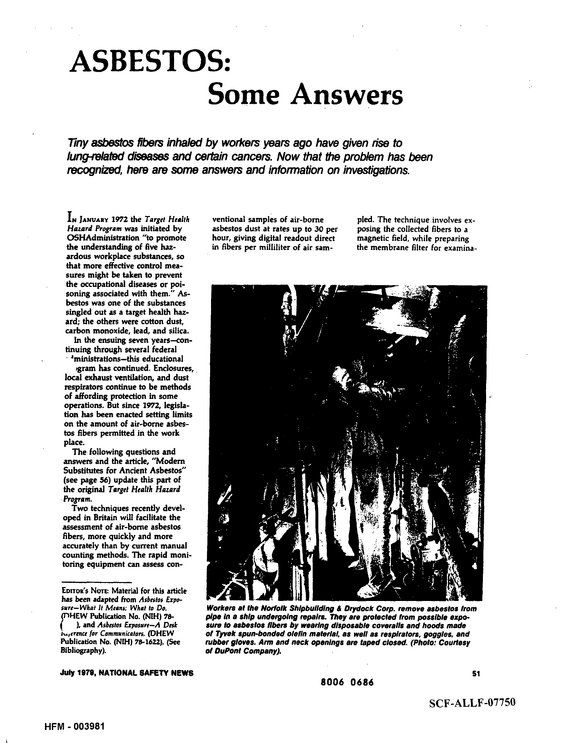
ASBESTOS: Some Answers Tiny asbestos fibers inhaled by workers years ago have given rise to lung-related diseases and certain cancers.
refid# kDb2N0Mp6mbD7E6vJYj2xMLzb1 page
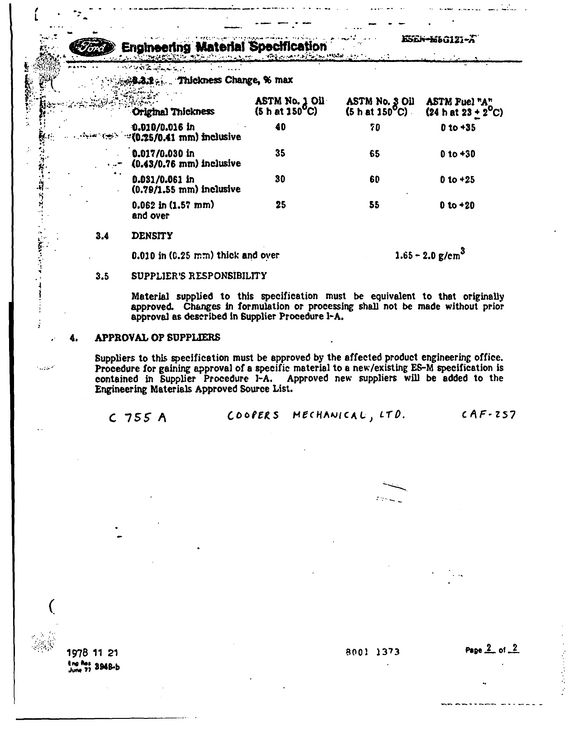
Engineering Material Specification ESEftHnSGlgl-M if ..
refid# LgGEB841RkqDnb1bBgo5jZrXg1 page
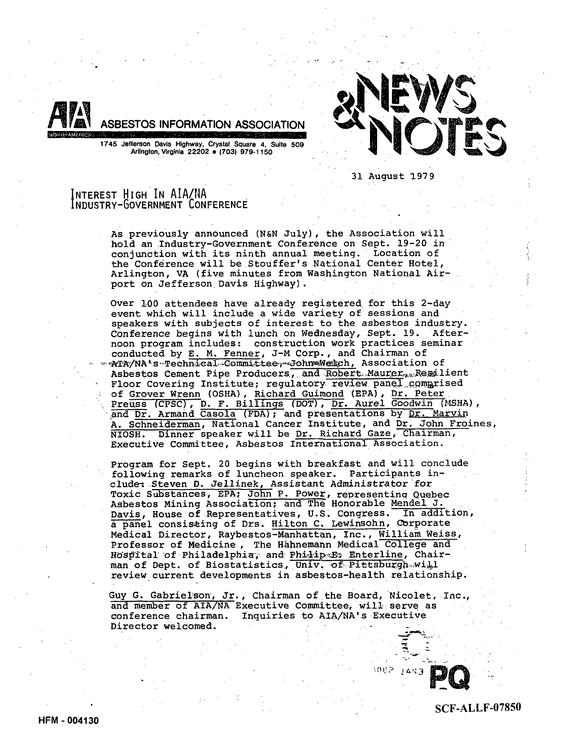
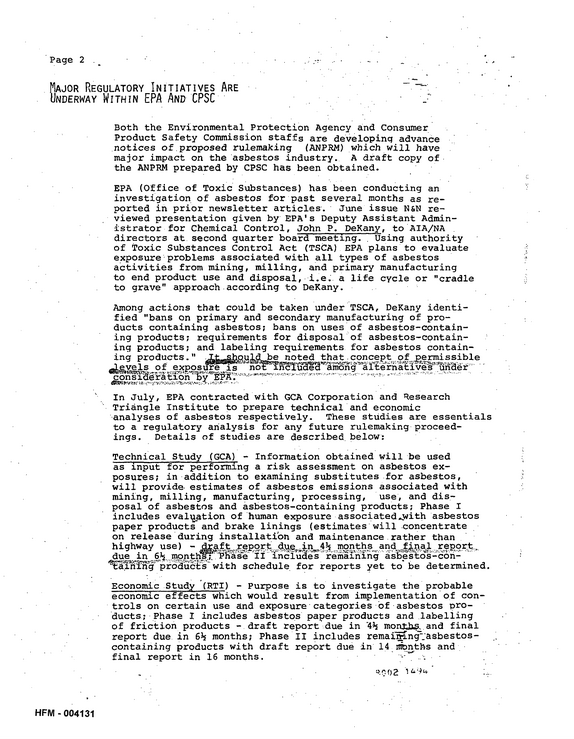
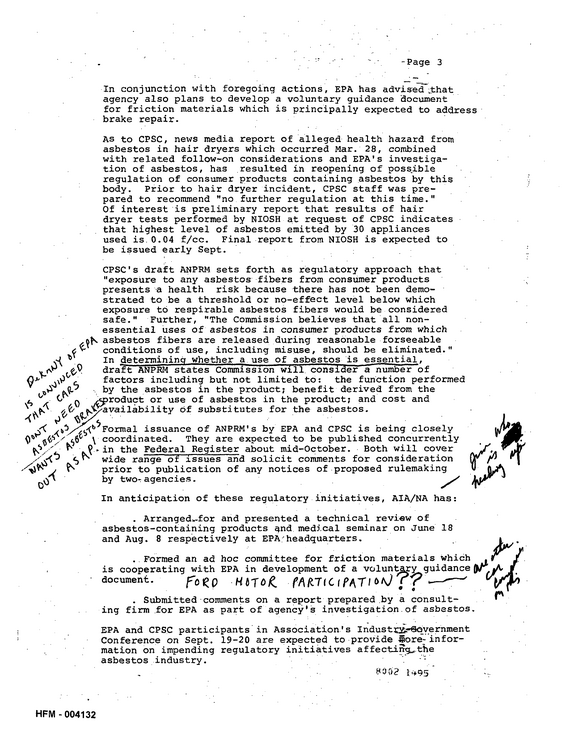
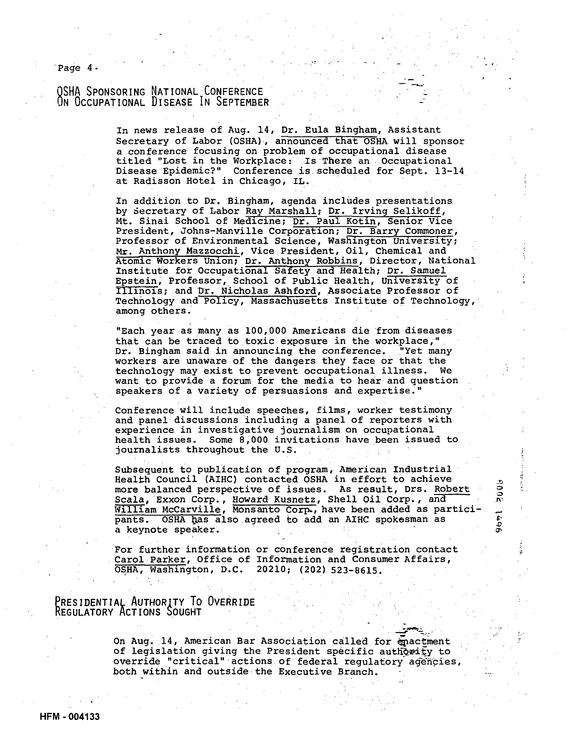
ASBESTOS INFORMATION ASSOCIATION BIwlilMMlWMM 1745 Jefferson Davis Highway, Crystal Square 4, Suite 509 Arlington, Virginia 22202 (703) 979-1150 Interest High In AIA/NA Industry-Government Conference 31 August 1979 As previously announced (N&N July), the Association will hold an Industry-Government Conference on Sept. 19-20 in conjunction with its ninth annual meeting.
refid# Jro7Mb2oXoeRdbnjL0R031Dov6 pages
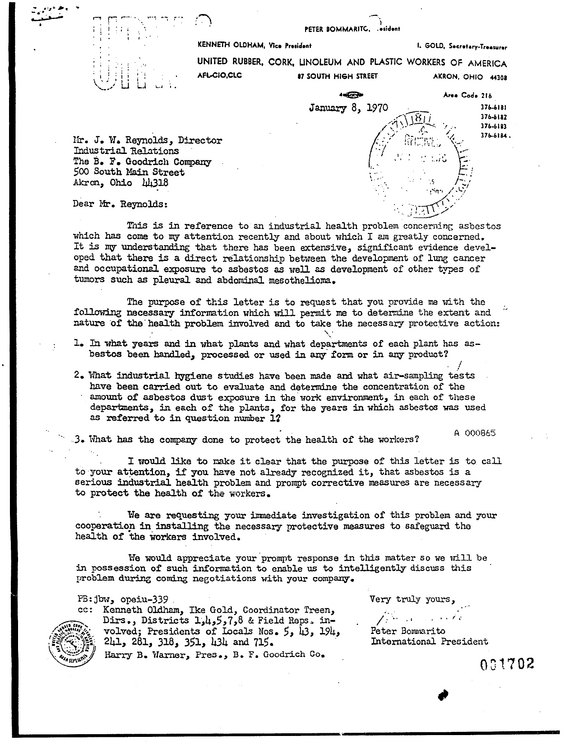
FILE NAME: BF Goodrich (BFG) DATE: 1970 Jan 8 DOC#: BFG065 DOCUMENT DESCRIPTION: Letter to BF Goodrich from URCLPWA Union President Requesting Info on Asbestos Hazards & Protective Measures Being Taken r-n *-- t > ) PETER BOMMARITC, ..trUn* KENNETH OLDHAM, Vie Prtiid.nt I.
refid# omdYRNjd7Z86jD2VMYZeBdRgD2 pages
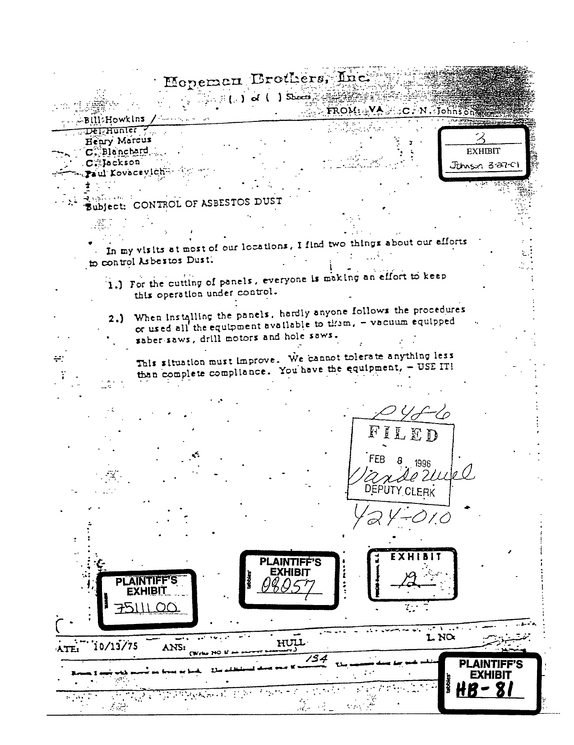
FILE NAME: Hopeman Brothers (HB) DATE: 1975 Oct 13 DOC#: HB027 DOCUMENT DESCRIPTION: Memo RE Control of Asbestos Dust E5o n ecaen `i'.\ .: )' ' V.
refid# mBvjp5VZYNqJj86D02jqpvkyg2 pages
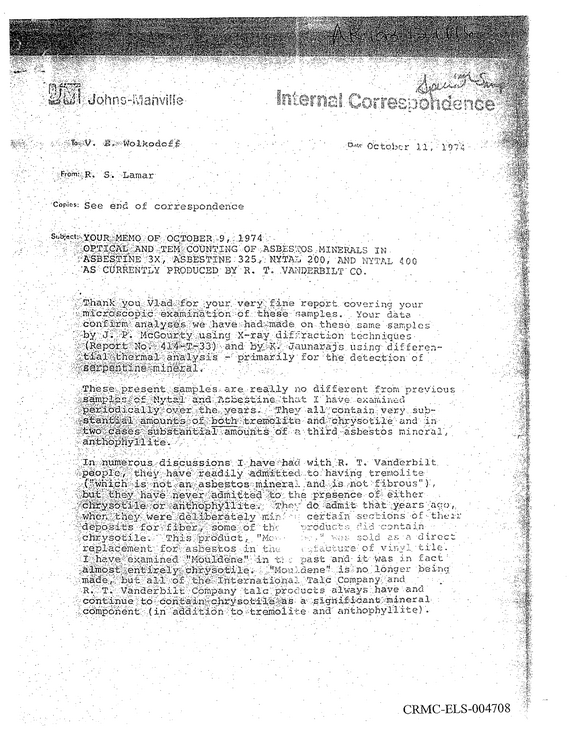
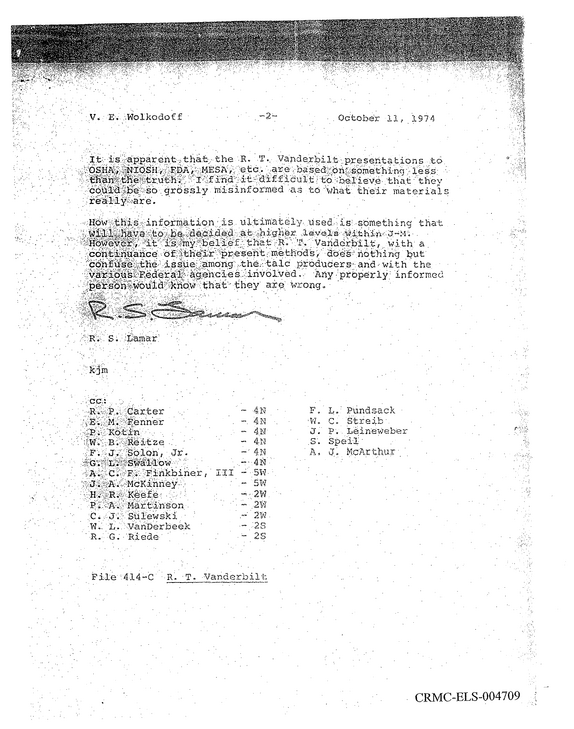
FILE NAME: RT Vanderbilt (RTV) DATE: 1974 Oct 11 DOC#: RTV217 DOCUMENT DESCRIPTION: J-M Memo RE Optical and TEM Counting of Asbestos Minerals in Asbestine 3X & Other RTV Asbestos Products Copies: gee end of correspondence , m Subject.
refid# 2RB2vxzkxB5Bw0GqD6EyDRxQ53 pages