Refine
Estimated Years 1960-1969Clear
16,810 results foundRefine Search
Industr-.a.
refid# revNgaYKZGLVovL8Der0zXjNr1 page
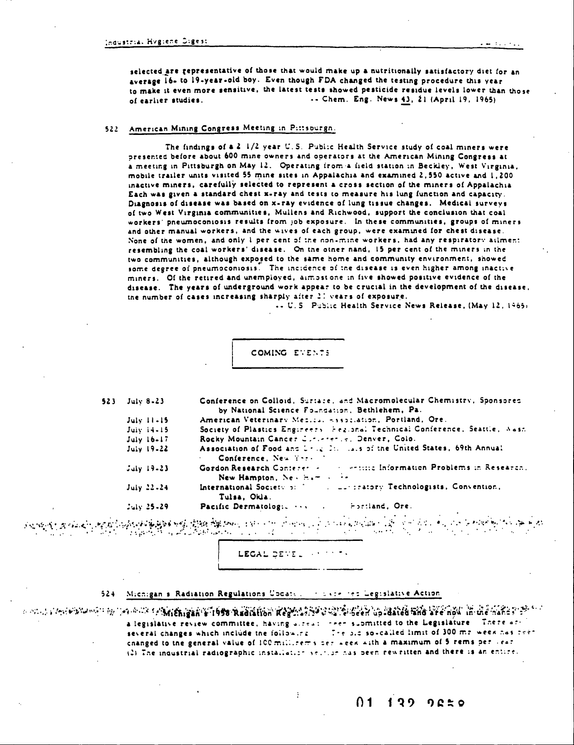
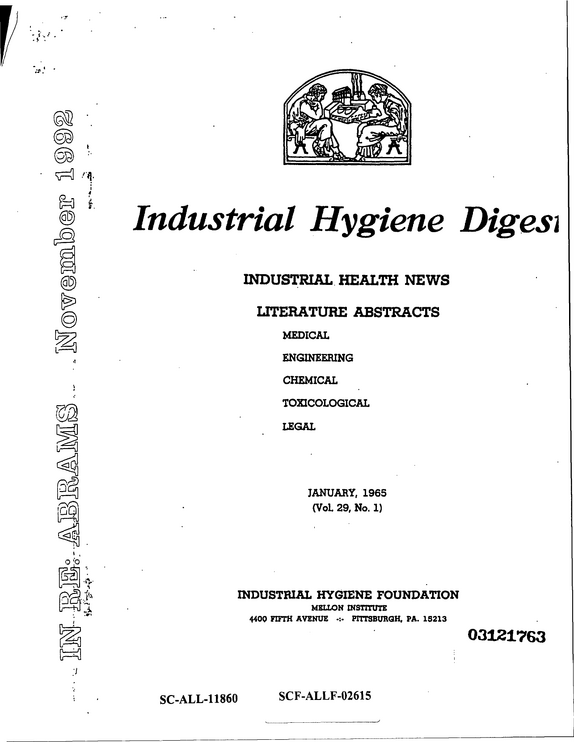
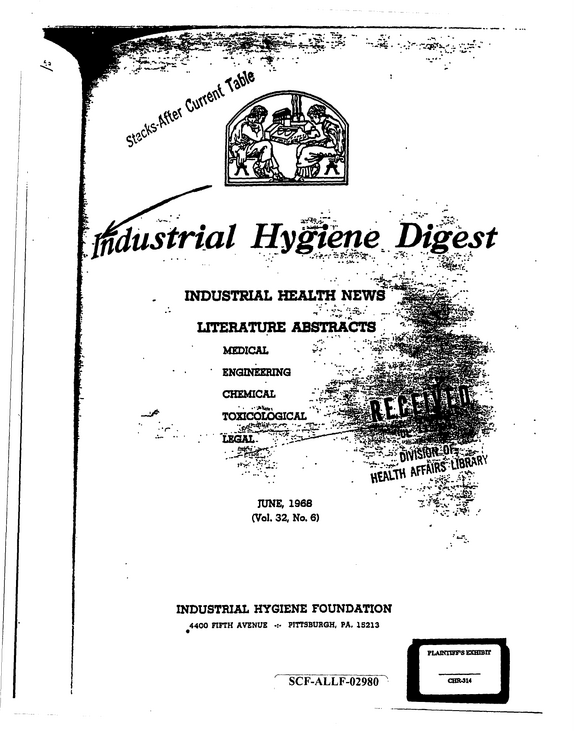
Industrial Hygiene Digest INDUSTRIAL HEALTH NEWS LITERATURE ABSTRACTS MEDICAL ENGINEERING CHEMICAL TOXICOLOGICAL LEGAL .

refid# yp0vZvpzO06NG8p6EJ0R58xKD37 pages
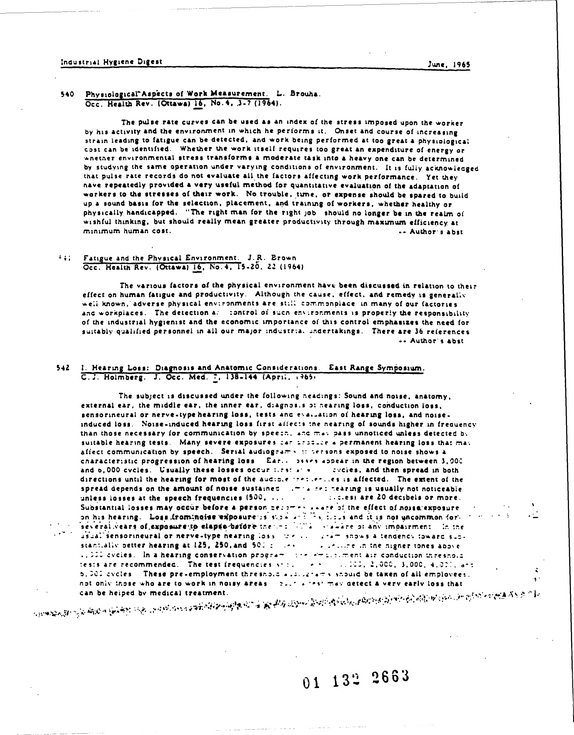
Industrial Hygiene Digest June, 196S 540 PhysiologicarAsp'ect* of Work Meaeurement L.
refid# 8QaXvL2kXg35vzM0NYRzyV1y1 page
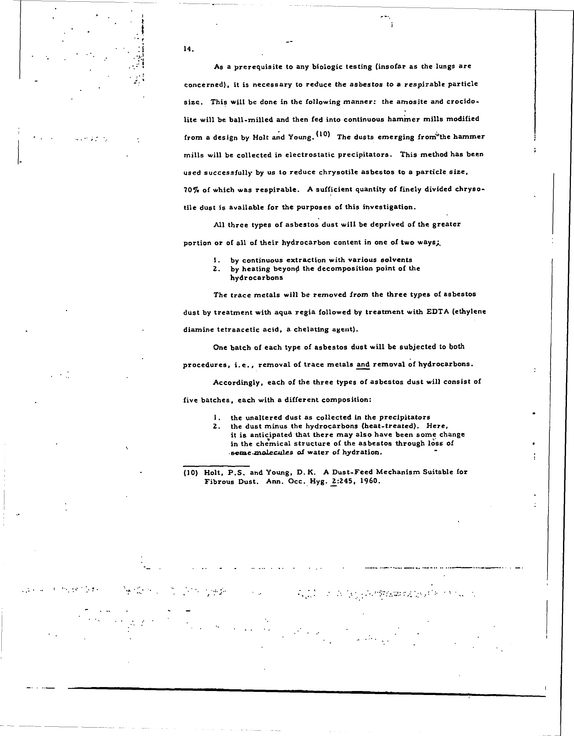
14.
refid# 6Ko521rEr1Gb4V0yYnDObVm61 page
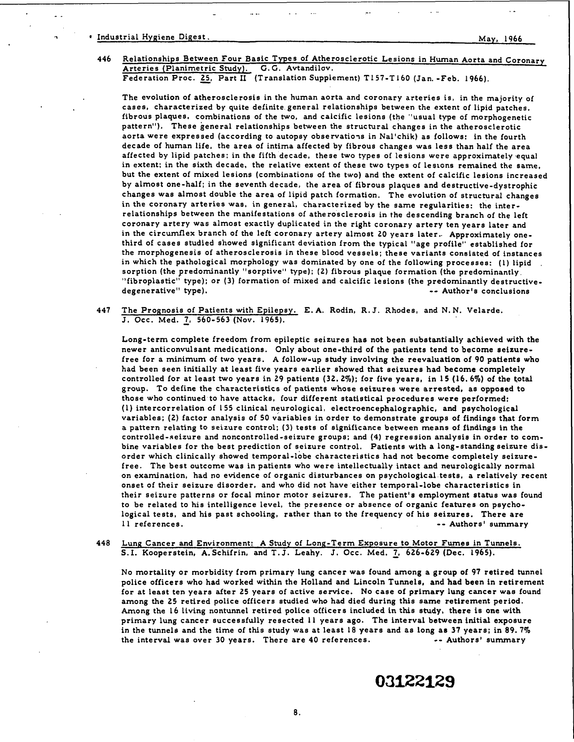
Industrial Hygiene Digest, May, 1966 446 Relationships Between Four Basic Types of Atherosclerotic Lesions in Human Aorta and Coronary Arteries (Planimetric Study).
refid# rnyxNRzzbBjEr0ge4qe5XMbv1 page
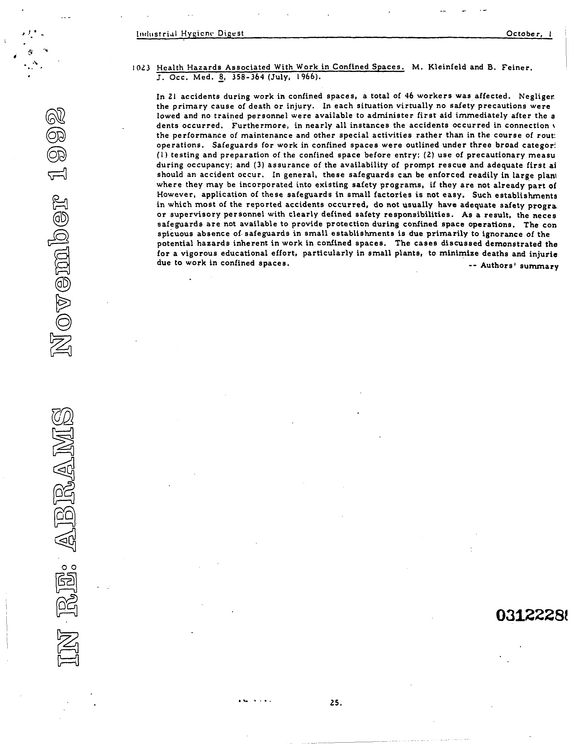
i 5 4 6' s=3 =3 Industrial Hygiene Difiest October, 1 1023 Health Hazards Associated With Work in Confined Spaces.
refid# ga90Dm120nRGRLQwX3BBxM091 page
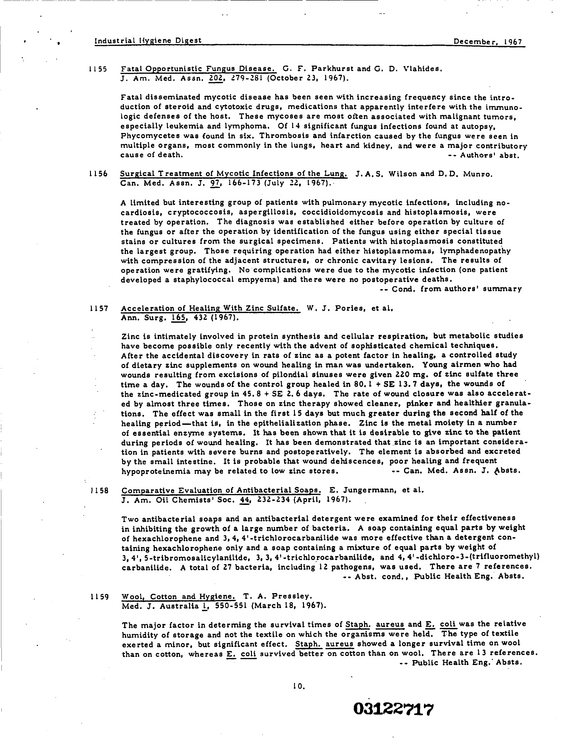
Industrial Hygiene Digest December. 1967 1155 Fatal Opportunistic Fungus Disease.
refid# Z4M1QzyDx5M6Y060ZrbNMQ0xO1 page
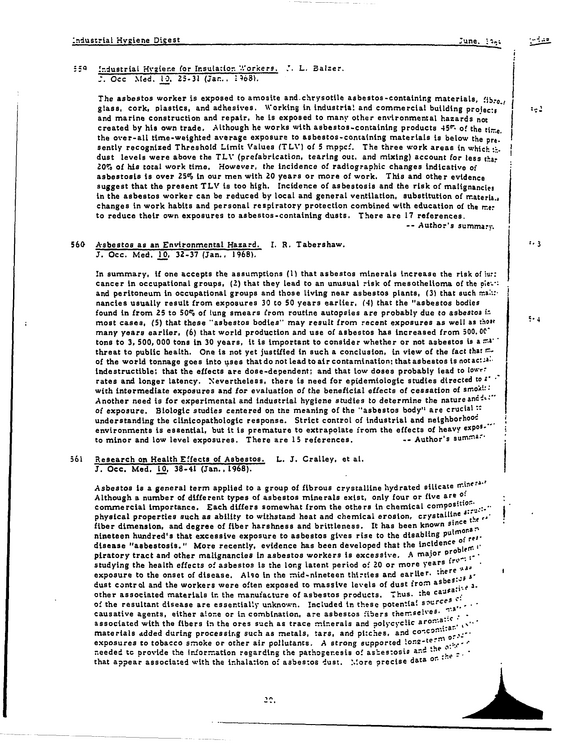
Industrial Hygiene Digest une.
refid# XzD3O41NQavqdZmYxRBEmN3by1 page
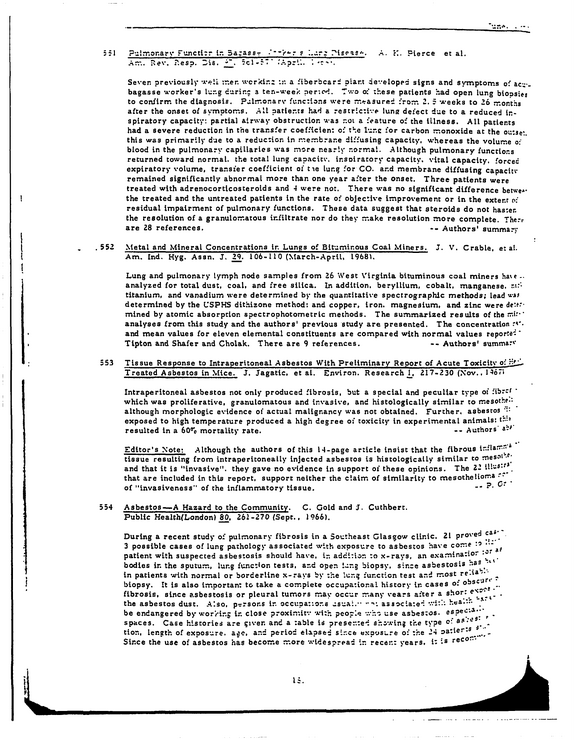
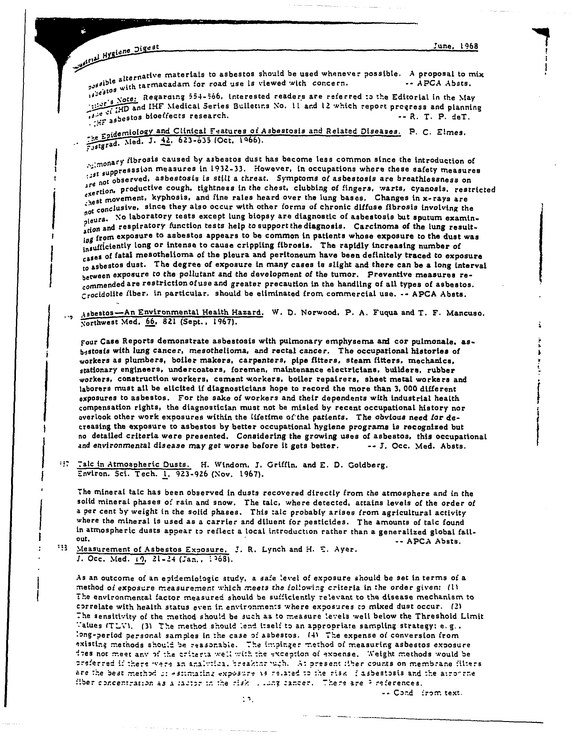
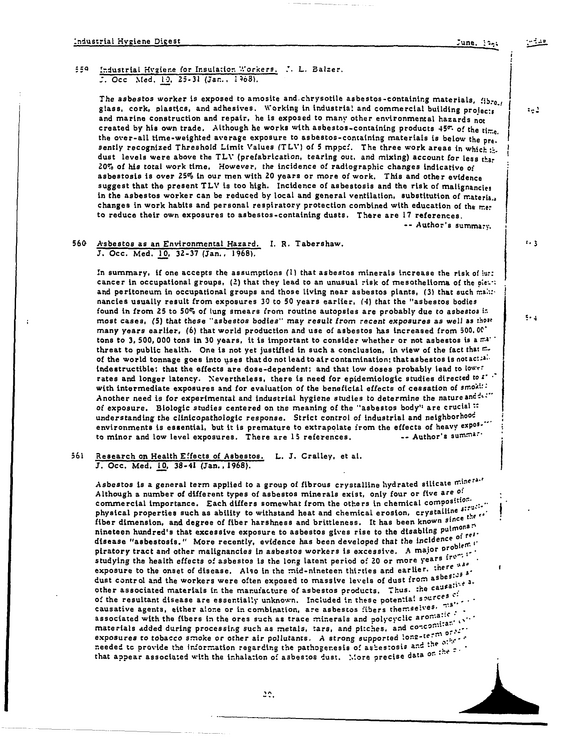
' -v--. " , * * Industrial Hygiene Digest a * ?
refid# 8O3bQV0n1y6dkmbnXK1p4pJjB5 pages
As there was some time lapse between the statistical planning and the field survey, by the time of the first working expedition to the plant in August, 1968, some of the original selection had been lost, chiefly by resignations and drafting for military service.
refid# n1gm1qyvD0aO5D668KnM6xp11 page
Accident Records and Injury Rates less than four because the lower limit will be negative Since a plant cannot experi ence a negative number of injuries per month, a chart based on an average of less than four would not yield meaningful results 3 Calculate a new average each year to reflect any change in the monthly average number of injuries 4 Construct more than one chart if there are seasonal changes in employment For example, if an operation employs one hundred people for the first 6 months of each year and four hundred people for the last 6 months, a separate chart must be constructed for each 6-month period 5 Construct a new control chart if external factors, such as a change in the level of employment, a change in the work environ ment, or a change m work hazards, bnng about a permanent change in work-injury experience When calculating a new aver age m such a situation, do not use experi ence prior to the change References American Standards Institute 1430 Broadway, New York, N Y 10018 Method of Recording and Measuring Work Injury Experience, Z16 1 -- 1967 Method of Recording Basic Facts Relating to the Nature and Occurrence of Work Injuries, Z16 2-1962 Walker, Helen M , and Lev, Joseph Elementary Statistical Methods, rev ed New York, N Y , Holt, Rinehart and Winston, 1958 266
refid# pmNbg9XJzBBRnd1nnL52J9Yxj1 page
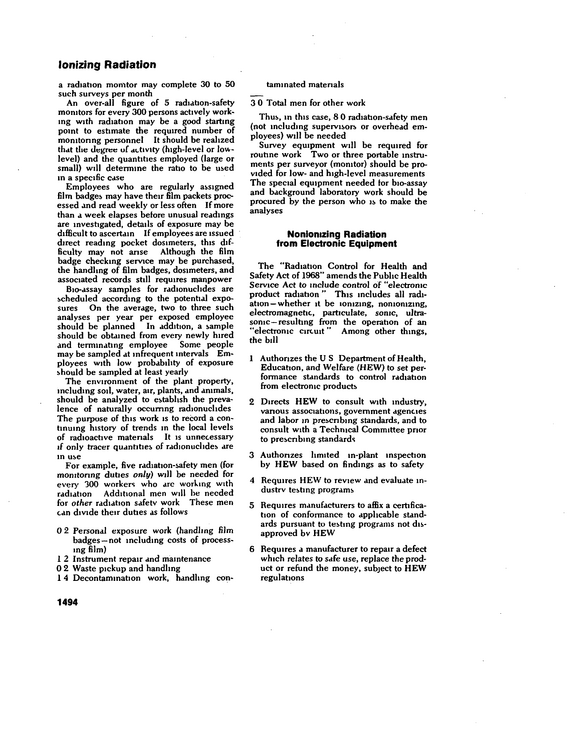
Ionizing Radiation a radiation monitor may complete 30 to 50 such surveys per month An over-all figure of 5 radiation-safety monitors for every 300 persons actively work ing with radiation may be a good starting point to estimate the required number of monitoring personnel It should be realized that the degree of activity (high-level or lowlevel) and the quantities employed (large or small) will determine the ratio to be used in a specific case Employees who are regularly assigned film badges may have their film packets proc essed and read weekly or less often If more than a week elapses before unusual readings are investigated, details of exposure may be difficult to ascertain If employees are issued direct reading pocket dosimeters, this dif ficulty may not anse Although the film badge checking service may be purchased, the handling of film badges, dosimeters, and associated records still requires manpower Bio-assay samples for radionuclides are scheduled according to the potential expo sures On the average, two to three such analyses per year per exposed employee should be planned In addition, a sample should be obtained from every newly hired and terminating employee Some people may be sampled at infrequent intervals Em ployees with low probability of exposure should be sampled at least yearly The environment of the plant property, including soil, water, air, plants, and animals, should be analyzed to establish the preva lence of naturally occurring radionuclides The purpose of this work is to record a con tinuing history of trends m the local levels of radioactive materials It is unnecessary if only tracer quantities of radionuclides are in use For example, five radiation-safety men (for monitoring duties only) will be needed for every 300 workers who are working with radiation Additional men will be needed for other radiation safetv work These men can divide their duties as follows 0 2 Personal exposure work (handling film badges --not including costs of process ing film) 1 2 Instrument repair and maintenance 0 2 Waste pickup and handling 14 Decontamination work, handling con taminated materials 3 0 Total men for other work Thus, in this case, 8 0 radiation-safety men (not including supervisors or overhead em ployees) will be needed Survey equipment will be required for routine work Two or three portable instru ments per surveyor (monitor) should be pro vided for low- and high-level measurements The special equipment needed for bio-assay and background laboratory work should be procured by the person who is to make the analyses Nonionizing Radiation from Electronic Equipment The "Radiation Control for Health and Safety Act of 1968" amends the Public Health Service Act to include control of "electronic product radiation " This includes all radi ation -- whether it be ionizing, nonionizing, electromagnetic, particulate, sonic, ultra sonic-resulting firom the operation of an "electronic circuit " Among other things, the bill 1 Authonzes the U S Department of Health, Education, and Welfare (HEW) to set per formance standards to control radiation from electronic products 2 Directs HEW to consult with industry, various associations, government agencies and labor in prescribing standards, and to consult with a Technical Committee prior to prescribing standards 3 Authonzes limited in-plant inspection by HEW based on findings as to safety 4 Requires HEW to review and evaluate in dustry testing programs 5 Requires manufacturers to affix a certifica tion of conformance to applicable stand ards pursuant to testing programs not dis approved bv HEW 6 Requires a manufacturer to repair a defect which relates to safe use, replace the prod uct or refund the money, subject to HEW regulations 1494
refid# 7RqvX4XxpbQOQBzDDVeyQnDo61 page
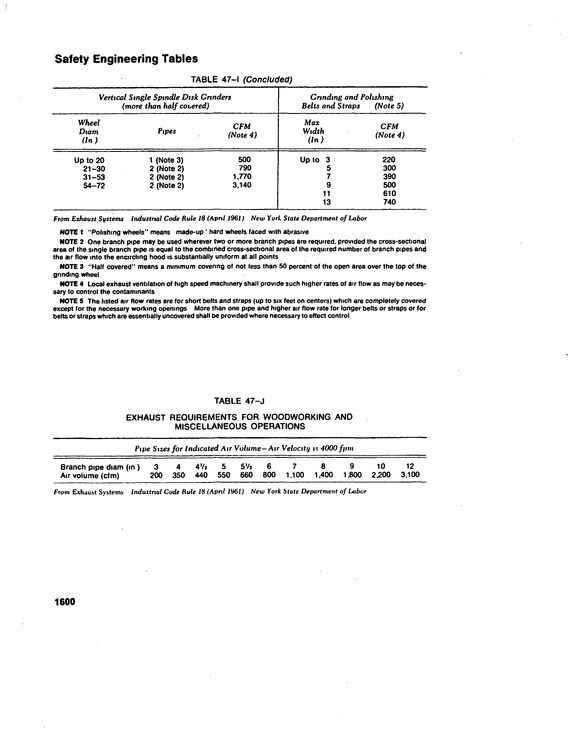
Safety Engineering Tables TABLE 47-1 (Concluded) Vertical Single Sptndle Dtsk Grinders (more than half covered) Grinding and Polishing Belts and Straps (Note 5) Wheel Diam (In) Pipes CFM (Note 4) Max Width (In) CFM (Note 4) Up to 20 21-30 31-53 54-72 1 (Note 3) 2 (Note 2) 2 (Note 2) 2 (Note 2) 500 790 1,770 3,140 Up to 3 5 7 9 11 13 220 300 390 500 610 740 From Exhaust Systems Industrial Code Rule 18 (April 1961) New York State Department of Labor NOTE 4 "Polishing wheels" means made-up' hard wheels laced with abrasive NOTE 2 One branch pipe may be used wherever two or more branch pipes are required, provided the cross-sectional area of the single branch pipe is equal to the combined cross-sectional area of the required number of branch pipes and the air flow into the encircling hood is substantially uniform at all points NOTE 3 "Half covered" means a minimum covenng of not less than 50 percent of the open area over the top of the gnnding wheel NOTE 4 Local exhaust ventilation of high speed machinery shall provide such higher rates of air flow as may be neces sary to control the contaminants NOTE S The listed air flow rates are for short belts and straps (up to six feet on centers) which are completely covered except for the necessary working openings More than one pipe and higher air flow rate for longer belts or straps or for belts or straps which are essentially uncovered shall be provided where necessary to effect control TABLE 47--J EXHAUST REQUIREMENTS FOR WOODWORKING AND MISCELLANEOUS OPERATIONS Pipe Sizes for Indicated Air Volume--Air Velocity is 4000 fpm Branch pipe diam (in ) 3 4 4'h 5 5'/j 6 7 8 9 10 12 Air volume (cfm) 200 350 440 550 660 800 1,100 1,400 1,800 2,200 3,100 From Exhaust Systems Industrial Code Rule IS (April 1961) New York State Department of Labor 1600
refid# pBRmg5GV3DQ9LN4rMvdBEX12X1 page
Produced ei-- undr !
refid# oedxBdx6rXXzRryBR68vB6N0r2 pages
/CV!
refid# pe281pLLyaj62nr9rKoymmK2k2 pages