Refine
Estimated Years 1960-1969Clear
31,974 results foundRefine Search
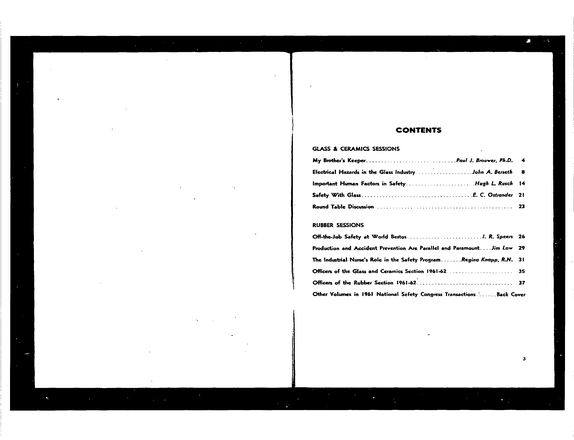
CONTENTS GLASS & CERAMICS SESSIONS My Brother's Keeper....................................................................Paul J.
refid# vVdq6r9wwQy8NEb0YQQEp60Nq1 page
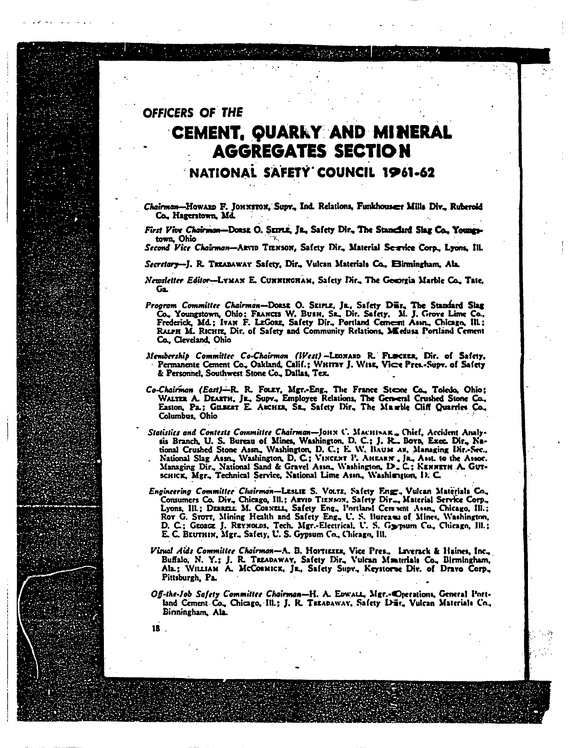
OFFICERS OF THE CEMENT, QUARRY AND MINERAL AGGREGATES SECTION NATIONAL SAFETV COUNCIL 1961*62 Chairman--Howard F.
refid# 6Opbe4d4KdmOY4zea0BjXmwo1 page
/: * $}fa:y'*v-?
refid# Z4p18r4ZKx27gvVzxJn3xEkZ71 page
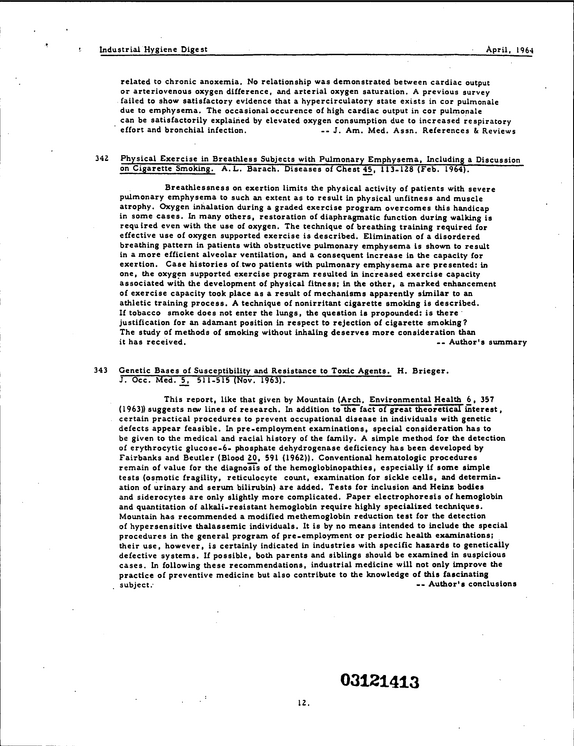
Industrial Hygiene Digest April, 1964 related to chronic anoxemia.
refid# KR611jwoaQoRjg46p10dK8gyr1 page
Industrial Hygiene Digest April, 19< discrete indicator of the early changes produced by silica should not be entirely ignored. -- APCA Absts. 373 Changes in Activities of Respiratory Enzymes in Lungs of Guinea Pigs Exposed to Silica Dust.
refid# 8zE1ZVeBDQaNJ7Yz8RBeRb6a1 page
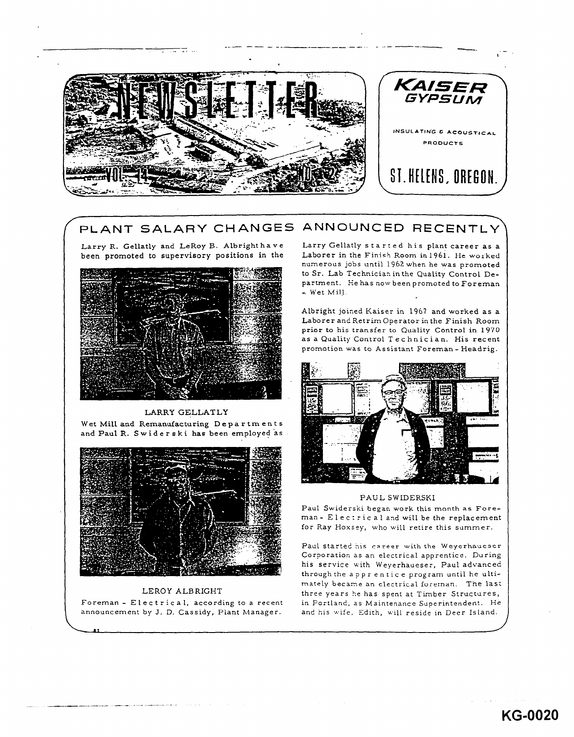
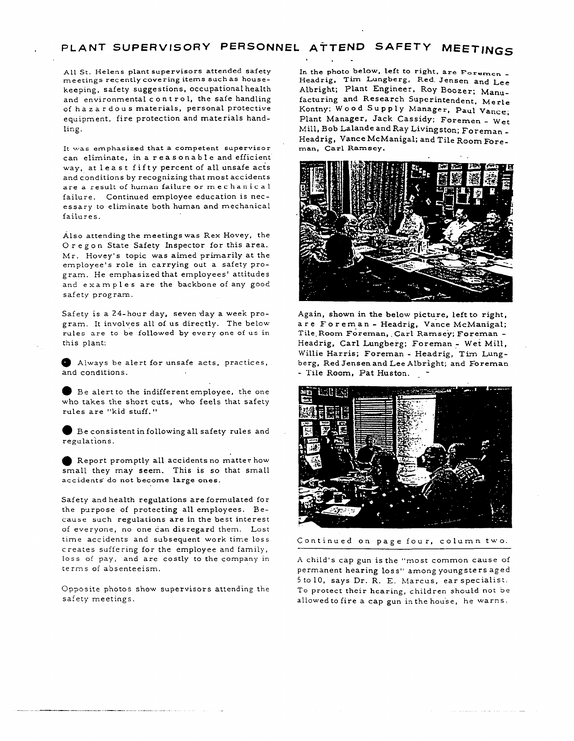
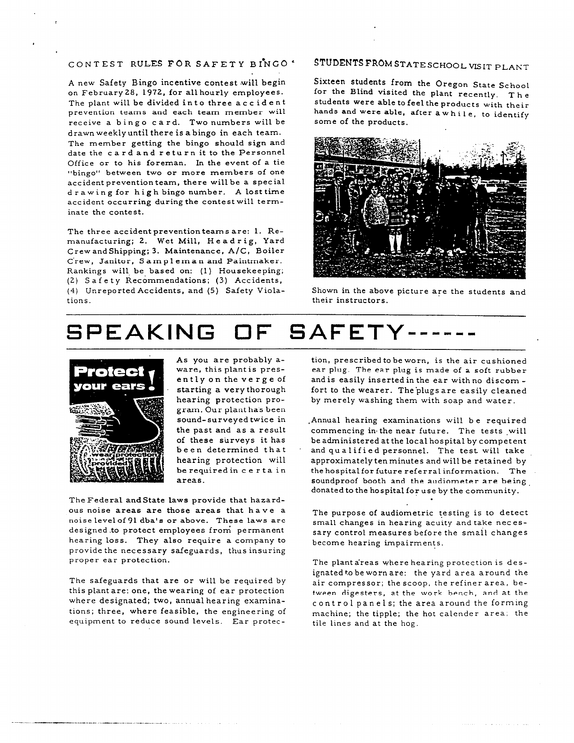
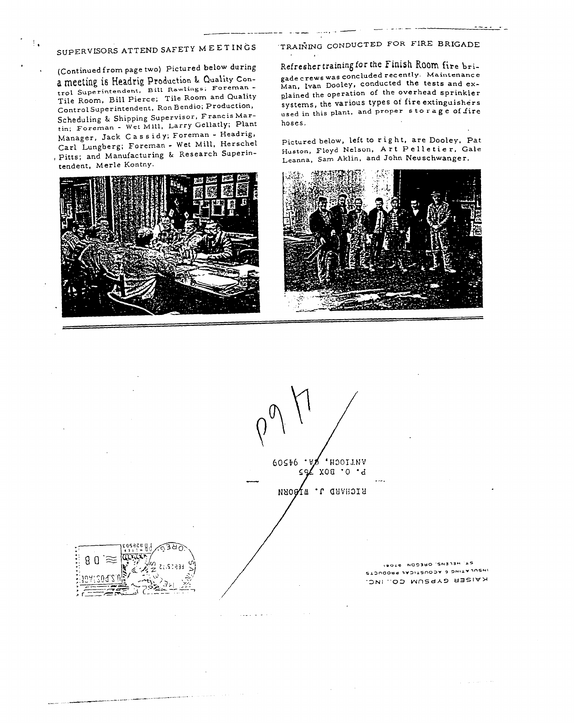
GYPSUM INSULATING G ACOUSTICAL PRODUCTS STHEIENS OREGON^ PLANT SALARY CHANGES ANNOUNCED RECENTLY Larry R.
refid# 4vovdBVDkBa3Rm02j9kqmKYga4 pages
Industrial Hygiene Digest May, 1964 511 Meteorological Tools in Evaluating and Reducing Effects of Air Pollution.
refid# J3kqyz5Er66bgdXRgreBK7QJ61 page
sfO t=3 Industrial Hygiene Features The evaluation of physical tasks in indus try is discussed in Abst.
refid# gEmq7yDVQ0KLVkRp1BK4vpqq1 page
Industrial Hygiene Digest October. 1966 effective topical therapy, these wounds would be converted to full-thickness loss and become the site of invasive bacterial infection.
refid# b9e58rmnGYm4B8Y9a96232Zk1 page
Occupational Health Nursing Committee control in laser production and use; also the use of epoxy resins and, as you will recall, the recent apprehension regarding x-radia tion from color TV sets.
refid# MMJjdLRDb1yLgKpM3rqzN7OJk1 page
1968 National Safety Congress safety, had set the stage for some direct selling that followed.
refid# opBXgmXbEv8QVXMxvXgYa9aX1 page
into account all the circumstances surround ing the particular job Safety observations serve to 1 Check adequacy of past training 2 Promote on-the-spot correction 3 Provide opportunities to compliment 4 Develop cooperative safety attitudes 5 Help supervisors learn about workers, and to identify problem workers 6 Sometimes suggest better job methods The kinds of special-problem employees who warrant such observations are 1 Inexperienced men 2 Accident repeaters 3 Chronic unsafe workers 4 Physical or mental cases In fact, all employees, even experienced workers, should be checked once in a while One reason why safety observation has not been more fully utilized is that safetymen and supervisors seldom develop or improve their power ofobservation Another is that planned safety observation involves a little more effort than the incidental safety observation There are several factors necessary for ef fective safety observation The inspector must 1 Be selective An inspector might look over a department first for safety, second for improvement of operations, third for training needs, and so on 2 Know what to look for The more a supervisor or safetyman knows about a job and a worker's responsibilities, the better an observer he will be 3 Practice observing The oftener a per son looks with the conscious intenbon to observe, the more he will see at each fresh tnal Like all skills, observation improves with practice 4 Keep an OPEN mind One way to increase open-mindedness is not to judge facts in advance The inspector must not deny the fact, no matter what conclusion it may seem to lead to The inspector must keep his mind open, at least until he has all the facts 5 DO NOT BE SATISFIED WITH GENERAL IM PRESSIONS A clean shop, or a careful rou tine, may still contain hidden hazards 6 Guard against habit and familiarity Asking the questions What, Where, When, How, and (especially) Why will often help uncover the real meaning of the situation 7 Record observations systematically All notes should be dated, with space for comment on action taken and on results of the action The notebook can serve both as a reminder and as a record of progress 8 Prepare a checklist A systematic check for litter, obstructions, handling of flammables, condition of fire-fighting equipment, and so on, will uncover tangi ble problems that can be corrected (Mak ing a checklist was discussed earlier in this chapter) Here are a few pointers that might help 1 Be firm, but friendly 2 Explain what and why 3 Review the safe alternative 4 Make your contact private 5 Get his reasons for acting unsafely 6 Get agreement on future practice It is sometimes necessary to watch men at work, not casually m passing, but closely This can be embarrassing to the men under observation--and one of the reasons for hav ing a small inspection team When it is nec essary to observe a man closely, a member of the team should talk to him and explain what is going on, then ask his permission to watch him as he works Usually, the man will con tinue his work naturally after such an intro duction If, however, he is nervous or un cooperative, it is better to postpone the observation When a person is observed performing an unsafe practice or act, the supervisor is faced with a problem in human relation skills The worker should be left with the feeling that he has been corrected in a decent way Scheduling Inspections.
refid# jqw6QBOzo8QenkQXDQxNGDNZ1 page
Sources of Help which falls in categories tested in the lab oratories Engineers should be aware, however, that UL listings apply only within the scope of the tests made, and may have no bearing on per formance or other factors not involved m the examination procedure If the function of the device or material tested and listed is a safety function then, of course, the test tells the safetyman what he wants to know UL tests are made under conditions of installa tion and use which conform to the appropriate standards of the NFPA Any departure from these standards by the user himself may affect the performance qualifications found by the Underwriters' Laboratories Insurance Associations Department, the Alliance makes a concerted effort to reduce accidents, fires, and other lossproducing incidents Under the guidance of its loss control advisory committee, sound safety engmeenng, mdustnal hygiene, fire protection engmeenng, and other lossprevention pnnciples are promoted Major activities include the dissemination of infor mation on safety subjects, conduct of special ized training courses for member company personnel, sponsorship of research, coopera tion in the development of safety standards, development of visual aids, and the publica tion of technical and promotional safety literature A catalogue of safety materials is available without charge Notable among the publications issued by the department are In addition to insurance associations listed under "Fire Protection Organizations," there are a number of insurance federations with accident prevention departments that pro duce technical information available to safety engineers The Amencan Association of State Compensation Insurance Funds P O Box 5922, San Francisco, Calif 94101 The Amencan Association of State Com pensation Insurance Funds is an International organization, the members of which are the state insurance funds of 17 states, Puerto Rico, Virgin Islands, and many of the pro vinces of Canada It has a permanent Safety Committee and several times a year issues bulletins to members relating to workmen's compensation Amencan Mutual Insurance Alliance 20 North Wacker Or, Chicago, III 60606 The Amencan Mutual Insurance Alliance is a national organization of leading mutual property-casualty insurance companies Its membership includes over 125 companies that safeguard the value of lives and property by providing protection against mishaps in work places and losses from fires, traffic accidents and other perils Alliance member companies, organized by and for policy holders, have a tradition of loss prevention which dates from the organization of the first Amencan mutual insurance company in 1752 Through its Accident and Fire Prevention Safe Openings for Some Point-of-Operation Guards Wood Working Circular Saws, Protection for Variety and Universal Types Spreaders for Variety and Universal Saws Nip Hazards on Paper Machines The Directory of Noise Control Services Handbook of Organic Industrial Solvents Judging the Fire Risk Simplified Water Supply Testing Tested Activities for Fire Prevention Com mittees Exit Drills in the Home Here's How-Traffic Safety Project Ideas Commercial Driver's Code Safety Memos for Fleet Supervisors The Alliance cooperates extensively with trade associations, professional societies and other organizations with similar interests, such as the National Safety Council, the National Fire Protection Association, the United States of America Standards Institute, Inc, and the Amencan Society of Safety Engineers Amencan Insurance Association Engmeenng and Safety Department 85 John Street New York.
refid# jgOXEGXm7La692KvpQQe7VZQp1 page
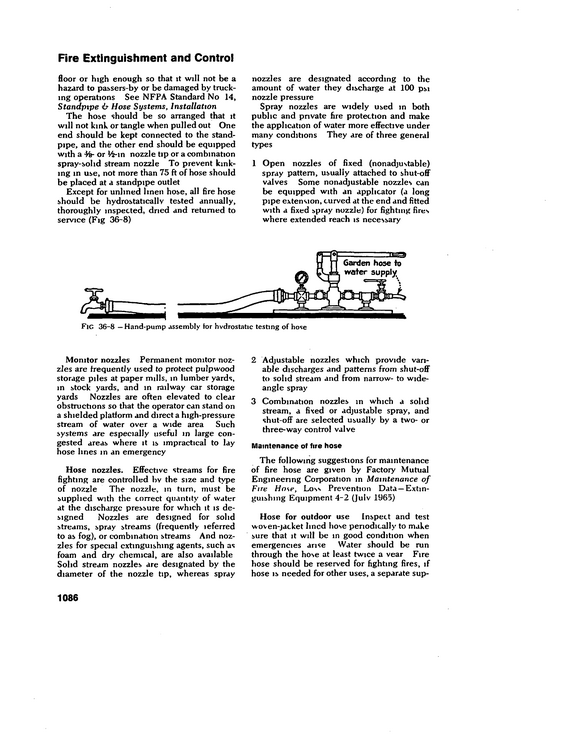
Fire Extinguishment and Control floor or high enough so that it will not be a hazard to passers-by or be damaged by truck ing operations See NFPA Standard No 14, Standpipe ir Hose Systems, Installation The hose should be so arranged that it will not kink or tangle when pulled out One end should be kept connected to the stand pipe, and the other end should be equipped with a &- or Vfc-m nozzle tip or a combination spray-solid stream nozzle To prevent kink ing m use, not more than 75 ft of hose should be placed at a standpipe outlet Except for unlined linen hose, all fire hose should be hydrostatically tested annually, thoroughly inspected, dried and returned to service (Fig 36-8) nozzles are designated according to the amount of water they discharge at 100 psi nozzle pressure Spray nozzles are widely used in both public and private fire protection and make the application of water more effective under many conditions They are of three general types 1 Open nozzles of fixed (nonadjustable) spray pattern, usually attached to shut-off valves Some nonadjustable nozzles can be equipped with an applicator (a long pipe extension, curved at the end and fitted with a fixed spray nozzle) for fighting fires where extended reach is necessary Garden hose to water supply Fic 36-8 -- Hand-pump assembly lor hydrostatic testing of hose Monitor nozzles Permanent monitor noz zles are frequently used to protect pulpwood storage piles at paper mills, in lumber yards, in stock yards, and in railway car storage yards Nozzles are often elevated to clear obstructions so that the operator can stand on a shielded platform and direct a high-pressure stream of water over a wide area Such systems are especially useful m large con gested areas where it is impractical to lay hose lines m an emergency Hose nozzles.
refid# 2J6YZKvq7wYrzR0Ea5Mj5q92p1 page
Nuclear Energy Materials Handling Manual Helm's Express, Inc, P O Box 268, Pittsburgh, Pa O'Kelley, C D Detection and Measurement of Nuclear Radiation Washington, D C , U S Department of Commerce, Office of Technical Services, 1962 Public Health Service, U S Department of Health, Education, and Welfare, 1014 Broadway Cincinnati, Ohio 45202 Radiological Health, rev 1960 RCA Service Company, Inc , Division of Radio Corporation of America, Cherry Hill, Camden, N J Atomic Radiation 1957 Seaborg's `Tables of Isotopes " Reviews of Modem Physics, 30, no 2 (part II) (April 1958 ) United Nations, Department of Public Information Report of the United Nations Scientific Committee on the Effects of Atomic Radtatton U N General Assembly Official Records 17th Session Supplement No 16 (A/5216) 1962 U S Government Printing Office, Washington, D C 20402 The Nature of Radioactive Fallout and Its Effects on Man 1957 Radiation Hazards in Firefighting AEC Safety & Fire Protection Tech Bulletin No 4, 1955 1507
refid# 5JJjMYL6rE81rVL8r9E9YqOV1 page