Refine
Estimated Years 1940-1949Clear
11,527 results foundRefine Search
928 CHAPTER 48 1949 Guide circulated through the finned tubing by means of circulators.
refid# jyn8qJeVokVRE5VLEY3zadQqQ1 page
1006 1949 Guide Illinois Engineering Co., 1326-1327 Fedders-Quigan Corp., 1076 COOLING TOWERS.
refid# oeaVVNJZENLKLkGMQoRBOG8gg1 page
HWBB-0839952 r.f) FOUNDATION FACTS February 23, 1940 This neu-s-ieujr (s issuotf moncfifr co member companies and trade associations affiliated with Air Hygiene Foundation.
refid# wq32nYgRXMmyX20dgDOv9G2q416 pages
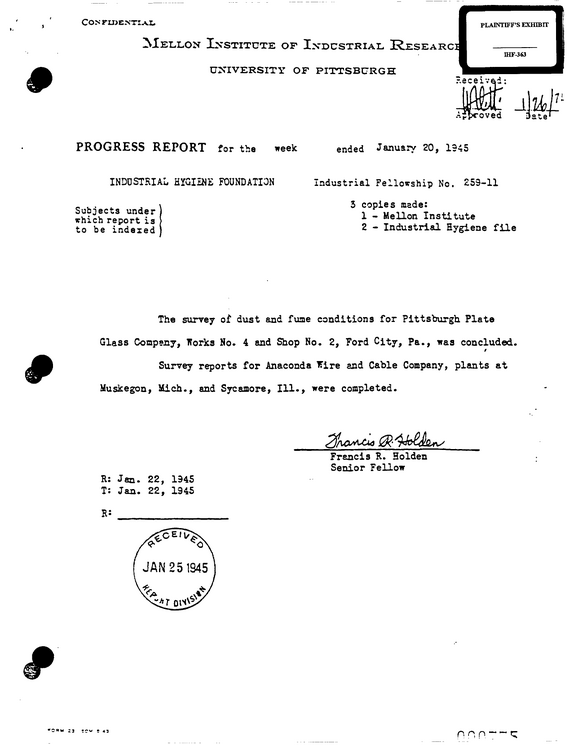
Con fluent:.vl ) PLAINTIFF'S EXHIBIT ZSIellon Institute of Industrial Researc UNIVERSITY OF PITTSBURGH PROGRESS REPORT for the week ended January 20, 1945 INDUSTRIAL HYGIENE FOUNDATION Subjects under which report is to be indexed Industrial Fellowship No. 259-11 3 copies made: 1 - Mellon Institute 2 - Industrial Hygiene file The survey of dust and fume conditions for Pittsburgh Plate Glass Company, Works No. 4 and Shop No. 2, Ford City, Pa., was concluded. t Survey reports for Anaconda IFire and Cable Company, plants at Muskegon, Mich., and Sycamore, 111., were completed.
refid# VjGD7z2D44X4N2jeO5xJ82QRw1 page
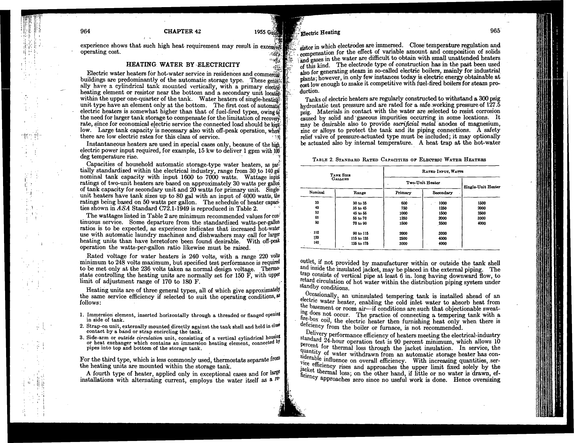
964 CHAPTER 42 experience shows operating cost.
refid# 99Z0GrV6N5xX02GEqokGMbqE71 page
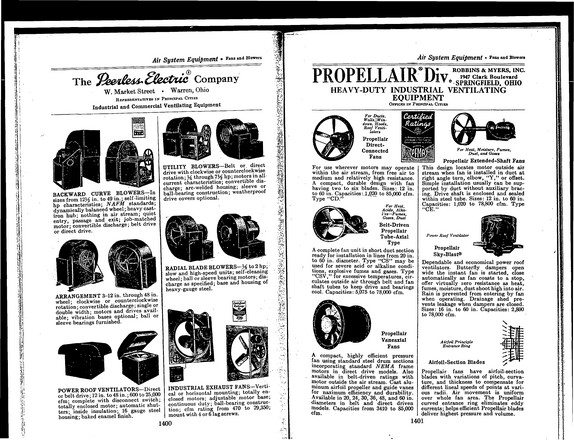
Air System Equipment Fans and Blowers The Company W.
refid# Ndg5RjM0yRYBm5w9J57gZYew1 page
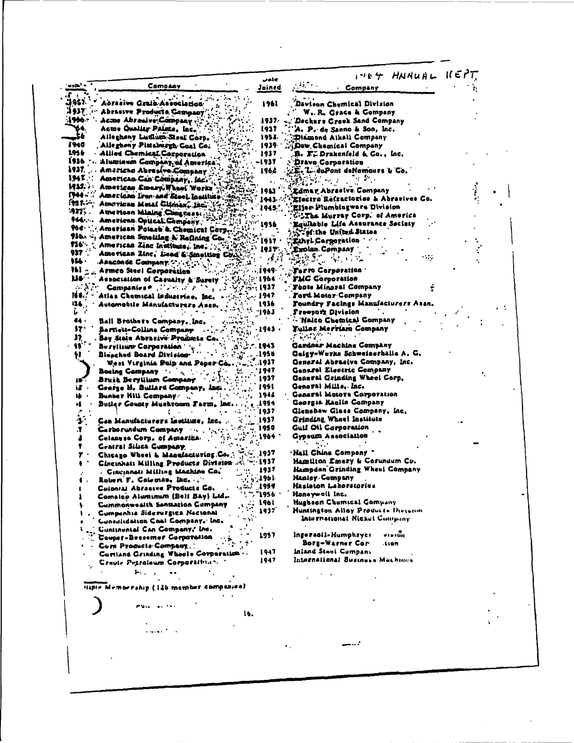
- Comauv i "'t V- HfiiHufiu Company ` jw-'v Adraaiv* CralaAteocUdoa 1761 . fiavieon Chemical Olvlaien Abrasive Products.
refid# mnyjmkYBkYwGB9pzzp3kVwgk1 page
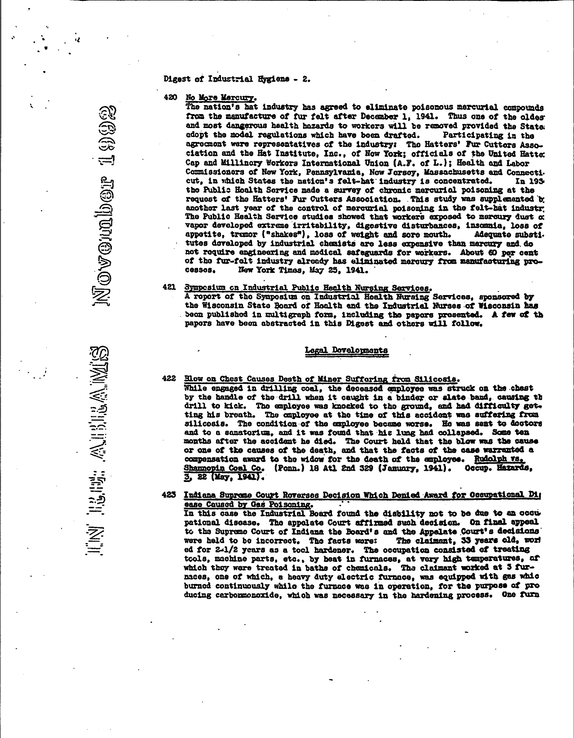
t wiijmlbip Ji &)&) Digest of Industrial Hygiene - 2. 420 So More Mercury.
refid# BR4K34ZBLaJmQ37Vy7YKNKyvE1 page
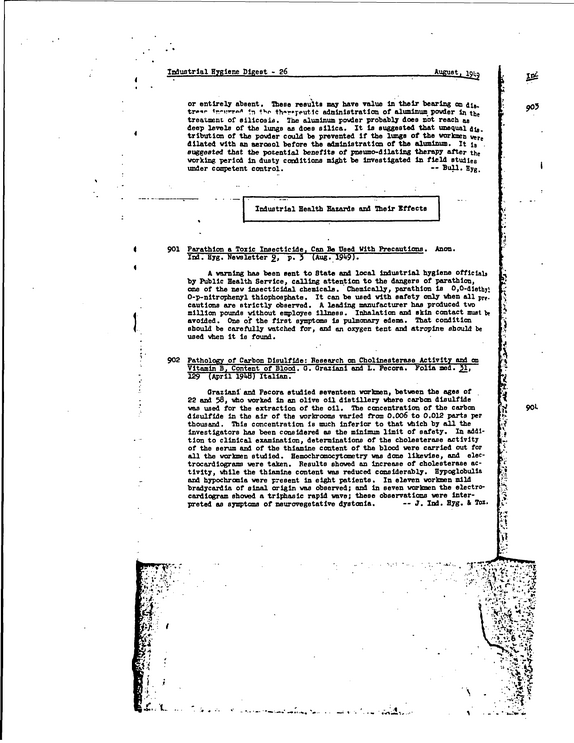
Industrial Hygiene Digest - 26 I Aueuet. 101^ or entirely absent, These results nay have value In their bearing an dls.
refid# byyZgLw9k7ZKYR3xe0RRpjGyg1 page
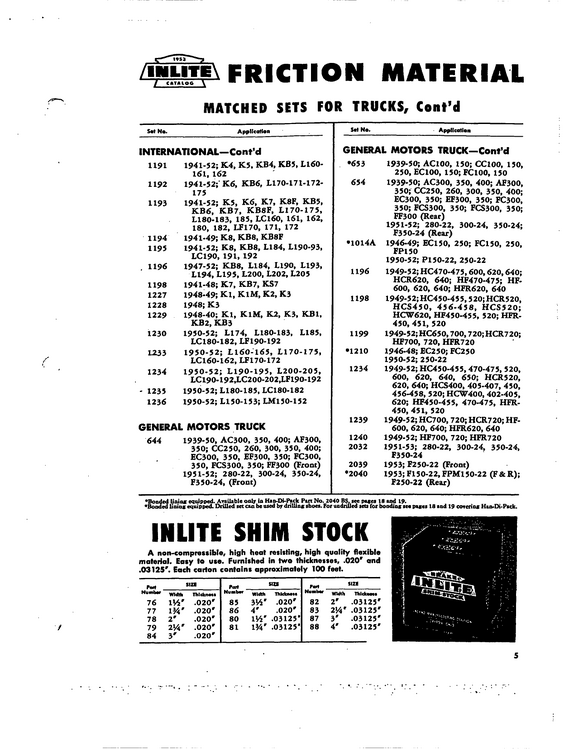
/ ~FISbS?
refid# Eq1K7qN6EXX0Lkz4MpV58VMpV1 page
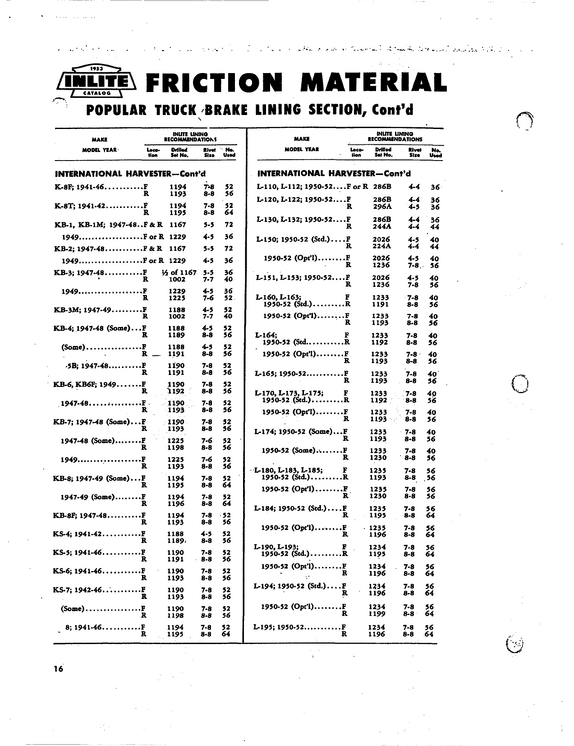
/jjTM\ FRICTION MATERIAL POPULAR TRUCK BRAKE LINIHG SECTION, Conf'd \ MAKE MODEL YEAR INLITE UNINO RECOMMENDATIONS Loco* Mon OHIled Sol No.
refid# XO3ZYa32KmYkx3n63jJdBzpZy1 page
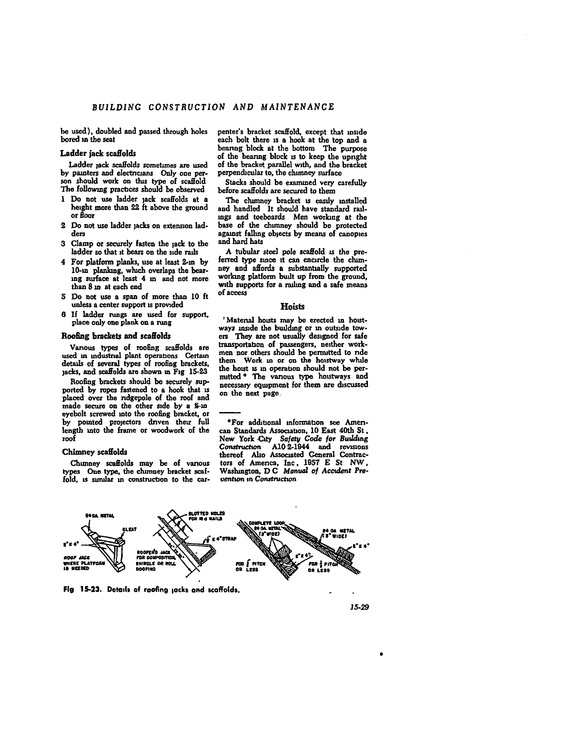
BUILDING CONSTRUCTION AND MAINTENANCE be used), doubled and passed through holes bored in the seat Ladder jack scaffolds Ladder jack scaffolds sometimes are used by painters and electricians Only one per son should work on this type of scaffold The following practices should be observed 1 Do not use ladder )ack scaffolds at a height more than 22 ft above the ground or floor 2 Do not use ladder jacks on extension lad ders 3 Clamp or securely fasten the jack to the ladder so that it bears on the side rails 4 For platform planks, use at least 2-in by 10-in planking, which overlaps the bear ing surface at least 4 in and not more than 8 in at each end 5 Do not use a span of more than 10 ft unless a center support is provided 6 If ladder rungs are used for support, place only one plank on a rung Roofing brackets and scaffolds Various types of roofing scaffolds are used m industrial plant operations Certain details of several types of roofing brackets, jacks, and scaffolds are shown m Fig 15-23 Roofing brackets should be securely sup ported by ropes fastened to a hook that is placed over the ridgepole of the roof and made secure on the other side by a SS-in eyebolt screwed into the roofing bracket, or by pomted projectors driven their full length into the frame or woodwork of the roof Chimney scaffolds Chimney scaffolds may be of various types One type, the chimney bracket scaf fold, is similar in construction to the car penter's bracket scaffold, except that inside each bolt there is a hook at the top and a bearing block at the bottom The purpose of the bearing block is to keep the upright of the bracket parallel with, and the bracket perpendicular to, the chimney surface Stacks should be examined very carefully before scaffolds are secured to them The chimney bracket is easily installed and handled It should have standard rail ings and toeboards Men working at the base of the chimney should be protected against falling objects by means of canopies and hard hats A tubular steel pole scaffold is the pre ferred type since it can encircle the chim ney and affords a substantially supported working platform budt up from the ground, with supports for a railing and a safe means of access Hoists 'Material hoists may be erected in hoist ways inside the building or in outside tow ers They are not usually designed for safe transportation of passengers, neither work men nor others should be permitted to nde them Work in or on the hoistway while the hoist is in operation should not be per mitted 0 The various type hoistways and necessary equipment for them are discussed on the next page.
refid# wED7je8d7jd9OdkrzGnOXgko1 page
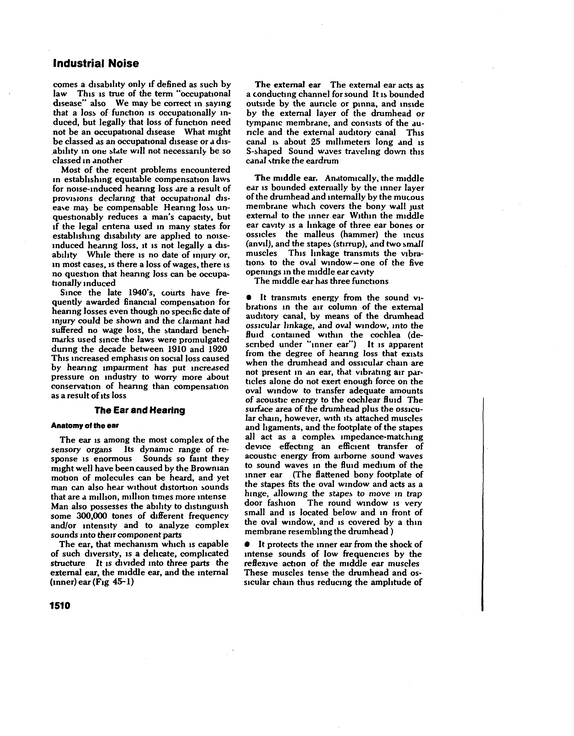
Industrial Noise comes a disability only if defined as such by law This is true of the term "occupational disease" also We may be correct m saying that a loss of function is occupationally in duced, but legally that loss of function need not be an occupational disease What might be classed as an occupational disease or a dis ability m one state will not necessarily be so classed in another Most of the recent problems encountered in establishing equitable compensation laws for noise-induced heanng loss are a result of provisions declaring that occupational dis ease may be compensable Heanng loss un questionably reduces a man's capacity, but if the legal cntena used in many states for establishing disability are applied to noiseinduced heanng loss, it is not legally a dis ability While there is no date of miury or, in most cases, is there a loss of wages, there is no question that heanng loss can be occupa tionally induced Since the late 1940's, courts have fre quently awarded financial compensation for heanng losses even though no specific date of injury could be shown and the claimant had suffered no wage loss, the standard bench marks used since the laws were promulgated dunng the decade between 1910 and 1920 This increased emphasis on social loss caused by heanng impairment has put increased pressure on industry to worry more about conservation of heanng than compensation as a result of its loss The Ear and Hearing Anatomy of the ear The ear is among the most complex of the sensory organs Its dynamic range of re sponse is enormous Sounds so faint they might well have been caused by the Brownian motion of molecules can be heard, and yet man can also hear without distortion sounds that are a million, million times more intense Man also possesses the ability to distinguish some 300,000 tones of different frequency and/or intensity and to analyze complex sounds into their component parts The ear, that mechanism which is capable of such diversity, is a delicate, complicated structure It is divided into three parts the external ear, the middle ear, and the internal (inner) ear (Fig 45-1) The external ear The external ear acts as a conducting channel for sound It is bounded outside by the auricle or pinna, and inside by the external layer of the drumhead or tympanic membrane, and consists of the au ricle and the external auditory canal This canal is about 25 millimeters long and is S-shaped Sound waves traveling down this canal strike the eardrum The middle ear.
refid# j2rX6nYwJOdJLYg89rZxrmDZ1 page
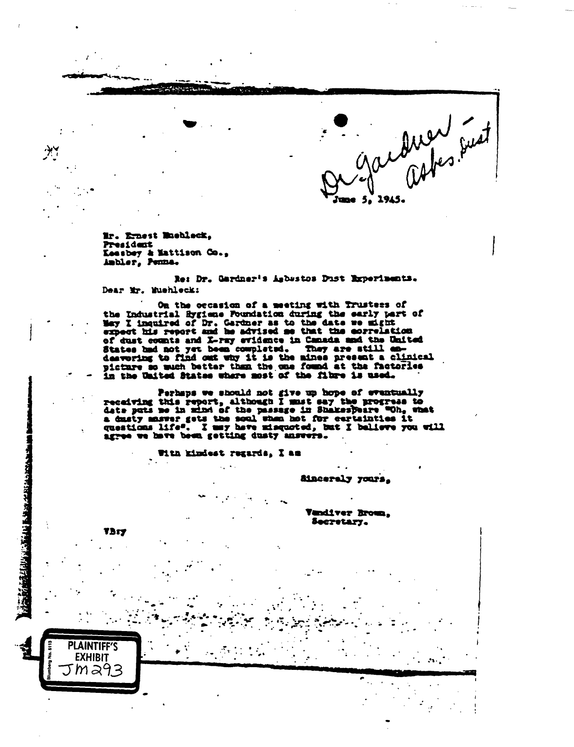
Was* 5, 1945.
refid# 2R9aL7O9JomGVV63V6Z1Xbkj51 page
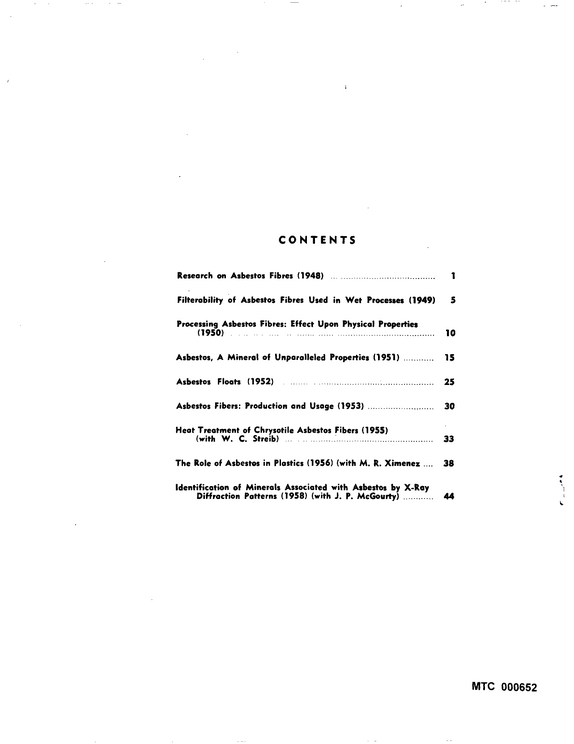
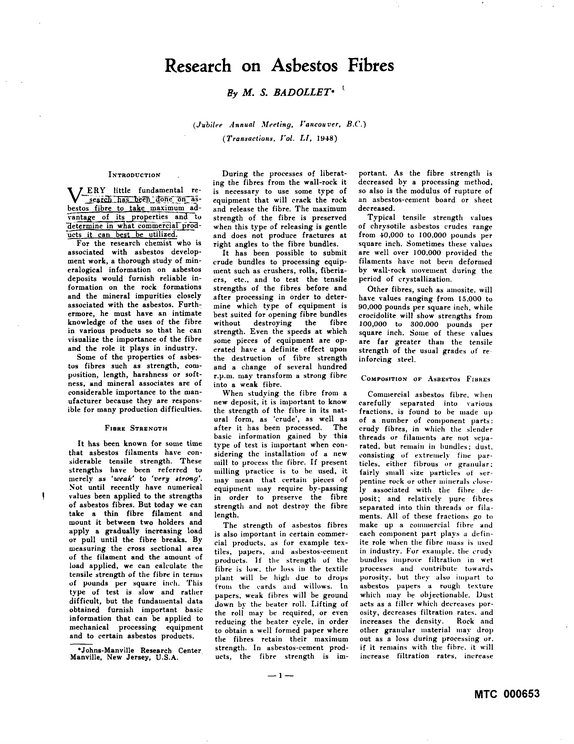
ASBESTOS A Symposium of Articles by M.
refid# 3Q5ZEO2QeO0p7jmLmy304dB8D51 pages