Refine
Estimated Years 1930-1939Clear
8,921 results foundRefine Search
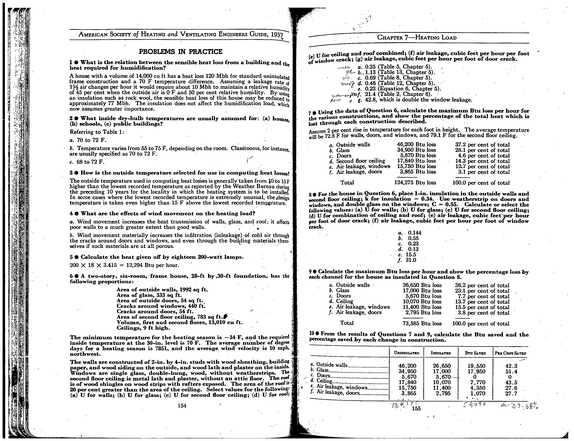
American Society of Heating and Ventilating Engineers Guide, 1937 PROBLEMS IN PRACTICE 1 What is the relation between the sensible heat loss from a building and the heat required for humidification?
refid# 2jNxRbrjOdgj0jJgyx6EOqynL1 page
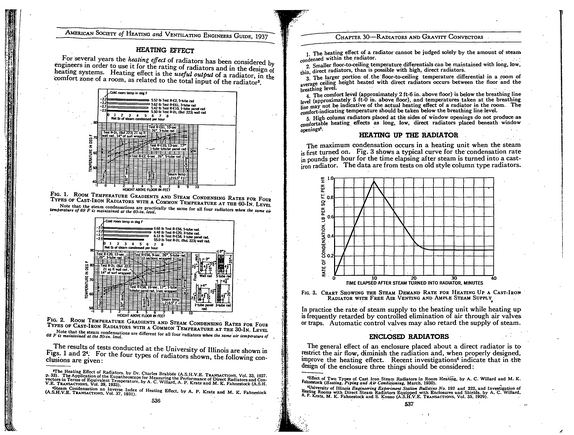
American Society of Heating and Ventilating Engineers Guide, 1937 HEATING EFFECT For several years the heating effect of radiators has been considered by engineers in order to use it for the rating of radiators and in the design of heating systems.
refid# dYjVrnoyLJNze1NNp8E2KRVJB1 page
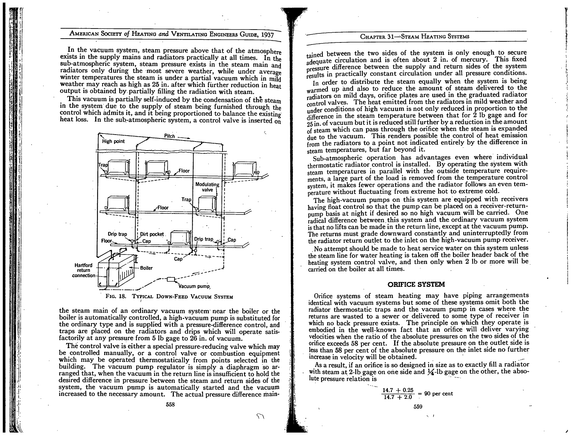
American Society of Heating and Ventilating Engineers Guide, 1937 In the vacuum system, steam pressure above that of the atmosphere exists in the supply mains and radiators practically at all times.
refid# e7BpXqeBbR8JpyqrrDXmLV9op1 page
American Society of Heating and Ventilating Engineers Guide, 1937 MORTON, Charles H.
refid# pBXD0KYq57Gd3NxDQ4Dv9vnD1 page
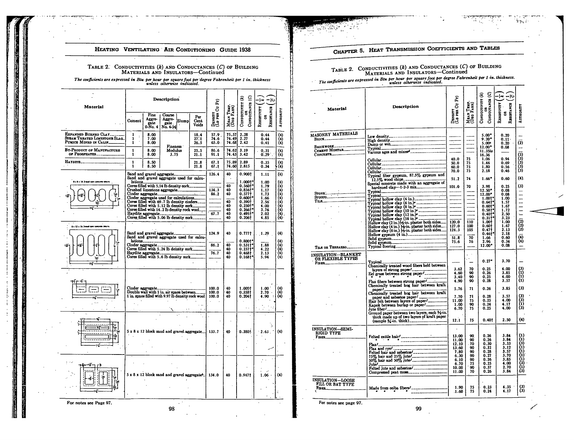
1 Heating Ventilating Air Conditioning Guide 1938 Chapter 5.
refid# 6R14wDMmRLbVvqNxaq604q7bR1 page
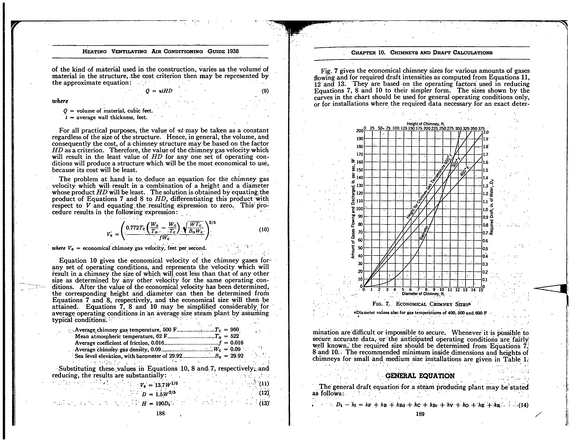
Y Heating Ventilating Air Conditioning Guide 1938 of the kind of material used in the construction, varies as the volume of material in the structure, -the cost criterion then may be represented by the approximate equation: Q = TciHD ' (9) where Q = volume of material, cubic feet.
refid# zow977gyjNOBXOK7kJMRMao8m1 page
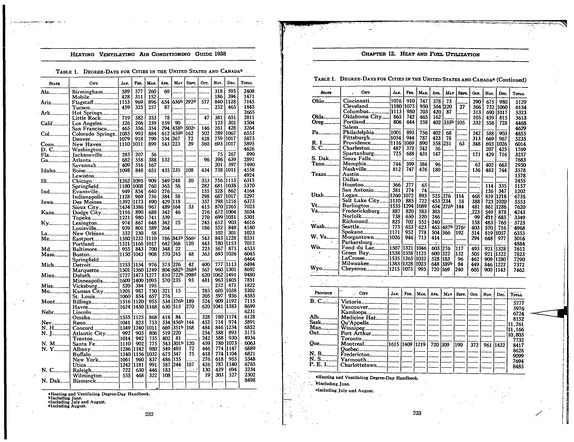
Heating Ventilating Air Conditioning Guide 1938 Table 1.
refid# By1zQmbawqyYRaVR5DJxNDbaJ1 page
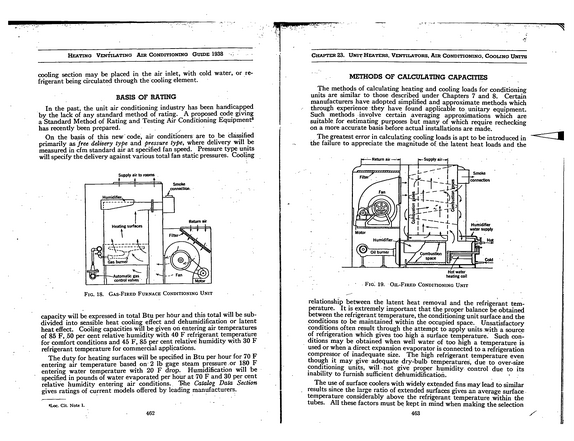
Heating Ventilating Air Conditioning Guide 1938 cooling section may be placed in the air inlet, with cold water, or re frigerant being circulated through the cooling element.
refid# bBdLGvoBVopBqY0N0r5pjNr8Z1 page
'Heating Ventilating Air Conditioning Guide 1938 dicitis for instance, which sometimes come with summer heat waves, and develop dangerously unless promptly operated upon.
refid# OE57QOd0gpxzjo7g6dowrBYvK1 page
r Heating Ventilating Air Conditioning Guide 1938 cent humidity line, move horizontally to the right to the intersection with the 140 F vertical temperature line at 13 per cent relative humidity; then move along the constant heat (or wet-bulb line) to its intersection with the 70 per cent relative humidity curve and read 97.5 F dry-bulb, which will be the temperature of the air leaving the dryer.
refid# jB0mwmyQZDzaLBpLmKdx5K4521 page
Heating Ventilating Air Conditioning Guide 1338 feathers and lint, the exhaust vent should be large enough to permit an air velocity of 200 to 500 fpm.
refid# 7Od3LjNO3dnO9enVE0y5Ngjna1 page
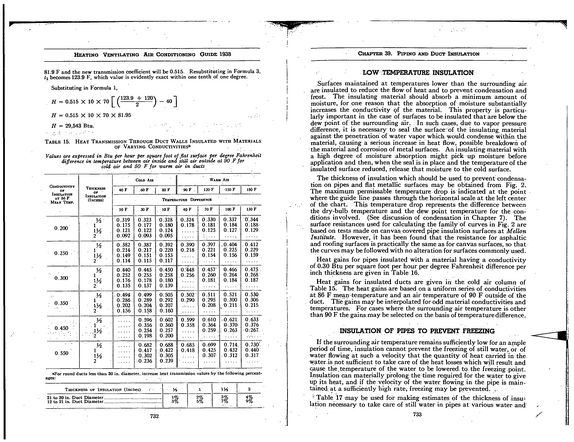
Heating Ventilating Air Conditioning Guide 1938 values obtained from a number of tests made on each type of material, also that all variables due to differences in thickness, pipe sizes, and air conditions are eliminated.
refid# M5g4V5w7zwvL9xKQw79gM7Jz1 page
r Heating Ventilating Air Conditioning Guide 1938 i Chapter 39.
refid# gDkVwyw0xgEoG0Lvekbw4GvRa1 page
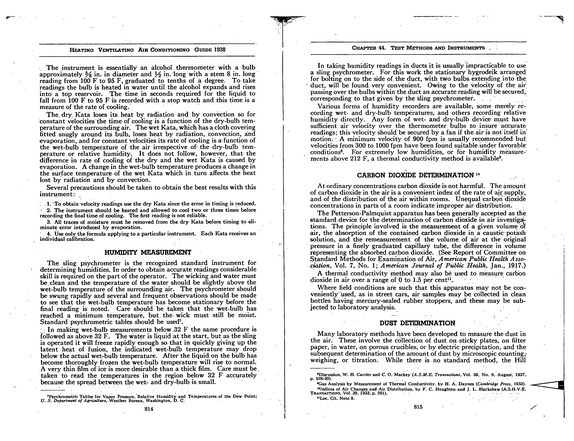
Heating Ventilating Air Conditioning Guide 1938 The instrument is essentially an alcohol thermometer with a bulb approximately % in. in diameter and Y2 in. long with a stem 8 in. long reading from 100 F to 95 F, graduated to tenths of a degree.
refid# OzQmLB1wG1vxoGj1G6bemEGpK1 page
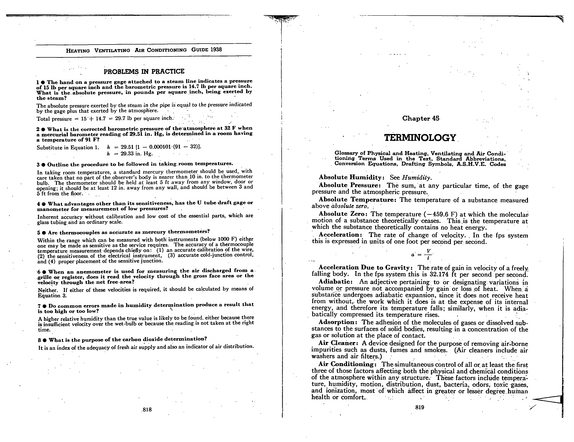
Heating Ventilating Air Conditioning Guide 1938 PROBLEMS IN PRACTICE 1 The hand on a pressure gage attached to a steam line indicates a pressure of 15 lb per square inch and the barometric pressure is 14.7 lb per square inch.
refid# QkYYQ8Y9gNoR9E19EVpvw48oL1 page